Why wild dogs are worth the effort
Ask a guide which sighting gets them most excited and a lot of them won’t say leopard. They’ll say wild dogs.
African wild dogs, also called painted wolves or painted dogs, are among the most endangered large carnivores in Africa. They’re fast, social, noisy and constantly on the move, which makes them hard to find and unforgettable when you do.
This guide covers where your chances are best, when to go, and why you shouldn’t take a sighting for granted.
Painted wolves: the basics
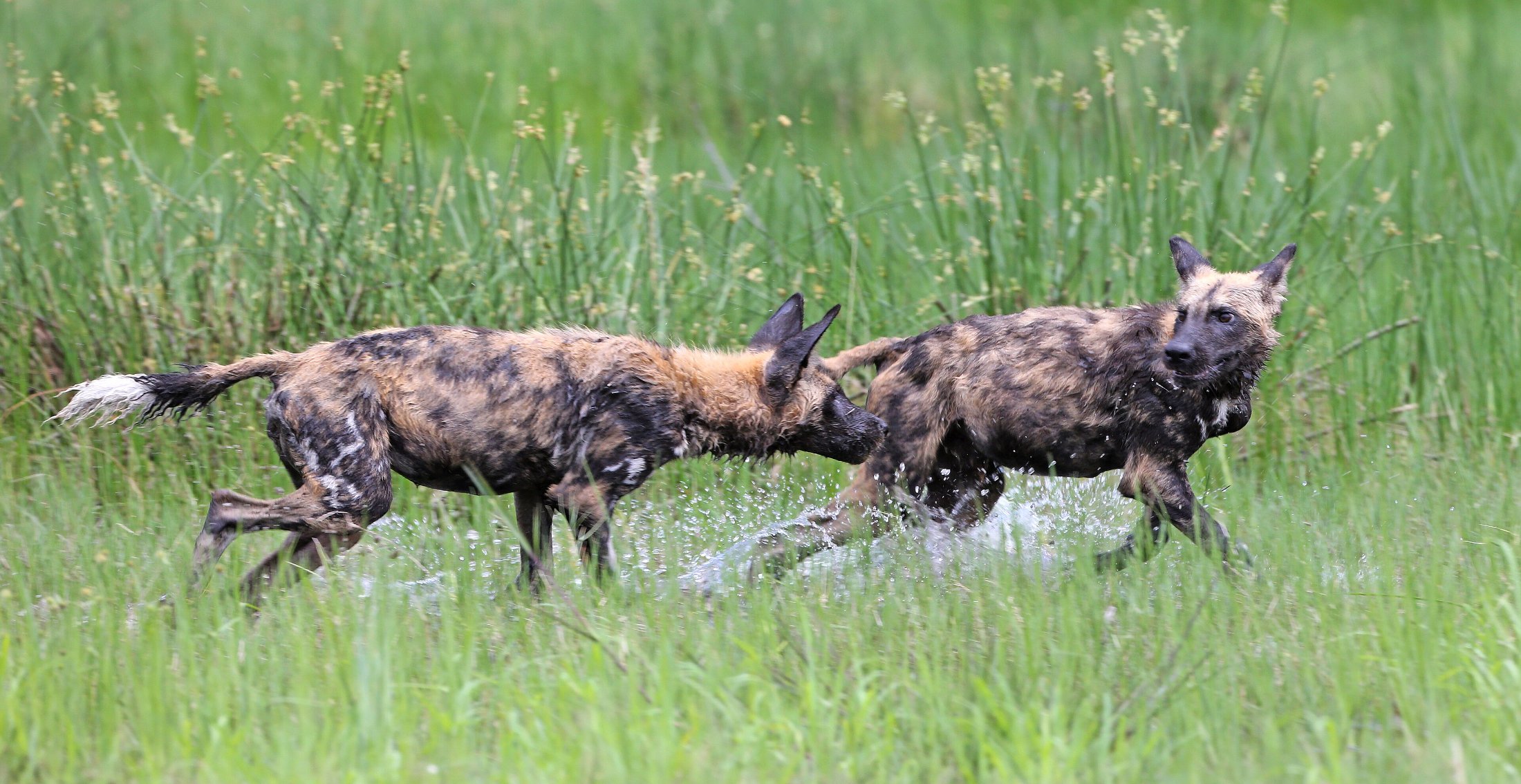
The scientific name, Lycaon pictus, translates roughly as “painted wolf-like animal”. It fits. Every dog has its own pattern of black, tan, white and yellow blotches, and researchers use those patterns to tell individuals apart.

They live in packs, usually around seven to 15 animals and occasionally many more. Normally only the dominant pair breeds, and the whole pack helps raise the pups, bringing back food and regurgitating it for them.
Two things you’ll often hear about wild dogs deserve a closer look:
- “They’re the most successful hunters in Africa.” The figure usually quoted is around 80%, but we couldn’t find a study behind it. A detailed GPS study of a pack in northern Botswana, published in Nature Communications in 2016, recorded 1,119 chases and found each dog succeeded in about 15.5% of them. What makes them effective is that they chase often, work together and share.
- “They vote by sneezing.” This one is real. Researchers in the Okavango Delta found that the more dogs sneezed during a pre-hunt greeting ceremony, the more likely the pack was to set off. When the dominant dogs started it, only a few sneezes were needed.
How many are left
The IUCN lists the African wild dog as Endangered. Its assessment, carried out in 2012 and published in 2020, estimates about 6,600 adults in 39 subpopulations, of which only around 1,400 are mature, breeding animals. The trend is downward.
Wild dogs still live in 19 countries. They’ve disappeared from 11 and may be gone from seven more. The biggest strongholds are in northern Botswana, western Zimbabwe, eastern Namibia and western Zambia, and in Tanzania and northern Mozambique.
The threats are familiar: fragmented habitat, conflict with livestock and game farmers, snares, road accidents, and diseases such as rabies and canine distemper, often picked up from domestic dogs. Because packs are small and range widely, a single outbreak can wipe out a local population. In 2017, distemper nearly eliminated the wild dogs of Laikipia in Kenya.

Where to see wild dogs
Zimbabwe: Mana Pools and Hwange
Mana Pools is probably the most famous wild dog destination in Africa. The BBC’s Dynasties episode “Painted Wolves”, filmed over 585 days and broadcast in 2018, followed its packs. The open floodplain woodland along the Zambezi makes them easier to follow than in thick bush.
Numbers here are debated, and local conservation groups report very different figures. Go for the habitat and the chance, not a promise.
Hwange is the base of Painted Dog Conservation, which reports well over 150 dogs in the area. See our Hwange Where to Stay page.
Zambia: South Luangwa
South Luangwa is one of the best places in Zambia to see them. The Zambian Carnivore Programme monitors wild dogs across the Luangwa, Kafue and Liuwa ecosystems and reported 455 dogs in 39 packs and dispersing groups in 2024. Luangwa’s healthy prey base helps.

Plan a few nights and ask your camp about recent sightings. See our South Luangwa Where to Stay page.
Botswana: the Okavango, Moremi and Linyanti
According to the IUCN, northern Botswana holds one of the largest wild dog populations left, and much of the research on their behaviour, including the sneezing study, comes from here. The Okavango Delta, Moremi and the Linyanti are all good bets, especially in private concessions where guides can follow a pack off-road.

South Africa: Kruger and the managed reserves
Kruger holds the largest connected wild dog population in South Africa. A count published in 2016 found 256 dogs in 17 packs, and numbers have gone up and down over the decades. Often your best chance is simply on the road: packs use roads to travel, which is also why road deaths are a threat.
Outside Kruger, South Africa runs one of the most hands-on conservation efforts anywhere. The Endangered Wildlife Trust coordinates a managed metapopulation: fenced reserves each hold a pack, and dogs are moved between them to keep the population genetically healthy. In 2016 this network held 239 dogs in 18 packs across 11 reserves, up from three reserves in 2000.
Reserves in the network include Hluhluwe-iMfolozi and Tembe in KwaZulu-Natal, and Madikwe in North West Province. Madikwe brought in its first dogs in December 1994, and rabies outbreaks have since hit its packs more than once, a reminder of how fragile small populations are.

Tanzania and Mozambique
- Nyerere National Park, formerly part of the Selous, is one of the most important remaining strongholds. A camera-trap study identified 222 individual dogs between 2020 and 2022.
- Gorongosa in Mozambique is a comeback story. Wild dogs were reintroduced in 2018 with 29 founders, and by 2020 there were 81 dogs in four packs. See our Gorongosa feature.
Kenya: Laikipia
In Laikipia, wild dogs were nearly wiped out by distemper in 2017. The following year a lone female appeared at Mpala and founded a new pack, the Phoenix Pack, which has grown to around 20 dogs.
When to go
The best time in southern Africa is denning season. Packs give birth around May and June, and keep the pups at a den until they’re about three to four months old. For those few months, a pack that normally roams hundreds of square kilometres keeps returning to the same spot.
That puts the best viewing roughly between June and September, which is also the dry season, when the bush is thin and animals gather near water.
Outside denning season, sightings are more a matter of luck, and of choosing a camp in an area where packs are known to move.
Watching them responsibly
Dens are where wild dogs are most vulnerable. Painted Dog Conservation has warned that too many vehicles and film crews close to dens in Mana Pools push packs to move their pups more often, which puts the pups at risk.
- Keep your distance at dens and follow your guide’s lead. If the pack seems unsettled, leave.
- Don’t push a guide to follow a hunting pack through the bush where off-road driving isn’t allowed.
- Never feed them or approach them on foot.

Explore more on 25South
- The Elusive Eleven: Africa’s hardest animals to spot.
- Speak Bush: how wildlife talks to each other.
- Mana Pools National Park: the reserve profile.
- South Luangwa National Park: the reserve profile.
- Wild Dogs in Madikwe: our own sighting of a pack in Madikwe, and how to find one.
Sources
- IUCN Red List assessment, African wild dog (2012, published 2020)
- IUCN SSC Canid Specialist Group, African wild dog
- SANBI, African wild dog
- African Wildlife Foundation, African wild dog
- Hubel et al., 2016, Nature Communications
- Royal Society, sneeze to leave (Walker et al., 2017)
- EWT and SANBI, Red List of Mammals: African wild dog (2016)
- Endangered Wildlife Trust, carnivore conservation
- Painted Dog Conservation, FAQ
- BBC Science Focus, filming Painted Wolves for Dynasties
- Zambian Carnivore Programme
- Parsais et al., 2025, wild dogs in Nyerere National Park
- Bouley et al., 2021, wild dog reintroduction in Gorongosa, PLOS ONE
- Mpala Research Centre, the Phoenix Pack
- Zimbabwe Situation, painted dog populations in Mana Pools
Top photo: Lip Kee / CC BY-SA 2.0, via Wikimedia Commons
Comments
One response to “African Wild Dogs: Where to See Africa’s Painted Wolves”
[…] African Wild Dogs: the other endangered predator worth chasing. […]