
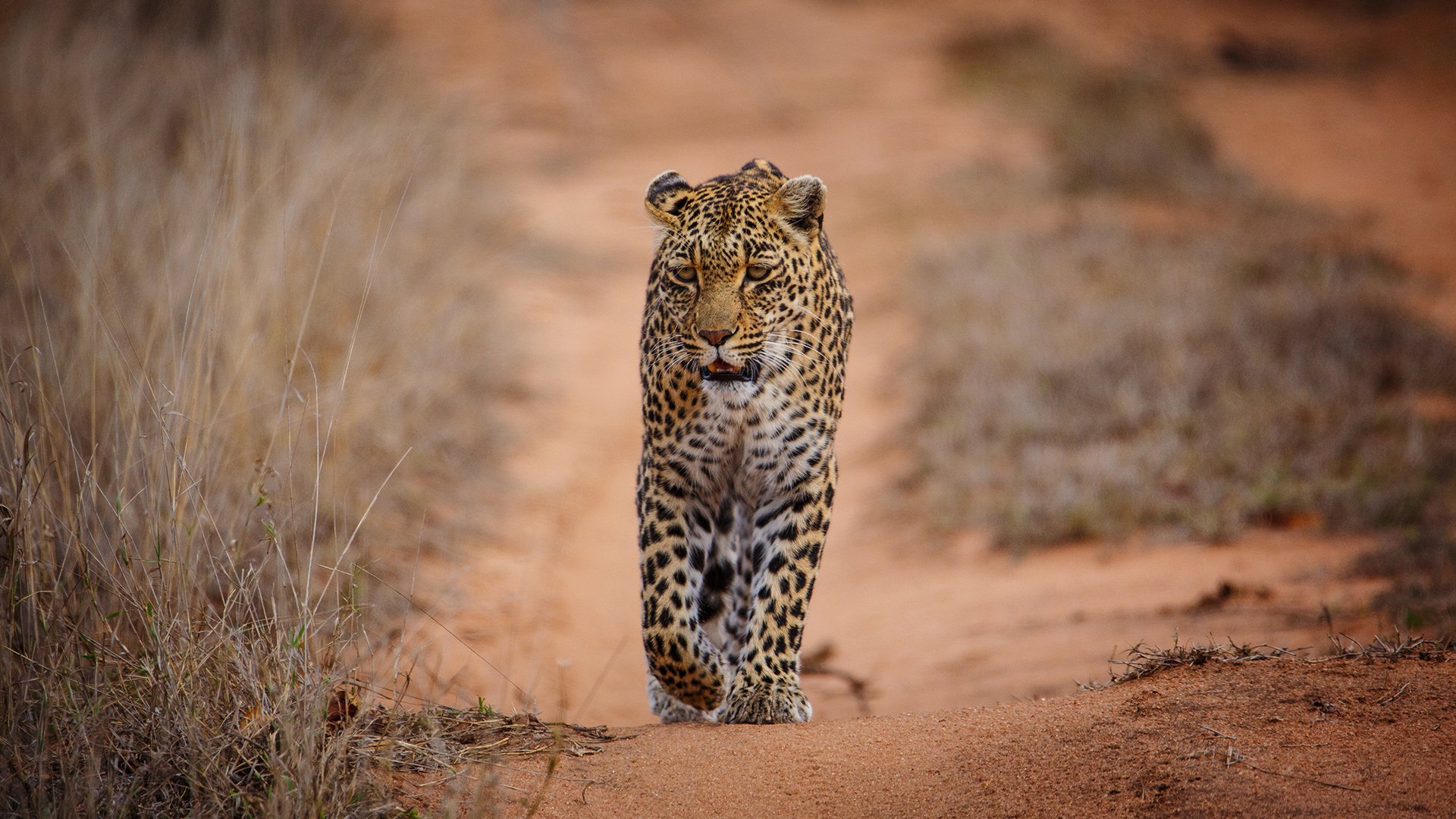
The cat everyone wants to see
Lions are easy. They sleep in the open, in groups, often next to the road. Leopards are the opposite: solitary, mostly active at night, and superbly camouflaged. You can drive past one lying in a tree ten metres away and never know.
That’s exactly why a good leopard sighting feels like such a reward. And it’s why where you go matters more for leopards than for almost any other animal.
Leopards in brief
Leopards are the most widespread big cat, but they’re in trouble. The IUCN lists them as Vulnerable. A 2016 study led by the Zoological Society of London and Panthera found leopards have lost between 63% and 75% of their historic range worldwide, with the worst losses outside sub-Saharan Africa.
The main threats are habitat loss, the loss of their prey to bushmeat hunting, conflict with livestock owners and illegal trade. According to the IUCN Cat Specialist Group, between 4,500 and 7,000 leopards a year are killed in Africa for skins used in ceremonies. Panthera’s Furs for Life programme has tackled this since 2013 by giving synthetic furs to members of South Africa’s Shembe Church, more than 22,000 so far by Panthera’s count.
A few facts that matter when you’re looking for one:
- They’re solitary and territorial. In African protected areas, a male’s home range is typically 30 to 78 km², a female’s 15 to 38 km².
- Males are much bigger. African males weigh roughly 20 to 72 kg, females 18 to 43 kg.
- They take kills up trees. Where lions and hyenas are around to steal food, leopards haul their prey into the branches, which is why a carcass in a tree is often the first clue.

Where to see leopards
Sabi Sand, South Africa
If there’s one place with a reputation for leopards, it’s the Sabi Sand, the private reserve on Kruger’s western edge.
Two things make it special. First, density: a 2017 camera-trap survey by Panthera in the reserve found 12.2 leopards per 100 km², the highest of any protected area surveyed in South Africa. Second, habituation. According to Africa Geographic, the practice of getting leopards used to vehicles was essentially pioneered at Londolozi in the late 1970s. Decades later, many Sabi Sand leopards are born to relaxed mothers and grow up treating game-drive vehicles as part of the landscape.
Guides in private reserves can also drive off-road to follow a leopard, which you can’t do in a national park.
The Sabi Sand is also one of the most studied leopard populations anywhere. Research drawing on records back to 1975 found that lions cause more than 20% of leopard deaths there.
See our Sabi Sand Where to Stay page.
Kruger National Park, South Africa
You don’t need a private lodge to see leopards. A study in the N’wanetsi area of central Kruger, using 2008 data, found 12.7 leopards per 100 km², comparable to the Sabi Sand.
The difference is access. In the national park you stay on the road, and leopards away from it stay hidden. Your chances improve on the river roads, early and late. Our guide to the best roads in Kruger covers where to drive.

South Luangwa, Zambia
South Luangwa is often called the valley of the leopard, and it has a big advantage: night drives. As darkness falls, guides go out with a spotlight, and that’s when leopards become active.
There’s no reliable count of how many live there. But a camera-trap study from 2012 to 2014 found leopard density 67% higher inside the national park than in the hunting areas next to it, where snares were more than five times as common. Protection makes a clear difference.

See our South Luangwa Where to Stay page.
The Serengeti and the Maasai Mara
The Serengeti is well regarded for leopards, particularly in the central Seronera area, where they rest in trees along the river valleys.

The Maasai Mara is famous for its leopards, thanks partly to years of wildlife television. But go with realistic expectations. A 2019 survey of the Mara Triangle estimated about 1.9 leopards per 100 km², which the researchers described as relatively low compared with other areas. Well-known individuals get a lot of attention, and with it a lot of vehicles.

Botswana and Namibia
In Botswana, the Okavango Delta and Moremi are well regarded for leopards, and private concessions allow off-road driving and night drives.
In Namibia, Okonjima, home of the AfriCat Foundation, offers leopard tracking. It’s worth knowing how it works: many of the reserve’s leopards wear research collars, which helps guides find them. Even so, Okonjima says sightings can never be guaranteed.
How to spot a leopard yourself
- Look up. Scan the thick horizontal branches of big trees, especially for a hanging tail or a dangling leg.
- Listen. Kudu give a loud bark and impala a sharp snort when a predator is near, and both stare straight at it. Baboons and vervet monkeys call too, and research on vervets has shown they have a distinct alarm call for leopards.
- Follow the scavengers. Hyenas and vultures around a tree can mean a kill in the branches.
- Go early and late. Leopards are most active at night, so the first and last hours of daylight, and night drives where allowed, give you the best chances.
- Be patient. A leopard in a tree often comes down at dusk. Wait.

Watching them responsibly
A relaxed leopard can quickly become a stressed one. Keep your voice down, keep the engine off, and don’t block its path or crowd it at a kill. Private reserves usually limit how many vehicles can be at a sighting at once, so be ready to wait your turn.
If a leopard is hunting, give it space. A disturbed hunt is a missed meal.
Explore more on 25South
- The Elusive Eleven: Africa’s hardest animals to spot.
- Best Roads in Kruger: where to drive for wildlife.
- Sabi Sand Game Reserve: the reserve profile.
- Speak Bush: how alarm calls work.
Sources
- IUCN Cat Specialist Group, leopard
- EurekAlert, leopard range loss (Jacobson et al., 2016, PeerJ)
- National Geographic, the state of leopards
- Panthera, Furs for Life
- San Diego Zoo Wildlife Alliance Library, leopard
- Africa Geographic, habituating leopards
- Singita and Panthera, measuring leopard density in the Sabi Sand (2017)
- Balme et al., Sabi Sand leopard data
- Maputla et al., 2013, surveying leopards in Kruger
- Rosenblatt et al., 2016, leopards in the Luangwa Valley
- National Geographic, South Luangwa, the valley of the leopard
- Tolhurst et al., 2025, leopards in the Mara Triangle
- Okonjima, leopard tracking
- Londolozi, decoding alarm calls
- Price et al., 2015, vervet monkey alarm calls, Scientific Reports
Top photo: Fir0002 / CC BY-SA 3.0, via Wikimedia Commons