Small animals, big names
Everyone knows the Big Five. Fewer people know there’s a smaller set that borrows their names: the elephant shrew, the buffalo weaver, the leopard tortoise, the antlion and the rhinoceros beetle.
SANParks lists these five for Kruger National Park, and nobody seems to agree on who first grouped them. It doesn’t matter much. The point is that they get you looking at the ground, the bushes and the sand, where a lot of the best wildlife watching happens.
Namibia has its own version. On the coastal dunes near Swakopmund, “Little Five” means something else entirely: a set of desert reptiles and a spider that live in sand that looks completely empty.
This guide covers both.
The classic Little Five
Elephant shrew
Named for its long, flexible, trunk-like nose. The twist is that elephant shrews, now usually called sengis, aren’t shrews at all. DNA studies place them in a group of African mammals that also includes elephants, so they’re more closely related to elephants than to shrews.
There are 20 living species, all found only in Africa. They range from about 25 grams to the giant sengis of East and Central Africa at up to 700 grams. They eat mostly insects and other invertebrates, and many species live in monogamous pairs.
In southern Africa, look for them in rocky areas, where they dash between rocks and cover.

Buffalo weaver
The name comes from the birds’ habit of following buffalo herds. The red-billed buffalo weaver, the species usually meant in southern Africa, is a black bird of 21 to 25 cm with a bright red bill.
It’s a bird of dry savanna and open woodland, and it’s easiest to find by its nests: big, untidy colonies of thorny twigs in trees, with separate chambers inside. In East Africa you’ll also meet the white-headed buffalo weaver, a different bird that doesn’t occur in southern Africa.

Leopard tortoise
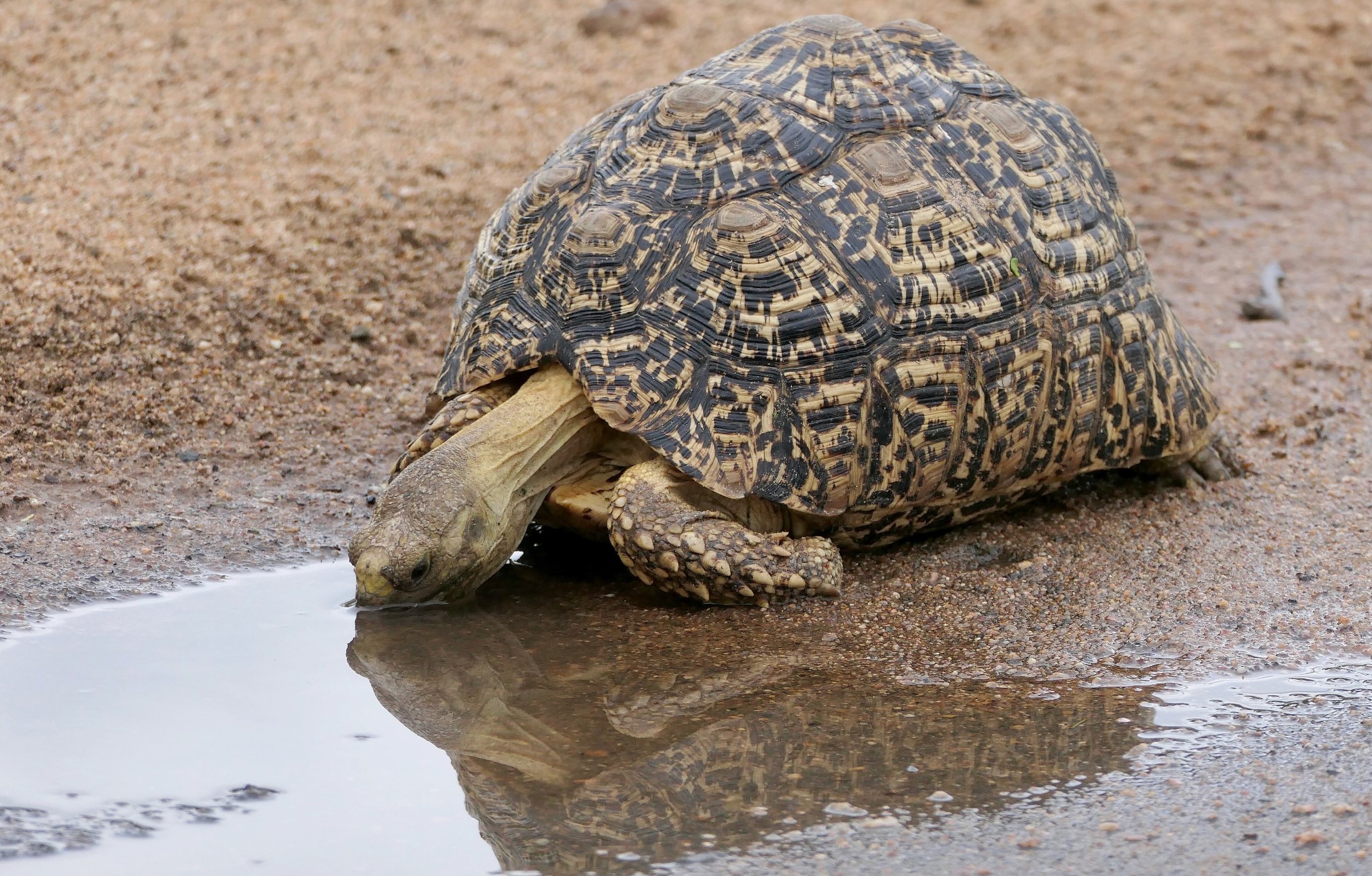
Named for the dark blotches on its shell. It’s the fourth-largest tortoise in the world, typically around 40 cm long and 13 kg, and it ranges from South Sudan and Somalia down to South Africa and Namibia.
It eats almost entirely plants, and because seeds pass through it undigested, it helps spread them across the veld. You’ll most often see one plodding through grassland or thorn scrub. Give it space, and never pick one up.
Antlion

The one you’ll find without ever seeing the animal. Antlion larvae dig small funnel-shaped pits in dry, sandy soil, a few centimetres deep, and lie buried at the bottom with only their jaws showing. An ant that slips over the edge slides down, and the larva grabs it.
Look for neat little cone-shaped dips in fine, dry sand. The adults are delicate, net-winged insects that fly weakly and look a little like damselflies.
Rhinoceros beetle
Named for the horns on the males’ heads, which they use to push rivals away rather than to injure them. Rhinoceros beetles are harmless plant-eaters, and their larvae grow in rotting wood.
Southern Africa has several species. One of the bigger ones, Oryctes boas, reaches about 44 mm.

How to find them
Most of the classic Little Five are easier to spot on foot than from a vehicle. Walk slowly, look down, and ask your guide. Kruger is a good place to start, since SANParks promotes the list there.
The Namib’s Little Five
The dunes between Swakopmund and Walvis Bay lie inside Dorob National Park, proclaimed in 2010 and covering around 7,800 km². From a distance they look lifeless. They aren’t. The cold Atlantic fog that rolls in on many mornings brings the moisture that keeps a whole community of small animals alive.
Half-day “Living Desert” tours head into these dunes with guides who read tracks in the sand and find the animals that made them. We did one ourselves and wrote about it in our Living Desert Tour story.
The five usually named:
Péringuey’s adder

A small adder, usually 20 to 25 cm long, with its eyes on top of its head. It buries itself in the sand with only the eyes and tail tip showing, and some individuals wiggle the dark tail tip to lure lizards within reach. It lives only in the Namib, from southern Angola to Lüderitz.
Namib web-footed gecko
About 13 cm long, with webbed feet that act like snowshoes on loose sand and like shovels when it digs. Its skin is so thin and translucent you can sometimes see its organs. It has no eyelids and cleans its eyes by licking them, spends the day in burrows and comes out at night. It’s found only in the Namib.

Namaqua chameleon
A ground-living chameleon up to about 25 cm, and a proper desert specialist. It turns dark on cold mornings to absorb heat and paler in the heat of the day. It hunts actively, mainly insects, and has even been recorded killing a Péringuey’s adder twice its length.

Shovel-snouted lizard
A small lizard, about 5 cm from snout to vent, nicknamed the Namib sand-diver because it disappears head-first into the sand. It eats insects and seeds blown in by the wind. Guides also point out how it lifts its feet off the hot sand, a habit often called its “thermal dance”.

Dancing white lady spider
A large, pale, nocturnal huntsman spider that lives in silk-lined burrows in the dunes. Males wander more than 50 metres in a night, and the spiders communicate by drumming on the sand.
You’ll often read that it cartwheels down the dunes to escape. That’s a different animal: the wheel spider, Carparachne aureoflava, which curls up and rolls downhill at up to 44 turns a second to escape parasitic wasps.
A bonus: the fog-basking beetle
Some guides add this one. On foggy mornings, Onymacris unguicularis climbs to a dune crest and stands head-down, letting fog condense on its body and run down to its mouth.
A word on handling
Guides on these tours sometimes pick animals up to show them. Businesses operating in Dorob National Park need a permit from Namibia’s environment ministry, and feeding wild animals there is an offence. Choose an operator that keeps handling to a minimum and puts every animal back where it was found.
Explore more on 25South
- The Living Desert Tour, Swakopmund: our day in the dunes.
- 210,000 Seals: What to Expect at Cape Cross: the other big wildlife stop on this coast.
- The Elusive Eleven: Africa’s hardest animals to spot.
- Kruger National Park: where SANParks promotes the classic Little Five.
Sources
- SANParks, Kruger: 5 things to seek
- California Academy of Sciences, evolution of sengis
- Sengis.org, biological synopsis
- Britannica, antlion
- Britannica, rhinoceros beetle
- Biodiversity Explorer, rhinoceros beetles (Dynastinae)
- Ministry of Environment, Forestry and Tourism, Dorob National Park
- Hedman et al., 2014, reptiles of the Namib (Reptiles & Amphibians)
- Nørgaard & Dacke, 2010, fog-basking behaviour in Namib beetles, Frontiers in Zoology
- Wikipedia: red-billed buffalo weaver, leopard tortoise, Bitis peringueyi, Pachydactylus rangei, Namaqua chameleon, shovel-snouted lizard, Leucorchestris arenicola, Carparachne aureoflava
Top photo: Bernard Dupont / CC BY-SA 2.0, via Wikimedia Commons