
Everyone arrives in Africa with a list, and at the top of it sit the Big Five: lion, leopard, elephant, rhino, buffalo. They are magnificent, and on a good safari you will tick them off. But there is a second, far more secretive list that only seasoned safari-goers chase — the Elusive Eleven. These are the animals you can spend twenty years looking for and still not see. Almost all are nocturnal, most are solitary, and several of us at 25South have driven thousands of kilometres without a single sighting of some of them. If the melanistic cats of our last feature were about rare colours, this is about rare encounters. Spot one of these and you have been, as one veteran guide puts it, “massively blessed.”
What makes the Eleven so hard to find
The Elusive Eleven are not rare in the sense of being endangered — most are reasonably widespread. They are rare to see. Ten of the eleven are primarily nocturnal, emerging only after the park gates have closed and self-drivers are confined to camp. Most are solitary and shy, many are small, and several spend the daylight hours underground. Your best chances come in the thin margins of the day — the first grey light at dawn, the last of the dusk — or on a guided night drive, which is precisely why they reward the patient and the lucky. Here they are, in alphabetical order.

1. Aardvark

The holy grail for many. Its name is Afrikaans for “earth pig,” and that is roughly what it looks like: a pale, hunch-backed, long-snouted termite-eater with rabbit ears. Strictly nocturnal and solitary, the aardvark spends its days in deep burrows and emerges in darkness to rip open termite mounds. Plenty of lifelong safari-goers have never seen one. Sightings are best in the cooler months, when aardvarks sometimes venture out before full dark. It is the sole survivor of its own order, Tubulidentata, with no close living relatives — a lone branch on the mammal family tree. A single aardvark can hoover up some 50,000 ants and termites in a night, and the burrows it digs and abandons become vital shelter for warthogs, porcupines, hyenas and a host of other animals.
2. Aardwolf

A small, shy relative of the hyena that looks like a delicate, striped jackal. Despite the family connection, the aardwolf is no hunter — it lives almost entirely on termites, lapping up 200,000 to 300,000 a night with a long, sticky tongue. It finds them by sound and scent but takes only part of each colony, leaving the mound to recover and feed it again. Nocturnal and seldom seen, it turns up most reliably in the open country of Namibia and the central Kalahari.
3. African Civet

A stocky, raccoon-faced omnivore patterned in black blotches and bands, the civet pads the bush at night on its own private rounds. You may go a decade without one and then find them turning up repeatedly at the same camp after dark. Listen and look around lit camps in the evening — they have a habit of appearing at the edge of the braai light. For centuries the civet was prized for ‘civet’ — a musky secretion from glands beneath its tail, once a valuable fixative in fine perfumery, and now largely replaced by a synthetic version. It uses the very same scent to mark its territory.
4. African Wild Cat

The ancestor of every house cat that ever curled on a sofa — and almost identical to a domestic tabby, which is exactly the problem. Spotting one means looking past “just a cat” to notice the longer legs, the rich rufous behind the ears, and the fact that it is hunting alone in the middle of the wilderness. The Kgalagadi and Etosha are reliable spots. DNA has confirmed that every domestic cat alive descends from this one subspecies, first tamed around 10,000 years ago among the early farmers of the Near East.
5. Bushpig

Far more secretive than the familiar warthog, the bushpig is a nocturnal, thickset, shaggy pig of dense vegetation in eastern and southern Africa. It keeps to cover and to the dark, and many regular visitors have never knowingly seen one in the wild. A genuine prize. Bushpigs live in family groups — ‘sounders’ of up to a dozen — swim well, and will trail fruit-eating monkeys to snap up what they drop. Territorial and easily provoked, they are among the more dangerous animals to surprise on foot.
6. Caracal

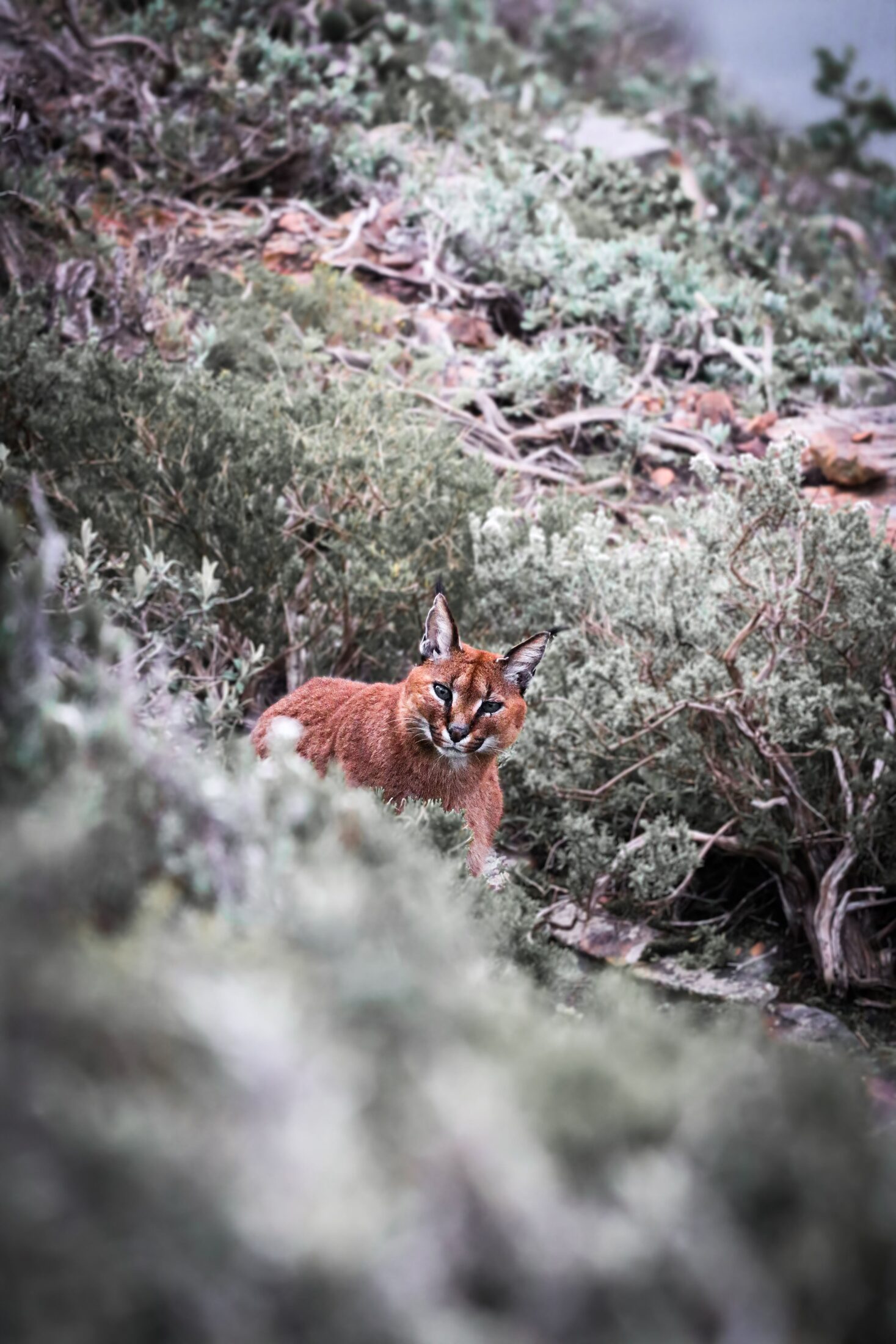
A sleek, muscular cat the colour of dry grass, unmistakable for its long black ear-tufts. The “desert lynx” is a superb ambush hunter, capable of leaping to swat birds out of the air, but it is so cautious and well-camouflaged that sightings are brief and treasured — often just a flash of pricked ears disappearing into the scrub. Its name comes from the Turkish karakulak, ‘black ear.’ So explosive is its leap — more than three metres from a standstill — that it can pluck birds clean out of mid-air, a skill once exploited in Persia and India, where trained caracals were set on flocks of pigeons for sport.
7. Honey Badger

The bush’s most fearless animal — Guinness once crowned it the world’s most fearless creature — and one of its most charismatic. Stocky, black-and-silver, and afraid of nothing, the honey badger will raid a beehive, dig out a snake, or stand its ground against animals many times its size. They are widespread but mostly nocturnal; sightings often come near camps, where their curiosity and notorious raiding of bins gives them away. Its resistance to snake venom is famous but not absolute: a puff-adder bite can leave it paralysed and apparently dead, only for it to come round hours later and finish the meal — the result of a tiny change in a nerve receptor that blunts the venom’s grip.
8. Pangolin

The most coveted sighting on the entire continent. A pangolin is an unlikely creature — a walking pine cone, an ant-eating mammal armoured head to tail in overlapping scales, that rolls into an impregnable ball when threatened. It is also nocturnal, solitary, increasingly scarce and heartbreakingly trafficked. To see one in the wild is the sighting of a lifetime, and the reason we have given it a feature all of its own. The one you might glimpse on a Southern or East African safari is Temminck’s ground pangolin, one of four African species. It is the only mammal fully covered in scales — made of keratin, like our own fingernails — and it is precisely these that drive the trade.
9. Porcupine

Africa’s largest rodent, and far more rarely seen than its size suggests. The crested porcupine forages after dark, rattling its black-and-white quills in warning, and vanishes well before dawn. Many guides count their lifetime sightings on one hand. Contrary to the old myth, a porcupine cannot shoot its quills; instead it reverses hard into a threat, driving the barbed spines home — wounds that have killed lions and leopards.
10. Serval

Arguably the most beautiful of the small cats: tall, slender, golden and spotted, with enormous radar-dish ears and the longest legs of any cat relative to its body. The serval hunts rodents in long grass and wetland margins, pouncing in great vertical leaps. Crepuscular rather than strictly nocturnal, it gives the patient dawn-and-dusk watcher a real chance. Nicknamed the ‘giraffe cat’ for its long neck and legs, it can spring nearly three metres straight up to bat down birds in flight, and pinpoints rodents in deep grass by sound alone with those outsized ears.
11. Sidestriped Jackal

Where the conspicuous black-backed jackal trots about in the open, the side-striped keeps to wooded, well-watered country and moves mostly after dark — so even where it is common, it is seldom clearly seen. The trick is telling it apart from its black-backed cousin: the side-striped lacks the bold black saddle and wears a paler, faint side-stripe and a white-tipped tail instead. Quieter and more retiring, it is the jackal you have to earn.
How to improve your odds
You will not tick off the Eleven by accident. Stack the deck: take a guided night drive wherever they are offered — it is the single biggest factor, because it puts you in the bush exactly when these animals are active and the self-drive gates are shut. Be out at first light and last light, the windows when the nocturnal animals overlap with the legal driving day. Watch around camp after dark, where civets, honey badgers, genets and porcupines come scavenging into the lit edges. Go in the cooler, drier months, when some normally nocturnal species venture out earlier. And above all, slow down and look closely — many of the Eleven are small, still and superbly camouflaged. Half of finding them is simply expecting to.
See even one or two of these on a trip and you will have joined a quiet club of safari-goers who know that the real magic of the bush is not always five tonnes and a roar — sometimes it is a pair of ear-tufts melting into the grass.
Explore more on 25South
- Kgalagadi reserve profile — one of the best places for wild cat, caracal and porcupine.
- Etosha reserve profile — floodlit waterholes for nocturnal species.
- South Luangwa reserve profile — famous for its night drives and elusive nocturnal wildlife.
Comments
One response to “The Elusive Eleven: Africa’s Hardest Animals to Spot”
[…] The Elusive Eleven: Africa’s hardest animals to spot. […]