Twenty-five years ago we drove into Pilanesberg in a company car, two small boys in the back and no idea what we were doing. This October I drove back in, and I will admit that I did not really want to.
I had my reasons. In the years since I have spent a lot of time in some of the most amazing reserves in Eastern and Southern Africa, and somewhere along the way Pilanesberg had turned in my mind into something close to a zoo: a fenced park a couple of hours from Johannesburg, busy at weekends, nice enough for a day out. Several people had also told me it was falling apart. The roads were terrible and not maintained, the official camps had gone downhill, and Manyane even burned to the ground. My wife wanted to go anyway. We raised our sons in that park, she said, and she was not going to be in the north west of South Africa and skip it. She was right, and most of this article is about how.
Our first weekends, 2001
We had moved to South Africa from West Africa in 2001 and stayed until 2008. A few weeks or months after we arrived, somebody told us about Pilanesberg. It was easy, it was close, and we simply had to go. We had never been on a safari. I can no longer tell you which of our early weekends was the very first, but I believe the car was an Audi A3 that the company provided, a sedan that was never meant for a game reserve and managed well enough on those roads anyway. Our eldest was eight, the second not yet two, and the third was still two years away.
After that we went dozens of times, usually for a weekend. We stayed at Manyane, either in the self-catering chalets or, better, in the safari tents. The camp was fenced, but in front of the tents lay a big stretch of open bushveld where zebra and antelope wandered past, and the boys and I played ball there and went for walks. The restaurant was decent. Later we stayed at Kwa Maritane and Bakubung as well, and at a few other camps, and we eventually bought proper 4x4s. But the weekends I remember best were the ones at Manyane, with the family or with friends visiting from overseas. We loved it.

What Pilanesberg actually is
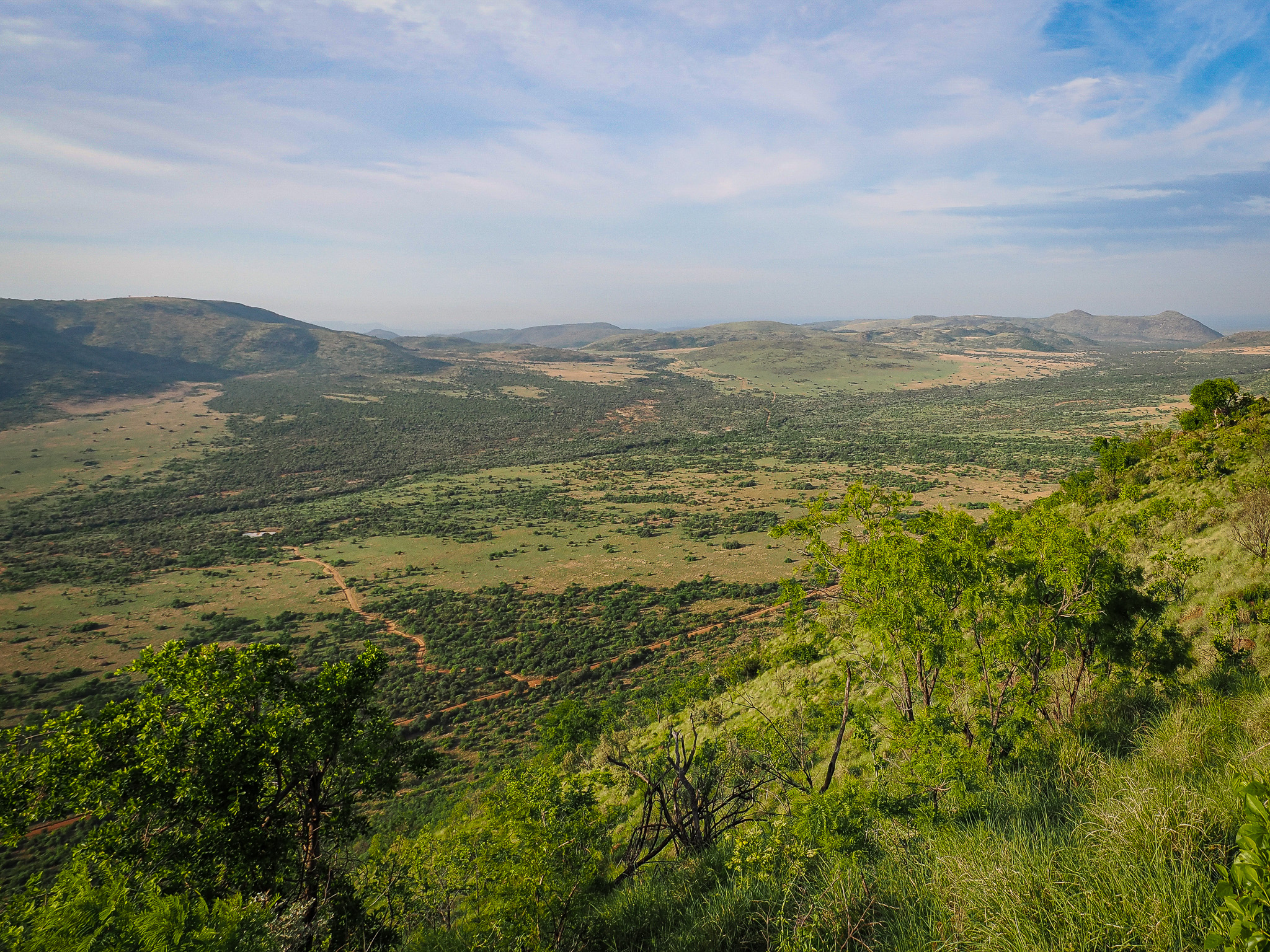
The hills you drive through are the worn-down remains of an extinct volcano, more than a billion years old. They form a set of concentric ridges and valleys, which geologists call an alkaline ring complex and count among the best preserved in the world. The collapsed centre is where Mankwe Dam sits today. The park covers roughly 570 square kilometres.
The animals are a more “recent” story. The park was fenced and restocked from 1979 in a programme called Operation Genesis, which brought back several thousand animals of species that had long vanished from the area. The Big Five are all here again, but they were put back by people, and I find that makes the place more impressive and not less.
What everyone warned me about
Before revisiting this year, every person I asked told me the same thing. The roads are bad, you can hardly drive there anymore, the camps are tired and Manyane burned down. Some of that is true. The parks board itself has admitted that maintenance has fallen behind.
But what I had already learned was another change. A number of private lodges have opened in and around the park, among them Ivory Tree and Shepherd’s Tree, and there is also the private Black Rhino Game Reserve. You can find several of these in our Where to Stay section for the Pilanesberg.
We stayed at Shepherd’s Tree, and it is no comparison with what we had in the 2000s. It is far more comfortable and, honestly, quite a lot more luxurious than the old safari tents or the self-catering units, which I say with some affection for both.
The rhino at the corner
One of the early trips in the 2000s gave me my first lesson in animal behaviour. I was driving a gravel road and came around a bend to find a black rhino standing in the middle of it. We stared at each other. I think we were equally shocked. I knew nothing about rhinos then, and the only plan I could come up with was to put the car in reverse and back away, very slowly, with the rhino watching. It did not follow. To this day I could not tell you which of us was more surprised. Honestly, today I am not even sure anymore if it was a black or a white rhino. Well, its head was up, so the story sounds better with the black rhino.
A day on our own
On our visit this October, on one day we skipped the lodge drives and did a full self-drive through the park. We entered at Bakubung Gate in the south and went first to Manyane, which almost brought tears to our eyes. A tent sells coffee and basic food, but there is no restaurant anymore and no tourism to speak of. The thatched roofs are gone from the buildings due to the fire and only ruins remain. The safari tents still stand and look quite decent, and that made the rest harder to look at, because the pool and the paving are exactly where we left them.


From there we drove up to Lenong, the highest point we visited, which is always a good view, and stopped quickly at the Pilanesberg Centre for drinks and a snack to take up. The Centre looked fine to me, and not much seemed to have changed. The roads surprised me most. I had expected the worst after everything I had heard, but we drove a small SUV with good ground clearance and never needed more. You could probably have done it in a sedan, as we used to.

The elephant and the baby seat
One of our best stories from the old days is from a stay at Bakubung, years later, when our third son was a small baby. He could not go on the lodge’s game drives, so my wife and the older boys went in the open vehicle with friends while I followed in the car. With my own car and the baby in the backseat, I always stayed in close proximity to the guide, on the theory that he knew where the animals were.
On one road along a hilltop I was ahead of the game vehicle when an elephant bull walked out of the bush between us. He stopped and looked up the road at the vehicle, then down the road at my car, and he chose the car. He started towards me. I started to drive away, slowly. He flapped his ears and shook his head, the warning signs that I now recognise, and then he came faster. So did I. In the end it was a chase.
Everyone in the game vehicle had a good laugh, my wife told me later. Look, they were saying, the elephant is chasing that car. My wife, meanwhile, was only thinking one thing: that’s my husband, and, even more important, my baby in that car.
Tlou’s road

This time the elephants were more polite, with one exception. On Tlou Drive a young calf charged us, ears out, and it was a fair complaint. Tlou is the Setswana word for elephant, and we were driving on his road.
The rest of the day was generous. On the Moloto Drive in the far north we found several herds of elephants. Further on there were giraffes, waterbuck, baboons along Tshwene Drive and a very scenic lone giraffe on Nkwe Drive. Just before joining Kubu Drive, on the Letsha Link, we came across a pride of lions, along with about 25 other vehicles.


That is the one real downside, and I suspect it has not changed in 25 years. Sightings here are not managed. Self-drive visitors, vehicles from the lodges inside the park, day-trip operators from outside and now the private lodges all share the same roads, and a good sighting can turn into a queue. Twenty-five vehicles is too many for one pride, and someone needs to manage it. But the park is large. On the smaller roads in the north there were stretches of an hour or more when we did not see another vehicle.
Was it a zoo?
For about ten minutes at the lion: yes. Everywhere else, no. What I had forgotten, after all those years in bigger and better-known parks, is how good Pilanesberg looks. Standing at Lenong or looking over Mankwe Dam, or driving out one of the northern valleys on a gravel road, I could not think of many national parks that compete with it for landscape. And the game is still there.
My wife was right to push. We came back to a park we had raised our sons in, found some of it sadly changed and most of it still better than I remembered, and left planning to return. Pilanesberg should always be on your itinerary when you are in the region or when you need a quick getaway out of Johannesburg.
Where we would stay
We stayed at Shepherd’s Tree Game Lodge, in the south-western part of the park. The room had a separate bedroom and living area, we ate at the boma one evening, and after dinner two elephants came down to the waterhole below the lodge. Our guide Doreen took us up to Lenong on the morning drive without being asked twice. For first-time visitors from overseas who want a comfortable base within reach of Johannesburg, Shepherd’s Tree Game Lodge is our recommendation.

Their sister Lodge is Ivory Tree Game Lodge, entered through the Bakgatla Gate on the north-eastern side. It has 70 rooms in five suite types, plus quad biking, archery and drumming sessions, which suggests a lodge with something for families and groups. Both are run by aha Hotels & Lodges.
We thank aha Hotels & Lodges for supporting the making of this article. What we write about the lodge and the park is our own.
Shepherd’s Tree Game Lodge
Shepherd’s Tree is a concession in an exclusive-use zone in the south-western part of Pilanesberg, off the R565. Rooms range from standard suites with an outdoor shower and patio to family suites that sleep up to six, executive suites with a private heated pool and two-bedroom private villas. Meals are served in the restaurant or at the boma, and open vehicles go out on two guided drives a day, with a coffee stop in the morning and sundowners in the evening. The lodge also has a spa.


Ivory Tree Game Lodge
Ivory Tree lies inside Pilanesberg, with its entrance at the Bakgatla Gate on the north-eastern side of the park. Its 70 rooms range from standard and deluxe suites to family suites with a private plunge pool, luxury suites with a fireplace and the Royal Pilane Suite with its own boma. Besides game drives, there is quad biking, archery, drumming sessions and a spa.


Pilanesberg at a glance
- Where: North West Province, in the crater of an extinct volcano, in the transition zone between the Kalahari and the Lowveld
- Size: about 570 square kilometres
- From Pretoria: about 150 km, roughly 1.5 to 2 hours
- From Johannesburg: about 170 km, roughly 2 to 2.5 hours
- Route: N4 west, then the R556 north towards Sun City. The R510 leads to the eastern gates, the R556 past Sun City to the western ones.
- Gates: Manyane (east), Bakgatla (north-east), Bakubung and Kwa Maritane (near Sun City). Shepherd’s Tree is reached off the R565, but limited to guests of the lodge.
- Opening times: roughly 05:30 to 19:00 from November to February and 06:30 to 18:00 from May to September, with changes in between. Please check the current times before you travel.
- Best season: the dry winter months, roughly May to September, when animals gather at the water and the bush is thin
- Malaria: the park is considered malaria-free
- Fees: see the visitor site’s rates and gate times page for current entry fees
Sources: pilanesbergnationalpark.org (unofficial visitor site), Wikipedia, aha Hotels & Lodges. Details can change, so confirm times and fees with the park before you go.

Explore more on 25South
- Pilanesberg National Park, our overview and ratings of the park.
- Where to Stay in Pilanesberg, the lodges we list, including Shepherd’s Tree and Ivory Tree.
- South Africa, our destination guide to the country’s reserves.
- Big Five game reserves near Johannesburg and Pretoria, how Pilanesberg compares with the other reserves within four hours of the city.
Comments
One response to “Pilanesberg, 25 Years Later”
[…] The 2025 fee rise and the roads. The December 2025 increase roughly doubled fees for South Africans and raised them about sixfold for international visitors. The North West Parks and Tourism Board said it needed the money to repair failing roads, fences and facilities. By August 2026 the fees had not been reversed, more than 80 km of roads were being graded, domestic visitor numbers were down by about a fifth, and tour operators still described parts of the road network as poor. For international visitors, a Pilanesberg day now costs more in fees than a day in Kruger. If you prefer to leave the driving to someone else, scheduled three-hour guided drives cost about R1,050 per South African adult and R1,550 per international adult. We drove the park ourselves in October 2026: see Pilanesberg, 25 Years Later. […]