Every safari reading list is the same. Open ten of them and you’ll find the same five books in the same order — Out of Africa at the top, a couple of elephant memoirs, something with a sunset on the cover — copied from one another until nobody remembers where the recommendations came from.
This isn’t that list. Fourteen books, arranged not by ranking but by what they’re for: the memoirs that built the romance (and the ones honest enough to puncture it), the naturalists who spent years in the bush so you don’t have to, and the modern writers telling Africa’s story from the inside. Each one comes with a straight verdict — including where a beloved classic has aged badly, and which famous title you can safely skip in favour of a better one beside it. Every book is tagged with where it’s set, because the best reading before a safari is a book that puts you in the very landscape you’re about to walk into.
One honest caveat up front: the classic safari canon was written almost entirely by white settlers and travellers — the memoir of the bush was, for a long time, a colonial form. We’ve flagged where that shows, and deliberately weighted the newer shelves toward African writers telling their own countries’ stories. The list leans, as we do, toward the wildlife regions of East and Southern Africa — Kenya and Tanzania, Botswana, Zimbabwe, Zambia and South Africa. You won’t need a single one of them to enjoy the bush. But the right book read at the right camp, in the hour between the afternoon game drive and dinner, has a way of turning a good safari into one you never quite come home from.
Memoir & Narrative
The romance and the reckoning
This is where the safari myth was made — and, in the sharper books, quietly dismantled. Read these for atmosphere and voice; they’re about a vanished world, and how the people who lived in it chose to remember it.

West with the Night — Beryl Markham · Kenya
Markham was raised on her father’s farm at Njoro in the Rift Valley, largely by the land itself — hunting barefoot with Nandi and Kipsigis boys, surviving a mauling by a half-tame lion, absorbing the bush as a first language rather than a destination. She became the youngest licensed racehorse trainer in Kenya, then one of its first bush pilots, flying mail and passengers across a country with no runways and scouting elephant herds from the air for safari parties below. The memoir circles all of this in loose, luminous vignettes rather than a straight timeline, culminating in her 1936 solo flight across the Atlantic from east to west — a first, ending in a crash-landing in a Nova Scotia bog. It’s spare, muscular and unsentimental, and Hemingway famously admitted she could write rings around all of them. Tellingly, she leaves out most of her scandalous private life, which only sharpens the book’s focus on land, horses and flight.
Read this if you want the prose of Blixen without the nostalgia — and the single best-written book on this list.

Out of Africa — Karen Blixen · Kenya
A Danish baroness writing under the name Isak Dinesen, Blixen ran a six-thousand-acre coffee farm at the foot of the Ngong Hills, just outside Nairobi, from 1913 until the plantation failed and she lost it in 1931. The book isn’t a plotted story so much as a series of reflections — on the farm and its Kikuyu squatters, her cook Kamante and her Somali steward Farah, the shooting parties, the hills, and her doomed love for the big-game hunter Denys Finch Hatton, who dies in a plane crash near the end. The writing is genuinely beautiful and the sense of place is indelible; you understand, reading it, exactly how the safari dream took hold of the European imagination. But it’s worth going in clear-eyed. This is an aristocratic, elegiac view of colonial Kenya that renders the Africans in it as noble scenery rather than people, and it reads very differently now than it did in 1937. A classic, with a permanent asterisk.
Read this if you want to understand the myth at its source — critically.

Don’t Let’s Go to the Dogs Tonight — Alexandra Fuller · Zimbabwe / Zambia
The antidote to the two above. Fuller grew up white and poor on a string of farms across war-era Rhodesia, Malawi and Zambia in the 1970s and 80s, and her memoir tells it without a scrap of varnish: the loaded rifle by the bed during the Bush War, the malaria and the mosquito nets, several siblings lost to accident and illness, and a mother slowly coming apart from grief and drink. What makes it extraordinary is the tone — feral, funny, and utterly refusing to make either her own family or the colonial project look noble. Where Blixen mourns a lost paradise, Fuller shows you the wreckage of the same era from a child’s-eye view, dust and all. It’s the best-written and most honest memoir on this list, and the one that will stay with you longest.
Read this if the classics feel too polished and you want the truth underneath.

Jock of the Bushveld — Percy FitzPatrick · South Africa
Before it was Kruger, the eastern Lowveld was a wilderness crossed by ox-wagon convoys hauling supplies to the 1880s goldfields, and FitzPatrick was one of the transport-riders who lived it. Jock is his dog — the runt of a litter, a plucky Staffordshire bull terrier — and the book is a string of true trail tales of the two of them: hunting kudu, standing off baboons and crocodiles, the camps, the oxen, the long red roads through country now stitched with famous private reserves. FitzPatrick first told these as bedtime stories to his children and published them in 1907 at Rudyard Kipling’s urging; generations of South Africans grew up on them. As a portrait of the bush before the fences went up it’s foundational — but be warned it’s very much a book of its time, with a Victorian, hunting-era sensibility that treats animals as quarry, and an ending that turns unexpectedly sad.
Read this if you’re heading to Kruger and want the ghost of the land it used to be. And if you’re planning your own Kruger trip, our guide covers the practical side.
Naturalist & Conservation
The bush itself
Less about people, more about the animals and the land — and the often quixotic humans who gave years of their lives to both. These are the books that deepen what you actually see on a game drive.

The Tree Where Man Was Born — Peter Matthiessen · Tanzania
Matthiessen — the only writer to win the National Book Award for both fiction and non-fiction — travelled through East Africa in the late 1960s and early 70s and wrote this as a meditation rather than a travelogue. It moves across the Serengeti plains, down into the Ngorongoro Crater, out among the Maasai and the hunter-gatherer Hadza, and back to Olduvai Gorge, where the earliest human remains were being unearthed — using the wildlife and the emptiness of the land to circle the question of where we all came from. There is very little plot and a great deal of thinking; the prose is dense, patient and closer to philosophy than to nature writing. It rewards slow reading and can feel like hard work if you want a story. But no other book on this list will make the Serengeti feel as vast, as old, or as haunted by deep time.
Read this if you want the Serengeti as a philosopher sees it, and you’re willing to work for it.

Cry of the Kalahari — Delia & Mark Owens · Botswana
In 1974 two young, near-penniless American zoologists flew to Botswana, drove into the Central Kalahari’s Deception Valley, and simply stayed — seven years in one of the emptiest places on earth, hundreds of kilometres from the nearest help, studying brown hyenas and lions that had never learned to fear people. The book is genuinely gripping: lions padding through their unfenced camp at night, near-death by thirst and bushfire, and hard-won discoveries about desert predators nobody had watched before. It builds into an early, passionate fight against the cattle fences and mining interests threatening the Kalahari’s wildlife. One honest caveat, though not about this book: the Owenses later became entangled in a violent, still-unresolved anti-poaching controversy in Zambia that’s worth knowing about before you canonise them. Taken on its own terms, this is one of the great wilderness memoirs.
Read this if you want to feel the sheer isolation of the desert — and the cost of the science done in it.

Return to the Wild (or Kakuli) — Norman Carr · Zambia
Norman Carr is one of the true founding figures of the modern safari, and this is the life behind the legend. Working in Zambia’s Luangwa Valley from the 1930s on, he helped create the country’s first national parks, and — radically for his time — argued that wildlife had to pay its own way by benefiting the people who lived alongside it, an idea that underpins nearly every conservancy model today. He also invented the walking safari, putting visitors on foot with a guide instead of behind a windscreen. Return to the Wild tells the intimate story of raising two orphaned lion cubs and releasing them back to the bush; the later Kakuli — his valley nickname, meaning old buffalo — is the wider memoir of a lifetime in the Luangwa. The writing is plain and unshowy, more countryman’s notebook than literary set piece. But if you walk in South Luangwa today, you are walking in ground this man shaped.
Read this if you’re bound for Zambia, or want to meet the man who put you on foot in the first place.

The Elephant Whisperer — Lawrence Anthony · South Africa
When a herd of traumatised, fence-breaking problem elephants was about to be shot, conservationist Lawrence Anthony took them onto his Thula Thula reserve in Zululand as a last resort — and the book is the story of slowly winning their trust, learning their hierarchy and temperament, and coming to understand them as individuals. It’s warm, dramatic and genuinely moving, an easy and emotional read that does more than most to convey elephant intelligence and family bonds. It is also, be warned, the most sentimental book on this list — Anthony leans hard on the heartstrings, and the famous coda, in which the herd reportedly walked to his house after his death in 2012, is either the most beautiful or the most eyebrow-raising thing here, depending on your temperament. Cynics should look elsewhere; everyone else will finish it a little in love with elephants.
Read this if you want to fall for the herd — and don’t mind having your heartstrings pulled.

Unbowed — Wangari Maathai · Kenya
Maathai was the first woman in East and Central Africa to earn a doctorate, and in 1977 she founded the Green Belt Movement, mobilising rural Kenyan women to plant trees against the deforestation and soil erosion that were quietly stripping the land. Her memoir traces that work from a childhood in the highlands near Nyeri to the Nobel Peace Prize in 2004 — the first ever awarded to an African woman, and the first to an environmentalist — by way of beatings, arrests and open confrontation with the Moi regime, which she fought to stop the concreting-over of Nairobi’s Uhuru Park. This isn’t a game-viewing book, and readers wanting lions and campfires should know that going in. But it is the most important conservation story on this list, and the one that reframes conservation as something Africans led rather than something done to Africa. It belongs here precisely because it isn’t the usual safari read.
Read this if you want to understand African conservation from the inside, led by the people who live there.
Modern & Literary
Africa telling its own story now
The newest and most vital shelf: contemporary writers, several of them African, working the same landscapes but from the inside and without the colonial soft-focus. Read these to understand the countries you’re visiting as they are, not as the classics remembered them.

When a Crocodile Eats the Sun — Peter Godwin · Zimbabwe
Godwin, a white Zimbabwean journalist, wrote this across the years of Mugabe’s ruinous land seizures and economic collapse in the early 2000s, returning again and again from abroad to a country coming apart — farms invaded, currency evaporating, friends leaving or dying. Threaded through the national tragedy is an intimate one: his father is failing, and Godwin discovers that the reserved English-seeming man he grew up with was in fact a Polish Jew who had hidden his identity for decades, having lost his family in the Holocaust. The title comes from an old belief that an eclipse — a crocodile eating the sun — is an omen of catastrophe, and the book braids these threads of exile, concealed identity and belonging into something genuinely powerful. The prose is clean and journalistic but the emotional reach is large. It’s the most substantial modern book here, and the best single portrait of what happened to Zimbabwe and its people.
Read this if you want to understand modern Zimbabwe through one family’s unravelling.

The Old Drift — Namwali Serpell · Zambia
The most ambitious book on this list — a sprawling, genre-bending debut novel by a Zambian author that follows three intertwined families, one white, one Black, one Indian, from the colonial settlement of the Old Drift near Victoria Falls around 1900 all the way to a near-future Lusaka of surveillance micro-drones. Along the way it swings from straight historical fiction through magical realism (a woman who weeps endlessly, another cloaked entirely in hair) into outright science fiction, narrated between chapters by a chorus of mosquitoes. It’s the story of a nation told sideways, through error, chance and the drift of history, and it won a shelf of major prizes for its nerve. Fair warning: it’s long, and its restless shape-shifting can be dizzying — this is the literary novel of the list, not a light pre-safari read. But nothing else here captures Zambia’s sweep of past and future in one breath.
Read this if you want the boldest, most inventive novel written about the region.

Paradise — Abdulrazak Gurnah · Tanzania
From the Zanzibar-born writer who won the 2021 Nobel Prize in Literature, this is the story of Yusuf, a twelve-year-old boy in early-twentieth-century East Africa who is handed over by his father to a wealthy merchant to settle an unpayable debt — pawned, in effect, into servitude. Travelling with the merchant’s trading caravans deep into the interior, Yusuf comes of age amid the Swahili-Arab trade routes just as European colonialism begins closing in, and the paradise of the title grows steadily more ironic as innocence gives way to a world built on ownership and loss. Gurnah writes with quiet, allusive precision rather than drama, and the pace is unhurried. It is the most demanding entry here in its stillness — but it offers something no other book on the list does: East Africa rendered from a Swahili-coast perspective, before the safari myth existed, by one of the great living writers.
Read this if you want East Africa from the inside, long before the first camera-toting visitor arrived.

Dust — Yvonne Adhiambo Owuor · Kenya
Owuor’s novel opens with a young man, Odidi Oganda, gunned down on the streets of Nairobi, and follows his body home to the family’s failing homestead in Kenya’s arid north — a vast, shimmering frontier landscape that functions less as backdrop than as a character in its own right. From there the book excavates the silences in one family, and in a whole country: the buried violence of Mau Mau, a 1960s political assassination, the bloodshed of disputed elections, all the things Kenya has agreed not to say aloud. The prose is fragmented, lyrical and demanding — this is the most challenging sentence-by-sentence book on the list, and it asks patience. But no other novel here renders the northern Kenyan desert, or the weight of the country’s unspoken history, with anything like this intensity.
Read this if you want Kenya’s northern wilderness and its hidden histories from a major Kenyan voice.

Out of Darkness, Shining Light — Petina Gappah · Zimbabwe / Zambia / Tanzania
When David Livingstone died in 1873 in what is now Zambia, sixty-nine African companions carried his body more than 1,500 miles over nine months, across the interior to the coast at Bagamoyo, so it could be shipped home to England — and Gappah tells that astonishing true journey entirely from their side of it. It’s narrated by two of the bearers: Halima, Livingstone’s sharp-tongued cook, and Jacob Wainwright, a devout, freed-slave scribe — voices that turn the great white explorer into a corpse being carried by the Africans who actually knew the land. Funny, moving and quietly radical, it reclaims one of the most famous stories of European exploration as an African one, and it moves through the very country — Zambia into Tanzania — that safari travellers cross today. A Zimbabwean writer at the height of her powers.
Read this if you want the great African trek retold by the Africans who made it.
If You Only Read Three
Fourteen books is a lot to pack. If you’re taking just a few onto the plane, one from each shelf will do more than any top-ten ranking:
West with the Night (Markham, Kenya) for the language and the romance done right. Cry of the Kalahari (Owens, Botswana) for pure wilderness adventure and the thrill of the unfenced bush. And When a Crocodile Eats the Sun (Godwin, Zimbabwe) to understand the modern region beneath the game drives. Between them you get the poetry, the wild, and the truth — and three different countries besides. (If you can stretch to a fourth, make it Alexandra Fuller.)
A last word
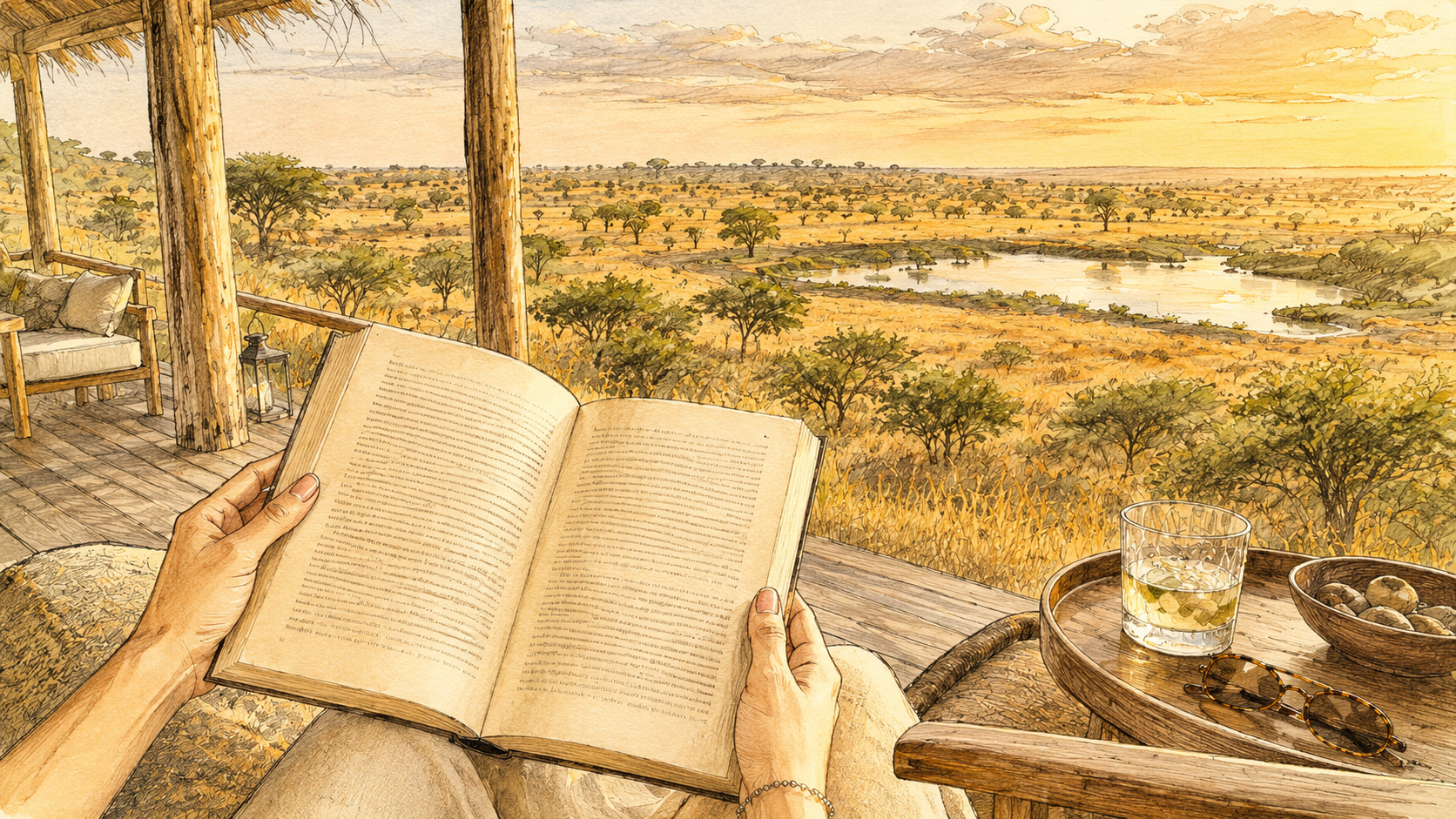
No book is required reading for a safari; the bush needs no footnotes. But the right one, opened in the golden hour between the afternoon drive and dinner, has a way of settling you deeper into a place. Read where you’re going, and the landscape starts talking back.
And if one of these books leaves you plotting an actual trip, we’ve written up the practical side too — our Etosha guide for Namibia’s self-drive circuit, or what it takes if you fancy climbing Kilimanjaro yourself.
Explore more on 25South
- Explore all our destinations — the places these books bring to life.
- The Great Migration — when and where to witness the world’s greatest wildlife spectacle.
- The Elusive Eleven — Africa’s hardest-to-spot species and where to find them.