Kruger at a Glance
Before the detail, here is the shape of the place. Kruger is enormous, biodiverse and unusually easy to visit independently — a tarred road network, fenced rest camps with shops and fuel, and a self-drive culture that few other African parks offer.
| Park status (Sept 2026) | The January 2026 floods hit the central and northern park hardest, from Olifants and Letaba north through Mopani, Shingwedzi and Punda Maria, closing camps and river crossings for months. Most of that is undone: the Letaba High-Level Bridge reopened in March, with final work completed in August, the H4-1 between Skukuza and Lower Sabie has been rebuilt with wider culverts, and the main rest camps are trading again. Still outstanding: 64 of Letaba’s tourism units are being restored in phases to the end of November 2026, and a few bush camps and day-visitor sites remain on later timelines. Check current camp and road status with SANParks before booking. |
| Size | ~19,485 km² (about 2 million hectares) — roughly the size of Wales or New Jersey |
| Dimensions | ~360 km north to south; average ~65 km wide |
| Established | Proclaimed Sabie Game Reserve in 1898; became Kruger National Park in 1926 |
| Managed by | SANParks (South African National Parks) |
| Entrance gates | 9 — Crocodile Bridge, Malelane, Numbi, Phabeni, Paul Kruger, Orpen, Phalaborwa, Punda Maria and Pafuri |
| Wildlife recorded | 147 mammal, 507 bird, 114 reptile, 49 fish and 34 amphibian species, plus 336 tree species |
| The Big Five | Lion, leopard, elephant, rhino and buffalo — all present; lions number around 1,500 |
| Malaria | Low-risk malaria zone; highest risk in the wet summer (Nov–Apr) |

Kruger is where most people’s idea of an African safari begins, and it is still the easiest big park in Africa to visit under your own steam. Nearly 20,000 square kilometres, a tarred road network you can drive in an ordinary car, fenced rest camps with shops and fuel, and prices that sit far below the private-lodge world on its western boundary. In 2026 it is also a park in recovery, and celebrating its centenary.

Flood Recovery: What Is Still Affected
The January 2026 floods were the most damaging in Kruger’s modern history, with repair costs running close to a billion rand. Most of the park is trading normally again, but if you are planning a trip in the next few months, three things are worth knowing before you book.
What is fixed. The Letaba High-Level Bridge, which reconnects the northern and southern halves of the park, reopened to traffic in March 2026, with the final surfacing completed at the end of August. The reconstructed culverts on the H4-1 between Skukuza and Lower Sabie, one of the busiest tourist roads in the park, were completed at the end of July 2026 with wider openings built to take heavier water. Shingwedzi reopened in March, Masorini in February, and the main rest camps are open.
What is not. At Letaba Rest Camp, 25 units are back in service and a further 64 are being restored in phases, with completion expected by 30 November 2026. Several smaller camps and sites were still closed or restricted through mid-2026, including Shimuwini and Sirheni bushveld camps, the Balule satellite camp, Pafuri Border Camp, the Sable sleepover hide, and the Thulamela heritage site. A number of gravel loops remain shut while road repairs continue, and the S1 between Skukuza and Phabeni was on a late-2026 timeline. Driving past a road-closed sign is an offence, and SANParks issued a public warning about it in August 2026 after visitors removed signage.
Getting to Orpen Gate is the one to plan around. The R531 bridge near the Wits Rural Facility, the main road link between Hoedspruit and Orpen, washed away in April 2026, and permanent reconstruction had not started by mid-year. A community-built detour is in place. If you are flying into Hoedspruit expecting to drive straight to Orpen, confirm the route with your lodge first, and be ready to use Phalaborwa or Paul Kruger Gate instead.
The wildlife came through better than the infrastructure. No flood mortality was recorded among GPS-collared lion, cheetah, hyena or wild dog. Animals simply moved to higher ground, and SANParks regards large floods as ecologically restorative, flushing alien plants and resetting river channels. The real conservation cost was that damaged roads cut ranger access to parts of the park for months.
Camp and road status changes month to month. Check the current position on the SANParks news page before you travel.
Table of Contents
- Planning Your Visit
- Best Time to Visit
- Getting There
- Accommodation Guide
- Inside vs Outside the Park
- Kruger Regions Explained
- The Greater Kruger National Park
- Self-Driving in Kruger
- Wildlife Guide: The Big Five and Beyond
- Wildlife Safety Tips
- Activities and Experiences
- Photography Tips for Safari
- What to Pack
- Health Considerations
- Gate Times, Hours and Fuel
- Budgeting Your Trip
- Common Mistakes to Avoid
- Visitor Centres and Education
Planning Your Visit
Booking Your Trip
Accommodation inside the park is booked directly with SANParks, and the good units go early. SANParks releases accommodation roughly twelve months ahead, but not on a fixed day each month: release dates are staggered and change without notice, so check the booking-periods page for the month you want rather than assuming a pattern. Booking early buys you availability, not a lower price. SANParks rates are set by season and by tariff year, so an early booking and a late one cost the same.
- Online: sanparks.org/reservations
- Phone: +27 12 428 9111
- In person: SANParks head office, Groenkloof, Pretoria
SANParks adds a 1 per cent community fund levy to accommodation and activity bookings, so the checkout total is fractionally higher than the quoted rate.
Conservation Fees
Everyone pays a daily conservation fee on top of accommodation, and this is the line that surprises first-timers most. It is charged per day in the park, including the day you leave, not per night. Rates change every year on 1 November, and they depend on who you are.
| Visitor | To 31 Oct 2026 | From 1 Nov 2026 |
|---|---|---|
| South African citizens and residents | R134 adult / R67 child | R140 / R70 |
| SADC nationals (with passport) | R275 / R137 | R296 / R147 |
| International visitors | R602 / R300 | R692 / R345 |
The Wild Card
If your trip runs beyond about six days in the park, the Wild Card is the single easiest way to cut the cost. It waives conservation fees at participating parks for 365 days. On the 2025/26 pricing that meant roughly R895 for an individual South African cluster card, R1,450 for a couple and R1,735 for a family, with the international cluster card at R4,680 individual and R8,745 family. Break-even against the November 2026 fees lands at about six or seven days for both South African and international visitors, which is well within the range of a normal Kruger trip, and the card also covers other SANParks reserves on the same journey. Prices are usually revised alongside the November fee increase, so check before buying.
Day Visits
You do not have to sleep in the park to visit it. During peak periods, notably the December and January festive season, day visitors at the busy southern gates must pre-book online, pay a non-refundable administration fee of R59 per adult or R29 per child on top of the conservation fee, and arrive within an assigned time slot. Wild Card holders pay that admin fee too, even though their conservation fee is waived. Once the daily quota is reached, only pre-booked visitors get in. Five gates, Paul Kruger, Phabeni, Numbi, Malelane and Crocodile Bridge, are cashless, so bring a card.
One date worth knowing for South African readers: SA National Parks Week, run in September, gives citizens free day entry to participating parks for a set week each year.
Best Time to Visit
The Dry Winter (May to September)
This is the classic game-viewing season and the reason most people come. The bush thins out, the grass is short, and animals concentrate around the rivers and the remaining waterholes, so you see more with less effort. Days are mild and dry, mornings are cold enough for a fleece, and there are far fewer insects. The trade-off is that the landscape is brown and dusty, and July and August are the busiest months of the year because they fall in the school holidays. If you want dry-season viewing without the crowds, May and September are the sweet spot.
The Wet Summer (November to April)
Green, hot and alive. Impala lamb in late November, migrant birds arrive, and the light after a thunderstorm is the best the park offers a photographer. Game viewing is harder because the grass is long and the animals are dispersed, and afternoons can be genuinely hot. Rates are lower and camps are quieter outside the December and January holidays. Note that this is also the peak of the malaria transmission season, which runs September to May.
Shoulder Season (April, September and October)
Our own preference. April and October sit either side of the dry season, and September combines short grass with the first warmth of spring. Camps are easier to book, rates are lower than midwinter peak, and the game viewing is still good. October can be very hot in the north.
2026 note: the park is marking its centenary this year. Kruger was proclaimed the Sabie Game Reserve in 1898 and became Kruger National Park in 1926.
Getting There
Flying
Most international visitors land at O.R. Tambo in Johannesburg, roughly five hours from the nearest gates. Four regional airports put you much closer, all with car rental on site.
- Kruger Mpumalanga International (MQP), Nelspruit: the main gateway for southern Kruger, about 45 minutes from Numbi and Phabeni gates.
- Skukuza (SZK): inside the park itself, at the largest rest camp. The shortest possible transfer, and the most expensive.
- Eastgate (HDS), Hoedspruit: served by Airlink, CemAir and FlySafair, and the usual choice for the Timbavati and Klaserie side of the Greater Kruger. Normally about an hour from Orpen Gate, but see the flood-recovery note above: the R531 bridge on that route washed away in April 2026.
- Phalaborwa (PHW): Airlink from Johannesburg, minutes from Phalaborwa Gate. The practical option for central and northern Kruger while the Orpen road is out.
Driving from Johannesburg
The drive is straightforward on good tar, mostly the N4 east. SANParks gives roughly four and a half to five hours to Malelane, Numbi and Orpen, five to six hours to Paul Kruger, Phabeni, Crocodile Bridge and Punda Maria, and six to seven hours to Phalaborwa. Leave early enough to be through your gate well before closing, and remember that the last stretch inside the park is driven at 50 km/h or less.
A useful side trip if you are short on time: our guide to the game reserves within easy reach of Johannesburg.
Accommodation Guide

SANParks Camps
SANParks runs twelve main rest camps, four satellite camps, five bushveld camps and three exclusive-use bush lodges inside Kruger, plus two unfenced overnight hides. The camps are fenced, practical and unpretentious, and they are what makes an independent Kruger trip possible at a fraction of lodge prices.
Main rest camps (Berg-en-Dal, Crocodile Bridge, Letaba, Lower Sabie, Mopani, Olifants, Orpen, Pretoriuskop, Punda Maria, Satara, Shingwedzi and Skukuza) have the full set of facilities: reception, shop, fuel, restaurant, laundry and an activity desk that books game drives and walks. Accommodation runs from campsites at roughly R450 for two people, through standard bungalows at around R2,000 to R2,300, to guest cottages near R4,000 and large guest houses between R8,000 and R11,000. Skukuza is the biggest, effectively a small village with a bank, a doctor and the Kruger Station precinct in the restored railway building.
Bushveld camps (Bateleur, Biyamiti, Shimuwini, Sirheni and Talamati) are small, quiet and self-catering only. No camping, no restaurant, no day visitors, and often a private access road. Cottages run roughly R2,200 to R2,700, and the larger guest cottages R4,000 to R4,800. Note that these are unit prices for four to six beds, so they are excellent value for a family or two couples, and more expensive than a main-camp bungalow for a couple travelling alone. Shimuwini and Sirheni were still closed for flood repairs through mid-2026.
Satellite camps (Balule, Malelane, Maroela and Tamboti) are the most basic tier, administratively attached to a nearby main camp, with no restaurant and, at Balule, no electricity. They are also the cheapest way to sleep in the park. Balule was expected back around the end of October 2026.
Private Lodges
The private reserves on Kruger’s western boundary sell a different product: all-inclusive rates, twice-daily drives in open vehicles with a guide and tracker, off-road driving, night drives and small guest numbers. Expect roughly 250 to 500 US dollars per person per night in the more affordable reserves such as Timbavati, Klaserie and Balule, 600 to 1,500 in the established luxury properties, and 1,500 to 3,500 and upwards in the top Sabi Sand lodges. Rates almost always include meals, drives and often drinks, and exclude flights, conservation or reserve levies and premium extras.
Inside vs Outside the Park
Staying inside means you are already in the park when the camp gates open, which in November, December and January is a full hour before the entrance gates. You hear hyena at night, you waste no time queuing at a gate, and the whole day is yours. It also means booking far ahead and accepting simple, dated rooms.
Staying outside, in Hazyview, Marloth Park, Komatipoort or Hoedspruit, buys you better rooms, more restaurants and lower prices, at the cost of a gate queue each morning and a hard deadline each evening. There is no single right answer. If you stay outside, pick a base within about thirty minutes of your gate, and be honest about how much of the day you are giving up.
Kruger Regions Explained
Kruger runs 360 km north to south, so where you base yourself matters more than how long you stay. The park divides naturally into three.
Southern Kruger, south of the Sabie River
The busiest and the most reliably rewarding third of the park. Dense bush, high game numbers, the best leopard country, and what remains of Kruger’s rhino population. Main camps: Skukuza, Lower Sabie, Berg-en-Dal, Pretoriuskop, Crocodile Bridge and Malelane. If you have three days and it is your first visit, stay here.
Central Kruger, Sabie River to the Olifants
Open grassland and knobthorn, the classic lion and cheetah country, and the plains game that supports them. Quieter roads than the south. Main camps: Satara, Orpen and Olifants, with Balule and Talamati as smaller options. The stretch between Satara and Orpen is the best cheetah ground in the park.
Northern Kruger, Olifants to the Limpopo
Mopane scrub, baobabs, big elephant herds and the finest birding in the country, particularly in the Pafuri region at the top. Far fewer visitors, longer distances, and lower general game density, so it rewards a second visit more than a first. Main camps: Letaba, Mopani, Shingwedzi and Punda Maria, with Bateleur, Shimuwini and Sirheni as bushveld options. This is the part of the park the January 2026 floods hit hardest, so check camp and road status before committing to a northern itinerary.
Distances are the thing first-timers get wrong. At 50 km/h on tar, less on gravel, and with stops at every sighting, Skukuza to Satara is a half-day, and Skukuza to Punda Maria is a full day and then some. Two or three camps in a week is a sensible maximum. Moving every night means spending your holiday driving past animals rather than watching them.
The Greater Kruger National Park
More than twenty private and community reserves lie along Kruger’s western boundary, adding roughly a quarter of a million hectares to the protected area. Most dropped their fences into the national park in 1993, some later, and the animals have moved freely between the two ever since. It is one ecosystem with two very different ways of experiencing it.
- Sabi Sand Nature Reserve, still widely called the Sabi Sands: the most famous of them, and the densest concentration of luxury lodges. Its leopards are the most habituated, and the most photographed, in Africa.
- Timbavati: known historically for white lions, quieter and generally less expensive than Sabi Sand.
- Klaserie: the largest of the private-landowner reserves, with many owner-run, smaller-scale lodges.
- Balule: the most affordable entry point into the open system.
- Manyeleti: community-owned, historically the reserve set aside for black South Africans under apartheid, and still notably uncrowded.
- Thornybush and Umbabat: smaller neighbours, Thornybush having dropped its fences into the system in 2017.
What you actually get, and what to ask
The practical differences from the national park are off-road driving, night drives with a spotlight, guided walks from the lodge, a maximum of about nine guests in an open vehicle, and a guide and tracker who work the same ground every day. That is what the price buys.
One question to ask before booking, which almost nobody asks: what are the lodge’s traversing rights? Fences came down reserve by reserve, but the area any individual lodge’s vehicles may actually drive is set by agreement and can be a small fraction of the reserve on the brochure map. Two lodges in the same reserve can offer very different amounts of ground.
The Greater Kruger is also where a good deal of current rhino conservation is happening. African Parks moved 160 southern white rhino into Greater Kruger reserves in November 2025, following 120 the year before, as part of a programme to rewild 2,000 animals over a decade. All were dehorned before release, which is why so many of the rhino you see here have no horn.
For a fuller picture, see our Greater Kruger destination guide, and a recent example of what the smaller reserves are building: Tintswalo Scops Rest, an exclusive-use villa in the Klaserie. If you are still weighing the two ways of doing Kruger, we set out the trade-offs in self-drive versus guided safari.
Self-Driving in Kruger

Self-driving Kruger is safe, legal and completely normal. Roads are signposted, camps are close together in the south, and thousands of ordinary families do it every weekend. It is the cheapest way to see the park and, for many people, the most satisfying, because every sighting is one you found yourself.
What you need to drive
A normal sedan handles every public road in the park. There is no 4×4 requirement anywhere on the tourist network, and the gravel roads are graded for ordinary cars. A higher vehicle helps only with seeing over roadside grass, which is a real advantage in summer. Four-wheel drive is needed only for the eco-trails. Vehicles over 4,000 kg and those with more than 25 seats are restricted to tar roads, and some roads are unsuitable for caravans.
The rules that matter
- Stay in your vehicle. You may get out only at camps, designated picnic sites, marked viewpoints and designated hides. In April 2026 a visitor who stepped out at a lion sighting was fined R2,500.
- No part of your body may protrude from a window or sunroof, and doors stay closed.
- Speed limits are 50 km/h on tar and 40 km/h on gravel. They are enforced, and you see far more at 25 to 30 anyway.
- Off-road driving is prohibited anywhere in the national park.
- Do not enter a road marked closed. Repairs are still running after the floods, and SANParks warned in August 2026 that driving past a closure is an offence.
- Never feed anything. Feeding is a serious offence, and animals that learn to associate cars with food usually end up being destroyed.
- Drones are prohibited in and over the park.
- Be back inside a camp before gate closing. Fines apply, and the times are printed on your permit.
How to actually find animals
Drive slowly and stop often. Predators are most active in the cool hours around dawn and dusk, and much of their hunting happens overnight, so the first two hours after the gates open are the best of the day. Water is the other reliable rule: rivers, dams and waterholes in the dry season, and the bridges over the Sabie, Olifants and Letaba where you may sit as long as you like. Watch other animals rather than the road, because impala staring in one direction will find you a cat more often than your own eyes will. Use the sightings boards at camp receptions, which is how information really travels in Kruger, and stop to ask other drivers what they have seen.
One exception to sharing sightings: never broadcast or geotag rhino locations. Turn location data off before posting rhino photographs, and do not post at all until you have left the area. Poachers monitor social media.
Wildlife Guide: The Big Five and Beyond

Lion
Best in central Kruger, on the open ground between Satara and Orpen, and along the Sabie in the south. Look for them on the road itself in the cool early morning, and in the shade of a knobthorn by ten. Be careful with the numbers you read elsewhere: there has been no park-wide lion census since 2005, when 1,803 were counted, and recent regional surveys by the Endangered Wildlife Trust and SANParks found a marked decline in the north, where one surveyed block held about 105 lions against 283 two decades ago. Snaring and poisoning are the drivers. Kruger remains one of the best places on earth to see wild lion, but the confident round numbers in older guides, our own included, no longer hold.
Leopard
The hardest of the five to find in the national park, and the reason many people eventually pay for a night in Sabi Sand. Riverine bush along the Sabie and the Olifants, early and late, and scan horizontal branches rather than the ground. Expect roughly a one in four chance across a few days of self-driving, and treat any sighting as luck rather than planning.

Elephant
Effectively guaranteed. SANParks re-estimated the population at about 31,300 in 2020 and it has been growing around five per cent a year since 2013, which makes elephant management one of the park’s central conservation debates. Best along the Olifants and Letaba rivers and throughout the mopane north. Give them room and never try to squeeze past one on a narrow road: two visitors were killed by elephants in Kruger in 2025.
Buffalo
Common, in herds of hundreds near water and in small groups of old bulls anywhere. Individually the most dangerous animal in the park on foot, and completely benign from a car.
Rhino
The honest picture, because it has changed enormously. Kruger’s white rhino fell from more than 10,600 in 2011 to roughly 2,250 by 2021, and black rhino to about 200, a collapse of around eighty per cent driven entirely by poaching. Survivors are concentrated in the southern half of the park, and sightings north of the Olifants are now rare. Black rhino is Critically Endangered on the IUCN list; white rhino is Near Threatened globally but has been devastated in Kruger specifically. Nationally, poaching fell sixteen per cent to 352 animals in 2025, but Kruger’s own losses doubled from 88 to 175 as pressure shifted back from Hluhluwe-iMfolozi. Many of the animals you see will have been dehorned deliberately, as a deterrent. The horn regrows. Treat a rhino sighting as a bonus rather than an expectation, and see the note above about not sharing the location.
Beyond the five
- Wild dog: endangered and genuinely scarce. Best odds are on the tar roads of southern and central Kruger in the cool early morning, usually as a pack moving fast and not stopping.
- Cheetah: uncommon and heavily outnumbered by lion and leopard. Open plains between Satara and Orpen, in the first hours after sunrise.
- Giraffe, zebra, kudu, waterbuck, impala: impala is by far the most abundant animal in the park and the food source that supports most of the predators. Wildebeest and zebra concentrate on the central plains.
- Hippo and crocodile: every permanent river, best viewed from the bridges.
- Birds: more than 500 species recorded. The Pafuri region in the far north is the finest birding in South Africa, and summer brings the migrants.
Realistic expectations over three days of self-driving: elephant, buffalo, giraffe, zebra and impala are near certain. Lion is likely. Leopard, cheetah, wild dog and rhino are all possible and none is probable. Anyone who promises you the Big Five in three days is selling something.
Wildlife Safety Tips
Kruger is safe if you follow a short list of rules, and the incidents that make the news almost always involve someone breaking one of them.
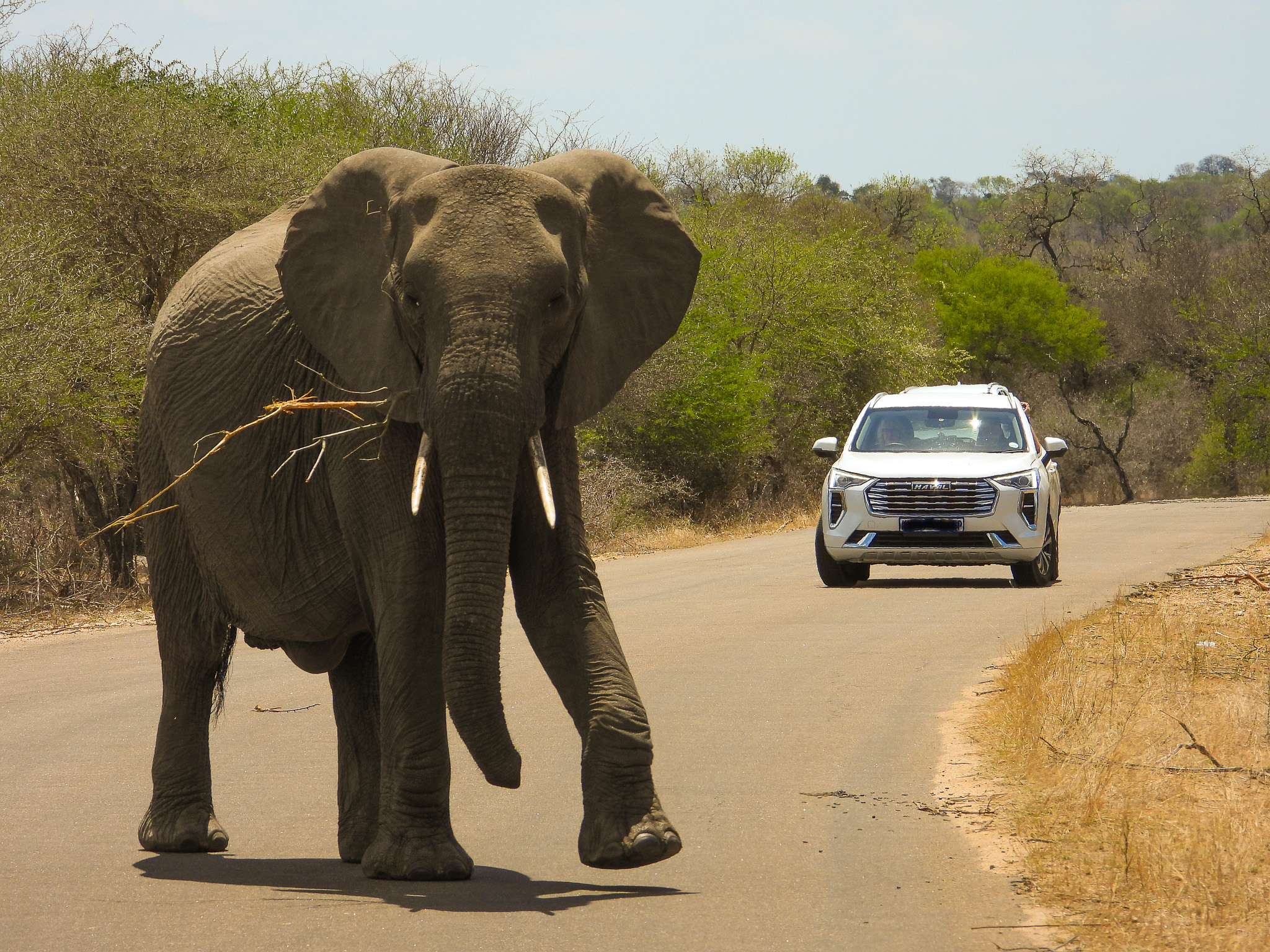
- Elephant: spread ears, a head shake or a mock charge means back off, in reverse, calmly. Never drive between a herd and its calves, and never sit and rev at a bull who wants the road. Two visitors were killed by elephants in the park in 2025.
- Lion: completely relaxed around vehicles because the vehicle is the shape it recognises. Break that shape by opening a door or leaning out and you become something else entirely.
- Hippo: the most dangerous large animal in Africa. Never come between one and the water, and never walk river banks.
- Buffalo: old bulls on their own are unpredictable. Keep your distance and do not crowd them.
Inside the camps
You can walk freely inside rest camps and at picnic sites, but a camp fence is not a wall. Baboons and vervet monkeys raid braai areas and will open an unlocked chalet door in seconds, honey badgers work the bins after dark, and hyena patrol the fence line. Never leave food unattended, keep doors and windows shut when you are out, and use a torch at night. Feeding any animal is a serious offence, and animals that learn to raid are usually the ones that end up destroyed.
Two more things worth knowing. Anthrax occurs naturally in Kruger in cycles, with cases confirmed in the north in September 2025. There is no respiratory risk to visitors, but never approach or touch a carcass, and report any dead animal at the nearest camp. And keep Kruger’s emergency number to hand alongside your booking reference: SANParks publishes it on the park’s contact page, and it is worth writing down before you lose signal.
Activities and Experiences

Everything below is run by SANParks and bookable at a camp activity desk or in advance, unless stated otherwise. Prices move with the tariff year, so treat figures as a guide.
- Guided game drives. Morning drives leave before the gates open and cost roughly R430 per person; sunset and night drives run around R390 and are the only legal way to be out after dark. Both use high open vehicles with a raised seating position that beats your own car, and the guide has a spotlight. Night drives are not a private-reserve exclusive, a common misconception: SANParks runs them from most main camps.
- Guided bush walks. Three to four hours on foot with two armed guides, from most main rest camps, minimum age 12, around R600 to R750. The single best way to understand the bush rather than photograph it.
- Wilderness trails. Seven three-night guided walking trails, among them Bushmans, Wolhuter, Napi, Nyalaland, Olifants and Sweni. Small groups, rustic camps, booked well ahead, and the most immersive thing Kruger offers.
- 4×4 eco-trails. The Lebombo Eco Trail runs 500 km along the Mozambique border from Crocodile Bridge to Pafuri, departing Sundays between April and October, and the Malopeni Eco Trail is a shorter overnight route from Phalaborwa Gate. Genuine 4×4 required.
- Mountain biking. Guided rides from Olifants Rest Camp, morning, afternoon or full day, 16 and over.
- Bush braais and bush breakfasts. A drive out to a bush site, a meal cooked in the open, and game viewing on the way back. Booked at the camp activity desk, subject to availability.
- Sleepover hides. Sable, near Phalaborwa Gate, and Shipandani, near Mopani: unfenced hides where you sleep above a waterhole. Both were affected by the floods, so check status before booking.
- Golf at Skukuza. Nine holes, eighteen tees, no fence, and warthog on the fairway. Worth playing once for the story alone.
Picnic sites, and where you may get out
Kruger’s picnic sites sit out on the road network between the camps, and they are the legal places to leave your car, stretch, brew coffee or cook. Afsaal, Nkuhlu, Tshokwane, Mlondozi, Nhlanguleni, Muzandzeni, N’wanetsi, Timbavati, Masorini, Mooiplaas, Babalala, Pafuri and the Albasini Ruins are the main ones. Most have toilets and gas braai facilities, skottel hire is available at many for a small fee, and Tshokwane and Nkuhlu have shops and food. Some sites were still closed after the floods, Makhadzi among them, so plan a fallback.
Photography Tips for Safari
A 100 to 400 mm or 150 to 600 mm zoom covers almost everything in Kruger from a car window. Add a wide lens for landscape and camp life, and a second body if you have one, because changing lenses at a sighting costs you the sighting. Bring more cards and batteries than you think, since charging in camp is not guaranteed.
- Light. The first and last ninety minutes of the day are worth the early alarm. Midday is for driving between camps, not photographing.
- Stability. A beanbag on the window frame beats a tripod in a car. Switch the engine off before you shoot.
- Settings. Shutter priority at 1/1000 or faster for anything moving; watch your ISO in the first light rather than your aperture.
- Composition. Get the eye sharp, shoot at eye level where you can, and leave room in the frame in the direction the animal is looking. Wide shots that show the habitat age better than tight portraits.
- Ethics. Never ask a guide to break a rule for a shot, never bait or call an animal, and do not crowd a sighting. Turn off location data before posting, and never geotag rhino.
- Drones are prohibited in and over the park, with no exceptions for visitors.
What to Pack
Neutral colours, layers, and less than you think. Winter mornings on an open vehicle are genuinely cold, and by eleven you will be in a shirt.
- Khaki, olive and brown clothing. Avoid bright white and dark blue or black, which attracts tsetse in some areas.
- A warm fleece and a windproof layer for morning drives, May to September especially.
- Long trousers and long sleeves for dusk, both for mosquitoes and for ticks on walks.
- Closed walking shoes, a wide-brimmed hat, sunglasses and high-factor sunscreen.
- Insect repellent containing DEET, and a plug-in or coil for the room.
- Binoculars, one pair per person. The most under-packed item in Kruger.
- A refillable water bottle, a torch, a power bank, a car phone charger and a printed copy of your booking.
- A cooler box and basic supplies if you are self-catering. Camp shops cover the essentials but not much beyond.
- Cash for tips and small purchases, and a card, since five gates are now cashless.
Leave behind camouflage clothing, which is illegal for civilians in some neighbouring countries and unnecessary here, and any thought of a drone.
Health Considerations
None of this is medical advice, and a travel clinic four to six weeks before departure is worth the appointment.
Malaria
Kruger is a malaria area, and the risk is usually described as low, but the detail matters more than the label. The transmission season recognised by South Africa’s health department and by international travel-health authorities runs September to May, not just the height of summer, and the United States CDC recommends prophylaxis for Kruger year-round. If you are travelling in the shoulder months this guide recommends, September and October included, you are inside the season.
For the 2026 season specifically: the January floods produced a sharp spike in cases across the Lowveld. Mpumalanga recorded 314 confirmed malaria cases in January 2026 against 69 in the same month a year earlier, concentrated in the Ehlanzeni district around southern Kruger. Treat the park as a single malaria area rather than assuming the north is riskier than the south, take medical advice on prophylaxis whatever the month, and use repellent, long sleeves and a room plug-in at dusk regardless.
Vaccinations and yellow fever
Routine cover should be current, and hepatitis A, typhoid and tetanus are commonly recommended. Rabies is worth discussing for longer trips, since camp animals are habituated, and any bite, scratch or lick on broken skin needs immediate medical attention.
Yellow fever is the one people get wrong. South Africa requires proof of yellow fever vaccination from every traveller aged one and over who arrives from, or transits through, a country with yellow fever risk. That catches a lot of people routing through Nairobi, Addis Ababa, Lagos, Luanda or São Paulo. You need a valid International Certificate of Vaccination dated at least ten days before arrival, and one dose is now accepted for life. Without it you can be refused entry or quarantined. It is not required if you fly direct from Europe, the United Kingdom, North America or Australia.
Everything else
- Water: tap water in Kruger’s rest camps is treated and safe to drink, so refill a bottle rather than buying plastic. The exception is the sleepover hides, where you bring your own. Outside the park, stick to bottled or filtered water in rural areas.
- Tick bite fever is the illness a Kruger visitor is most likely to actually pick up, particularly on guided walks. Trousers tucked into socks, repellent on ankles, and a check afterwards. A black scab at the bite with fever, headache and swollen glands a few days to two weeks later means see a doctor: it responds quickly to doxycycline.
- Do not swim or wade in rivers or dams. Crocodiles and hippos aside, southern African fresh water carries bilharzia.
- Sun and heat: the Lowveld is hot and dry and the car is a greenhouse. Drink more than you feel like, and take the midday hours slowly.
- Skukuza has a doctor and a pharmacy. Elsewhere, carry your own basic kit and any prescription medication in its original packaging.
Gate Times, Hours and Fuel
Gate times change month by month, and getting them wrong is the easiest way to earn a fine on your first trip. These are the entrance gate times. Camp gates open earlier, up to an hour earlier in high summer, and close at the same time.
| Month | Entrance gates open | All gates close | Camp gates open |
|---|---|---|---|
| January and February | 05:30 | 18:30 | 04:30 (Jan), 05:30 (Feb) |
| March | 05:30 | 18:00 | 05:30 |
| April | 06:00 | 18:00 | 06:00 |
| May, June and July | 06:00 | 17:30 | 06:00 |
| August and September | 06:00 | 18:00 | 06:00 |
| October | 05:30 | 18:00 | 05:30 |
| November and December | 05:30 | 18:30 | 04:30 |
Fuel is available at all twelve main rest camps: Berg-en-Dal, Crocodile Bridge, Letaba, Lower Sabie, Mopani, Olifants, Orpen, Pretoriuskop, Punda Maria, Satara, Shingwedzi and Skukuza. Fill up before a long northern leg rather than after it. In-park fuel sits a little above the inland pump price, which was close to R27 a litre in September 2026. Outside the park, there are stations in Hazyview, Malelane, Komatipoort, Hoedspruit and Phalaborwa.
Shops and services. Every main camp has a shop selling groceries, firewood, ice, drinks and basic supplies. Restaurants vary by camp: Skukuza has the Cattle Baron Grill and Bistro plus the Kruger Station precinct in the restored railway building, Mugg and Bean operates at Lower Sabie and Letaba, and Tindlovu, a proper sit-down restaurant, is at Berg-en-Dal, Satara and Olifants. Pretoriuskop has a Wimpy, and Mopani, Punda Maria and Shingwedzi have self-service outlets. Expect long waits at peak times.
Do not count on connectivity. There is no general guest wifi in the camps, and mobile signal is patchy away from the main southern camps. Skukuza is the only camp with a bank and an ATM, so bring cash for tips and small purchases, and a card for the cashless gates.
Budgeting Your Trip
Kruger is one of the cheapest ways to see the Big Five anywhere in Africa, provided you self-drive and self-cater. The figures below are for three days and two nights, per person for two people sharing, at September 2026 prices and roughly sixteen rand to the US dollar. Conservation fees are shown from 1 November 2026, since anyone reading this and booking ahead will pay the new rates.
South African citizens and residents
- Bungalow, two nights, R2,200 per unit: R2,200 per person
- Conservation fee, R140 per day for three days: R420
- One guided morning drive: R430
- One sunset drive: R390
- Food, self-catering: R700
- Fuel, share of tank: R420
- Extras: R500
Roughly R5,060 per person, about 315 US dollars, excluding car hire and the drive from home.
International visitors
Same trip, but the conservation fee is R692 per person per day rather than R140, which adds about R2,076 for three days, and most visitors add car hire from the airport. Reckon on roughly R9,000 to R11,000 per person, about 560 to 690 dollars, before flights. That is still a fraction of a private lodge, where two nights all-inclusive starts around 500 dollars per person per night in the more affordable reserves.
A note on the daily budgets you see quoted online: 40 to 60 dollars a day works only if you qualify for South African conservation fees. For an international visitor the fee alone is about 43 dollars a day from November 2026, so 110 to 150 dollars a day is the honest floor for the same self-catering trip.
Where the savings actually are
- Buy a Wild Card if your trip runs beyond about six days in the park, or if you are visiting other SANParks reserves on the same journey.
- Self-cater. Every unit has a fridge and most have a braai. Camp restaurants are convenient rather than cheap.
- Travel in the shoulder or wet season, when accommodation rates drop and camps are quieter.
- Fill a unit. Bushveld camp cottages and guest cottages sleep four to six and are excellent value split three or four ways, and poor value for a couple.
- Drive yourself and buy one or two guided activities rather than the other way round.
Common Mistakes to Avoid
- Trying to see the whole park. Kruger is 360 km long. Two or three camps in a week, and let the driving be game viewing rather than transit.
- Sleeping in. The first two hours after the gates open are worth the rest of the day put together. Ask at reception what time your camp gate opens, because it is often earlier than the entrance gate.
- Driving too fast. The limit is 50 on tar and 40 on gravel, and you will see roughly twice as much at 25 to 30.
- Chasing the Big Five. The best mornings in Kruger are usually about something else: a martial eagle on a kill, dwarf mongoose in a termite mound, an elephant herd crossing in front of you.
- Booking too late. Accommodation for the winter school holidays goes almost as soon as it is released, roughly twelve months ahead.
- Forgetting binoculars. One pair per person. The most common regret we hear.
- Underestimating the conservation fee. It is charged per day, including your departure day, and it is easily the most-missed line in a Kruger budget.
- Cutting it fine at the gate. Work backwards from closing time and add half an hour for the sighting you will inevitably stop for.
Visitor Centres and Education
- Letaba Elephant Hall. The best small museum in any South African park, built around the tusks of the Magnificent Seven. Open daily, roughly 08:00 to 16:00, free. Note that Letaba camp itself is still being restored after the floods, with the last units due by 30 November 2026.
- Stevenson-Hamilton Knowledge Resource Centre, Skukuza. The park’s library and museum, covering Kruger’s first warden, the early ranger years and the park’s conservation history. Skukuza also screens wildlife films most evenings, and there is a cinema at Kruger Station.
- Eco Information Centre, Lower Sabie. Small, and a good orientation stop on a hot afternoon.
- Masorini, near Phalaborwa Gate: a reconstructed Late Iron Age village with iron-smelting furnaces, reopened in February 2026.
- Albasini Ruins, near Phabeni Gate: the remains of an 1840s trading post, now a picnic site with a display.
- Thulamela, the thirteenth to seventeenth century stone-walled site in the far north, was still inaccessible in mid-2026 after flood damage to its access routes. Check before planning a visit.
All of it is worth an hour out of the midday heat, when the animals are lying up anyway.
Three Itineraries That Work
Three nights, first visit, southern Kruger. Two nights Lower Sabie, one night Skukuza, entering at Malelane or Crocodile Bridge. The Sabie River road between the two camps is the densest game viewing in the park, and you can do it slowly, twice, without repeating yourself. Add one guided morning drive and one sunset drive.
Five nights, south and centre. Two nights Lower Sabie, two nights Satara, one night Olifants. You pick up the open plains and the best lion and cheetah country, and the Olifants view over the river is the finest in any camp. Roughly two to three hours of driving between camps, which with sightings means half a day each move.
Ten nights, the whole park. Work south to north: two nights Berg-en-Dal or Pretoriuskop, two Lower Sabie, two Satara, one Olifants, two Letaba or Mopani, one Punda Maria, exiting at Phalaborwa or Pafuri. Check flood-recovery status for the northern camps before you commit, and consider flying into one end and out of the other rather than driving back.
Rough driving times to plan around, at park speeds and without stops: Skukuza to Lower Sabie about an hour, Skukuza to Satara around two and a half hours, Satara to Olifants an hour and a half, Olifants to Letaba under an hour, Letaba to Punda Maria three to four hours. Then add half again for the sightings you will stop for, because you will.
The Short Version
Book early, stay inside the park if you can, pick one region rather than three, drive slowly, and be at the gate when it opens. Take the conservation fee seriously in your budget, take malaria seriously whatever month you travel, and check the flood-recovery status of any northern camp before you commit to it. Do that and Kruger will give you more than any guide can promise, usually on a morning when you were looking for something else entirely.
Sources and further reading
- SANParks, Kruger National Park, for camps, gate times, tariffs, activities and current park news
- SANParks reservations
- Africa Geographic on the Greater Kruger
- KrugerPark.co.za travel advisory
- Conservation figures in this guide come from SANParks Scientific Services, the Endangered Wildlife Trust and the South African government’s rhino poaching statistics for 2025, published February 2026.
Prices, fees, gate times and camp status change. Everything here was checked in September 2026, and the park is still in flood recovery, so confirm anything time-critical with SANParks before you travel.
Related reading: Want the insider’s view of life in the bush? Listen to Wildest Kruger Stories, our pick for a Kruger-guide-hosted safari podcast. And if you are still torn between driving Kruger yourself and letting a guide take the wheel in a private reserve, we set out the trade-offs in Self-Drive vs. Guided Safari: Which Is Right for You?
Explore more on 25South
- Kruger National Park reserve profile — our ratings, best season and how it compares to other parks.
- Greater Kruger private reserves — the fence-free lodges bordering the park.
- Game Reserves Near Johannesburg — malaria-free Big Five within a few hours’ drive.
- Wildest Kruger Stories — the podcast from behind the scenes in the Greater Kruger.
Updated: September 2026
Comments
One response to “Kruger National Park: A First-Timer’s Safari Guide”
[…] Kruger National Park: A First-Timer’s Safari Guide: gates, camps and planning. […]