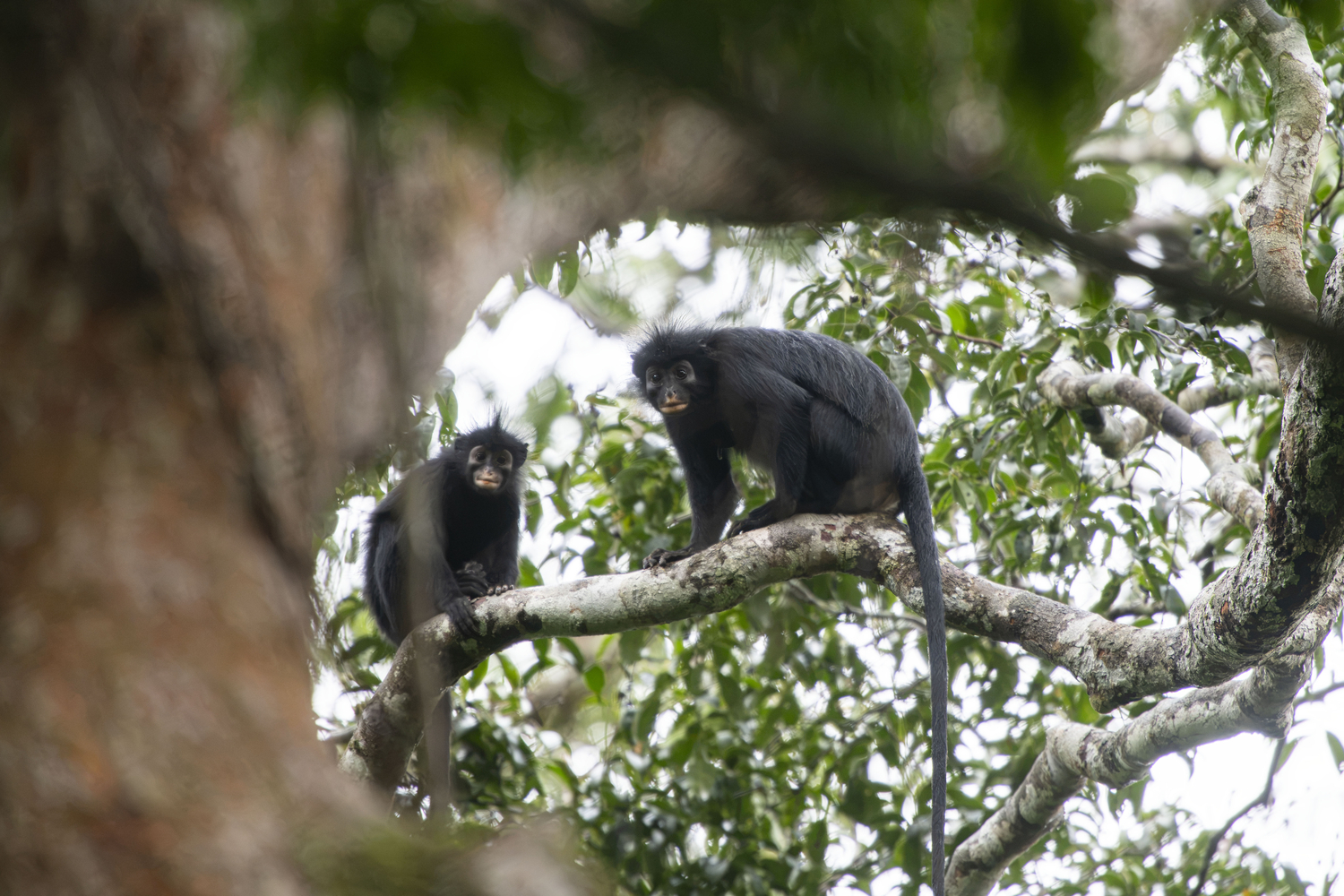
The rainforests of the Democratic Republic of Congo have just given up one of the rarest finds in modern primatology — a black, orange-masked monkey that science is meeting for the very first time.
Every so often, the natural world reminds us how much of it we still haven’t seen. In July 2026, an international team of scientists announced that a previously unknown African monkey had been formally described from the rainforests of the Democratic Republic of Congo. Its new scientific name is Colobus congoensis. To the people who have shared its forest for generations, it is simply the Likweli.
It is only the fifth monkey species to be newly described in Africa in the past 75 years — a statistic that says as much about a century of thorough exploration as it does about the sheer remoteness of the place this animal calls home. Hidden in a rarely visited stretch of the Congo Basin, it slipped past decades of scientific surveys before finally being pinned down.
A decade-long mystery
The story began with a glimpse. In 2008, researchers photographed a strange colobus in the forest, the animal half-hidden behind leaves — enough to intrigue, not enough to prove anything. It would be roughly another decade before the team encountered the monkey again and captured a far clearer image. That second sighting was the spark that launched a full investigation into one of the hardest-to-observe primates in central Africa.
What followed was painstaking detective work. Between 2018 and 2022, the researchers logged 114 sightings across the animal’s range. They compared skulls and pelts against museum collections at the Yale Peabody Museum and the American Museum of Natural History, ran genetic and acoustic analyses, and sat down with the people who knew the forest best.
An animal unlike its neighbours
Colobus congoensis is unmistakable once you know what you are looking at. It wears glossy, light-reflecting black fur with a cape-like mantle over the shoulders, a long, sweeping tail, and a bright orange-cream patch around the mouth and nose that gives it an almost mask-like face. Long black facial hairs and large, folded ears sharpen the effect; distinctive white markings at the rear set it apart still further. At just under seven kilograms, it is noticeably smaller than its colobus relatives.
Its voice is its own, too. The deep, resonant roars echo those of other colobus monkeys but carry a characteristic acoustic structure — a distinct dialect in the canopy.
But the real surprise was written in its genes. The analyses confirmed the Likweli belongs to the genus Colobus, yet its closest known relative, the black colobus (Colobus satanas), lives more than 1,200 kilometres away in the forests of Cameroon and Gabon. The two lineages split an estimated four to five million years ago — one of the oldest known divergences within the entire colobus family tree.
“The discovery of Colobus congoensis changes our understanding of how African monkeys evolved,” said Kate Detwiler of Florida Atlantic University, the study’s senior author.
Named for a nation
For Junior Amboko, a Congolese doctoral researcher at Florida Atlantic University who had the honour of naming the species, the discovery was personal. Colobus congoensis is the first primate ever named after the Democratic Republic of Congo itself — a nod to both the country’s global significance and the pride of the people who live alongside this animal. Locally, alongside “Likweli,” it is also known as “kasaba nkoni,” which translates as “the branch shaker.”
A tiny kingdom under pressure
The Likweli’s entire known world is astonishingly small. It occupies an estimated 1,700 square kilometres of scattered high forest between the Lomami and Congo (Lualaba) rivers in the eastern-central DRC — an unusually restricted range for a colobus, hemmed in naturally by rivers and forest barriers. When researchers spoke with communities across the buffer zone of Lomami National Park, only eight villages knew the animal or could describe it accurately. Everyone agreed: it is shy, and rarely seen.
That fragility is now the central concern. Because of its extremely limited range, small population, mounting hunting pressure and ongoing habitat loss, the research team recommends the species be listed as Endangered on the IUCN Red List. Most of its known habitat lies within Lomami National Park, which makes protecting this single landscape critical to the animal’s survival.
This is familiar ground. The same forests produced the lesula (Cercopithecus lomamiensis) in 2012, another monkey new to science found by several members of this same team. The Lomami landscape — where the Zoological Society of Frankfurt (ZGF) has worked for years alongside the Congolese conservation authority ICCN and local communities — is a stronghold for bonobos, forest elephants and a long list of threatened species.
“We are reminded again and again that the Congo Basin remains one of the last great frontiers of mammal research in the world,” said John A. Hart of the Lukuru Wildlife Research Foundation, the study’s lead author. “Even in regions already explored, entirely new species keep coming to light.”
Why it matters
The discovery of the Likweli is, in Detwiler’s words, “both a scientific triumph and a sobering reminder that some of the rarest creatures on Earth could disappear before the world even knows they exist.” A monkey that split from its nearest cousin before our own ancestors walked upright has survived, unnoticed, in a shrinking patch of Congolese forest — and its future now depends on whether that forest can be kept standing.
For anyone who cares about wild Africa, it is a reminder of what the continent still holds, and of how much is riding on protecting places like Lomami before their secrets are lost.
It’s a fitting companion to another conservation story we’ve covered on the site — Saving the Pangolin, on Africa’s most trafficked mammal.
Colobus congoensis was described by an international team from Florida Atlantic University, the Lukuru Wildlife Research Foundation, Yale University, the City University of New York, Lomami National Park and the Zoological Society of Frankfurt, and published in the journal PLOS One in July 2026. Lead image: the new species, the “Likweli.” Photograph: Daniel Rosengren / Zoological Society of Frankfurt (ZGF).
Explore more on 25South
- The Elusive Eleven — the hardest-to-see animals on an African safari.
- The Black Sheep of the Family — Africa’s rare melanistic wildlife.