
The number first
Two hundred and ten thousand.
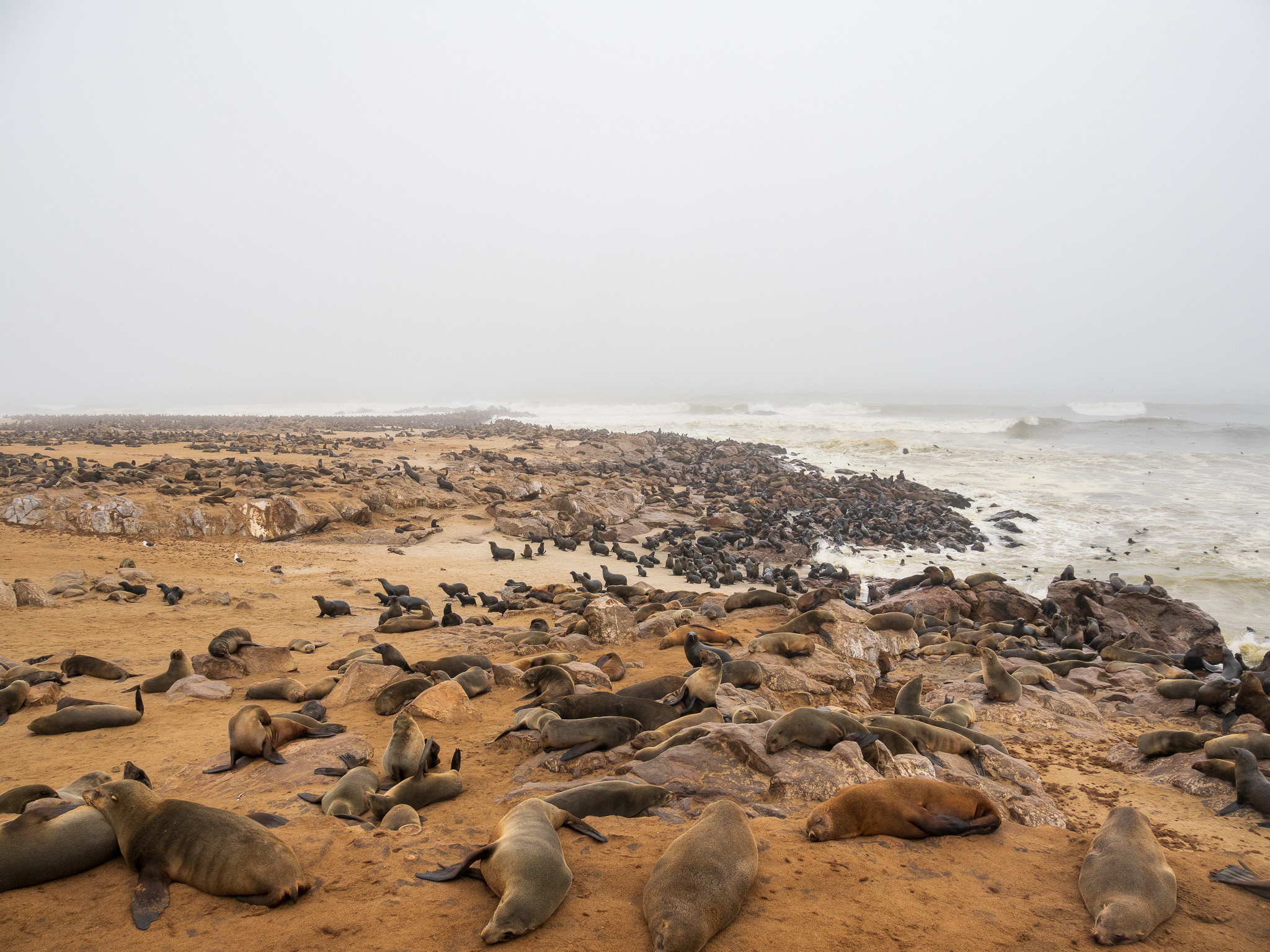
That is the figure Namibia’s environment ministry uses for the number of Cape fur seals present at Cape Cross in November and December, and it is worth sitting with for a moment before you go. Not two hundred. Not two thousand. Two hundred and ten thousand animals, each one the size of a large dog or considerably bigger, packed onto a few hundred metres of rock and open sand on an otherwise empty coast.
The ministry calls it the world’s largest breeding colony of Cape fur seals. Whatever the exact ranking in any given year, nobody disputes the order of magnitude, and the order of magnitude is the point. This is one of the densest concentrations of large mammals anywhere on earth, and unlike almost every other wildlife spectacle in Africa, you can walk up to it on a boardwalk, in your own car, on an afternoon out from Swakopmund.
Cape Cross sits on the Skeleton Coast about 120 kilometres north of Swakopmund. The reserve was proclaimed in 1968 and covers roughly 60 square kilometres, most of it gravel plain and salt pan, with the colony itself occupying a fraction of the shoreline. It falls inside the wider Dorob National Park today.

The reason the seals are here and not somewhere warmer is the Benguela. The current runs north up this coast carrying cold water from the Southern Ocean, and along the Namibian shore it drives one of the four great upwelling systems of the world, pulling nutrient-rich water up from the deep and turning it into one of the most productive stretches of ocean on the planet. Sardine, anchovy, horse mackerel, hake, pelagic goby. The desert behind the beach gets almost no rain and supports almost nothing. The water in front of it supports this.
That contrast is the whole character of the place, and it explains everything else you will see: why there are so many animals, why they are all facing the sea, and why the coast is as cold and grey as it is on a day when Windhoek is baking.
What 210,000 actually looks like
Numbers on a page do not prepare you for the arrangement.
The first thing that registers is not individual seals. It is texture. From the car park the beach appears to have a surface rather than a population, a moving grey-brown mass that resolves into animals only when your eye settles on one. Then you notice that it is not a flat mass at all. At the waterline it runs up over dark rock and fills the gullies between, and a few metres inland the ground turns to open sand, which is where most of the colony actually lies. It continues around the headland out of sight, and when you finally walk out onto the boardwalk and look down, there are seals directly beneath you at a distance of a few metres, entirely unbothered.
The second thing that registers is sound. It does not stop and it does not settle into a rhythm. Cape fur seals produce a continuous overlapping bark, pitched somewhere between a sheep and a dog, thousands of them at once, and underneath it a lower register of growls and grumbles from the bulls. It arrives before you reach the viewpoint and it carries well down the beach after you leave. If you are making video here, record five minutes of nothing but the sound. It is more evocative than any single shot you will take.
Then you start to pick out individuals, and the colony sorts itself into a structure.
The bulls
The Cape fur seal is the largest of all fur seal species, and the bulls are the reason you know that at a glance. A full-grown male runs to about two and a half metres and somewhere between 300 and 360 kilograms. That is heavier than a big male lion, on an animal built like a barrel with a thick maned neck, hauled out in the open on bare sand.
During the breeding season those bulls hold territory. They arrive ahead of the females, take a patch of beach, and then defend it more or less continuously against every other male who wants it. The remarkable part is what that costs them. A territorial bull does not leave to feed. He does not drink. He holds his ground for weeks on end, living off his own reserves, and by the end of the season he can be down to around 187 kilograms, roughly half of what he weighed when he arrived.
So when you are looking at the big animals in November, you are looking at something closer to a siege than a beach. The fights you see, and you will see them, are short, loud, and genuinely violent. Much of the scarring on the necks and shoulders around you was earned this way.
The females and the pups

Females are a different animal entirely, under two metres and under 100 kilograms, and in the breeding months they are the ones moving. They come ashore to give birth, and the pups arrive small: four and a half to a little over six kilograms, sixty to seventy centimetres long, black, and immediately loud.
What happens next is the part that is hard to picture until you are standing there. A female nurses her pup for a few days, then goes back to sea to feed, and she may be gone for days at a time before she returns. When she comes back onto a beach holding tens of thousands of near-identical black pups, she finds her own. By voice. She calls, the pup answers, and the two of them work towards each other through the noise until they meet. Mother and pup recognise each other’s call, and they get it right.
Pups nurse for a long time by mammal standards, up to about a year, with the mother alternating long foraging trips at sea and short spells ashore. They practise swimming in the tidal pools and the shallows long before they are any good at it, which is why the water’s edge at Cape Cross is usually full of small animals doing something that looks like play and is actually training.
Timing: the 34-day window
If you take one practical fact away from this article, make it this one.
Around ninety per cent of all Cape fur seal pups are born inside a single window of about thirty-four days, from late November into early December. Not spread across the summer. Not staggered. Compressed into roughly five weeks.
Multiply that by a colony of this size and the arithmetic becomes difficult to hold in your head. Tens of thousands of births, in one place, in a little over a month, every year.
This is also the single biggest factor in what your visit looks like, and it is the thing most trip planning gets wrong.
November and December is the colony at maximum. Peak numbers, the bulls on territory, the fighting, the newborn pups, the full noise. It is also the busiest the viewing area gets, and the most confronting, because a birth event on this scale produces losses on the same scale.
January to April the colony is still large and the pups are growing, but the territorial structure has broken down and the drama has gone out of it. Good for watching young animals in the water.
May to September is the quieter colony. Numbers on the beach fluctuate a great deal with how many animals are out at sea, and you can arrive to find the beach busy or comparatively thin. The pups from the previous season are well grown. The weather is cold, often foggy, and the light is frequently flat and grey, which is not necessarily bad news for photography here.
There is no wrong time to come. But there is a wrong assumption, which is that the colony is a fixed installation that looks the same all year. It is not. Decide what you actually want to see, then pick the month.
Behaviour: what to watch for once you stop counting
Most visitors take ten minutes of photographs of the mass and then run out of things to do. That is a shame, because the interesting material starts once you pick one animal and stay with it.

They are built for the water, not the beach. On land a fur seal moves in an ungainly gallop, which is what makes the whole colony look comic. In the surf the same animal is transformed. Cape fur seals have been recorded diving beyond 400 metres and they routinely feed far offshore, spending long stretches at sea between visits to land. Watch the animals in the swell just off the rocks rather than the ones lying down, and you see what the body is actually for.
They eat an enormous amount of fish. An adult takes in roughly 270 kilograms of food in a year, mainly Cape horse mackerel, Cape hake, lantern fish and pelagic goby. Run that across a colony of this size and Cape Cross alone is removing tens of thousands of tonnes from the Benguela annually. Stand there long enough and the colony stops looking like a pile of animals and starts looking like what it is, which is the visible end of an enormous fishery.

Thermoregulation explains most of the odd postures. Seals are warm-blooded and run at about 37 degrees, wrapped in fur and blubber, lying in full sun on sand that holds the heat all afternoon. The animals you see holding a single flipper straight up in the air are not waving. They are radiating heat through the thin skin of the flipper. Once you know that, you see it everywhere in the colony.

The edges are where the action is. Do not spend your whole visit looking at the middle. The perimeter of the colony is worked by black-backed jackals, and at dawn and dusk sometimes by brown hyena, the coastal scavenger Namibians call the strandwolf. They are there for the pups and the carcasses, and a jackal trotting along the tideline between sleeping seals is one of the most reliable pictures at Cape Cross. Offshore, the predators are sharks and killer whales.

Not every pup makes it. Roughly thirty per cent of pups die in their first months, from crushing, separation, starvation and predation. On a beach this size that is visible, and it is the part of Cape Cross nobody puts in the brochure. It is worth saying plainly rather than letting it ambush people: if you visit in the breeding season you will see dead pups, and the jackals working them. It is not a sign that something has gone wrong. It is what a colony of this density looks like, and it is why the jackals and the hyenas are there at all.
The cross on the headland
The name has nothing to do with the seals.
In 1486 the Portuguese navigator Diogo Cão came ashore here and planted a padrão, a stone pillar topped with a cross, of the kind Portuguese captains erected to mark their landfalls and claim them for the crown. It was the first European marker on this coast, set down more than five hundred years ago on a headland that looks today much as it must have looked then.
It did not stay. In 1893 a German naval captain, Gottlieb Becker of the SMS Falke, removed the cross and took it to Europe, where it was presented to Kaiser Wilhelm II. It spent the next hundred and twenty-six years in Berlin, latterly at the German Historical Museum. Namibia formally asked for it back in 2017, the museum agreed in May 2019, and the padrão came home the same year. It is in Windhoek now, in the care of the National Museum of Namibia, so the stone Diogo Cão set down on this headland is in the country again for the first time since the nineteenth century.
Replicas stand on the headland today, the first of them put up by German settlers in the 1890s to replace what had been taken. It takes five minutes to walk up, most visitors skip it, and it is the only place at Cape Cross where you get the colony, the coast and the desert in one frame.

The harvest
Cape Cross is a seal reserve and it is also a harvesting site. Namibia permits an annual commercial harvest of Cape fur seals under quota, administered by the fisheries ministry, and Cape Cross is one of the locations where it takes place. It is carried out early in the morning, before the reserve opens to visitors.
It is controversial, it is legal, and it is not something you will witness on a normal visit. We mention it because it is a real feature of this place and readers who research Cape Cross will encounter it, usually in a considerably more heated register than this. Namibia’s position is that the harvest is managed and sustainable. A number of conservation organisations dispute that. We are not going to settle it in a paragraph.
Practical: visiting Cape Cross

Getting there. Cape Cross is roughly 120 kilometres north of Swakopmund, about 60 kilometres past Henties Bay, on the C34 salt road. The salt road is a good surface when dry and a slippery one when the coastal fog has been through, which is often. It is a sealed salt-gravel surface, not tar. Drive it accordingly, allow around 90 minutes from Swakopmund, and do not treat a straight empty road as an invitation. A 4×4 is not required. Fuel at Henties Bay.
Opening hours. The reserve is open daily from 10:00 to 17:00. It does not open at dawn, which is worth knowing if you were planning to be there for first light. Permits are bought at the reserve office on arrival.
Fees. Namibia raised its park entrance fees on 1 April 2026, and Cape Cross sits in the top tier alongside Etosha, Namib-Naukluft, Dorob and the Skeleton Coast. International visitors now pay N$280 per person per day, roughly 14 euro at the current rate, up from N$150. Namibian citizens and SADC nationals pay reduced rates, and children under eight are free. A vehicle fee is charged on top of the per-person fee. Fees are payable at the gate, and cards as well as cash are accepted.
How long to allow. Two hours at the reserve is comfortable: an hour on the boardwalk, twenty minutes at the cross, and the rest spent waiting for something to happen at the edges. As a day trip from Swakopmund, budget a full half day with the drive.
The boardwalk. There is a raised walkway along the colony with information signage, which keeps you off the beach and lets you get close without disturbing the animals. Stay on it. The bird platforms in the southern part of the reserve are closed to the public, and angling in the reserve is prohibited.
What to wear. Colder than you expect, every time. The Benguela keeps this coast grey and windy even in high summer, and fog is normal. Take a windproof layer regardless of the month and what the forecast in Swakopmund says.
Yes, about the smell. It is strong, it is fish and ammonia, and it is downwind of 200,000 animals. It is also, honestly, a smaller problem than its reputation. You notice it hard for the first two minutes and then you largely stop noticing it. It does get into clothing, so do not wear the jacket you plan to sit in at dinner. That is the whole of the practical advice on the subject.
Photography. Overcast is the normal condition and it is a gift here: soft even light on wet fur and no harsh shadows in a colony that is mostly dark bodies on pale sand. Bring a long lens for individual animals and behaviour at the edges, and a wide lens for the thing you actually came for, which is scale. Expose for the bright sand or the pups go to featureless black. Sea spray is constant, so keep a cloth in your pocket and change lenses as little as you can manage.
Staying over. Cape Cross Lodge sits just outside the reserve, and there is camping further down the coast at Mile 72 and Mile 108. Be aware that staying nearby does not buy you dawn at the colony, since the gate does not open until 10:00. What it does buy you is an unhurried morning, the drive in good light, and the coast itself after the day visitors have turned back towards Swakopmund. The lodge has its own website for rates and bookings.
Combining it. Cape Cross works naturally as a day out from Swakopmund, and it pairs well with the drive itself, which is one of the emptiest and strangest stretches of coast in Namibia. Heading north from here takes you into the Skeleton Coast proper.
Worth the drive?
Yes, and not for the reason people expect.
Cape Cross is not a beautiful place. The setting is bare sand, dark rock and cold surf, the animals are not elegant on land, and the experience has none of the polish of a game drive. What it has is scale that you cannot get anywhere else on the continent, and a completely unmediated view of it. There is no vehicle, no guide, no distance. You stand a few metres from two hundred thousand wild animals going about a normal day, and for once nothing at all is arranged for your benefit.

That is rarer than it sounds. Go in the last week of November if you want the colony at full volume. Go in May if you want it quiet. Either way, give it two hours rather than twenty minutes, and spend most of them watching the edges.

Comments
One response to “210,000 Seals: What to Expect at Cape Cross”
[…] 210,000 Seals: What to Expect at Cape Cross: the other big wildlife stop on this coast. […]