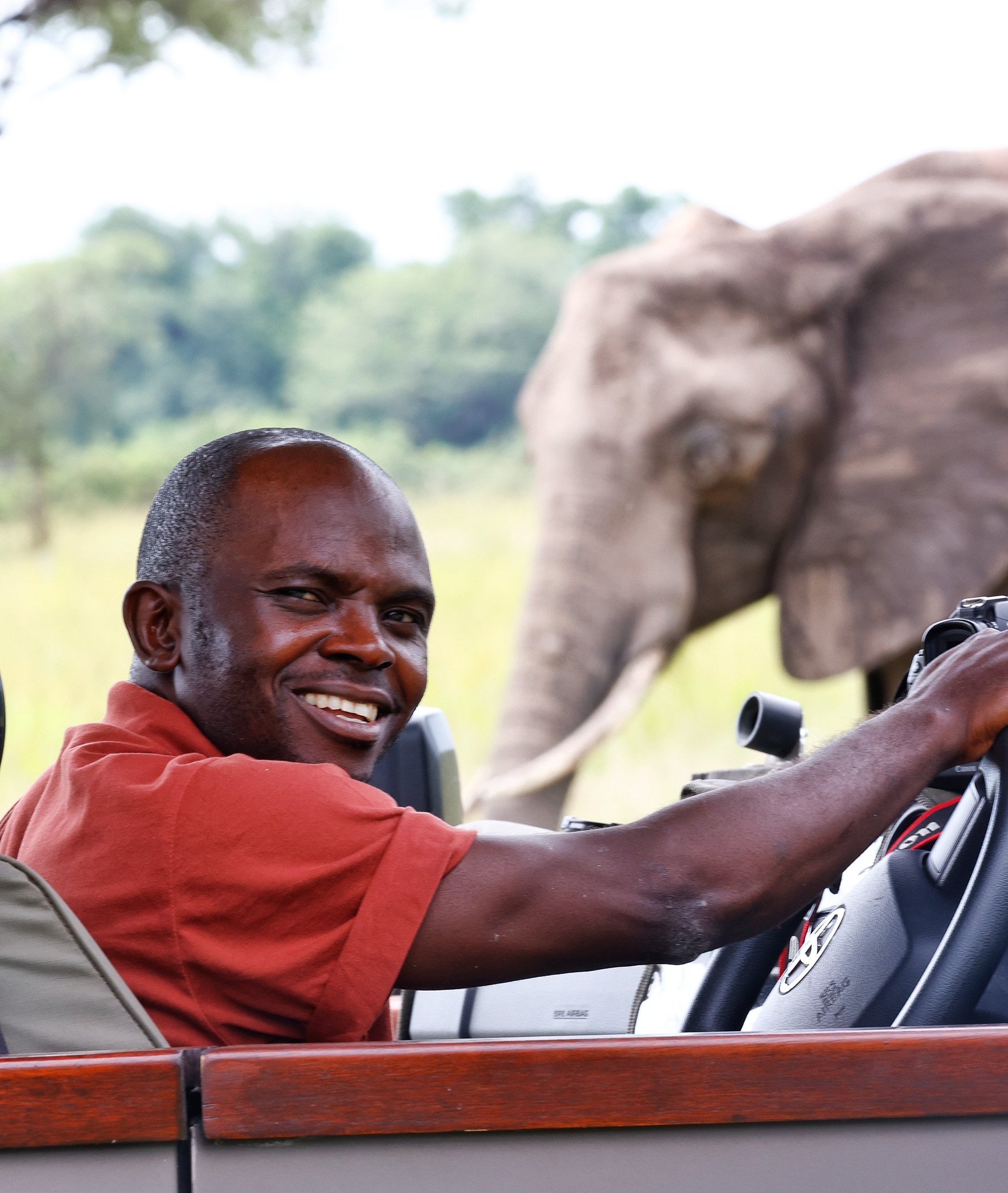
Andrew Mweetwa was born and raised in a village just outside South Luangwa National Park, at Mfuwe, and has spent twenty years guiding in the valley. He is a Pro-Guide at Chichele Presidential Lodge and Puku Ridge, he guides in English, and when we asked for his specialities he answered: everything. He is a student of all the bush has to offer.
25° SOUTH: Tell us about a sighting you’ll never forget, the one you still tell other guides about.
Andrew: Tracking a pride of lions on foot, and then we got caught up in a hunt. On a morning game drive we picked up fresh lion tracks and decided to follow them. After two or three kilometres I spotted some buffaloes on the edge of the bushes ahead, and before we could work out where the lions were, the buffalo started running straight towards us. We rushed to the nearest mopane tree and stood behind it as the herd ran past us, then the lions. The smell of dung, thumping hooves, the dust, lions running past us, then the bellowing. Utterly unforgettable.
When the dust cleared, we saw thirteen lions on a buffalo, thirty or forty metres away. We watched the whole thing, and then had to walk around the lions and the remaining buffaloes to get back to the game viewer. It was just incredible.
25° SOUTH: Have you ever been genuinely scared in the bush?
Andrew: During that one. I was scared, and worried that one of my guests would freak out and run. I also prayed the buffalo they were after didn’t decide to use our tree for cover.
25° SOUTH: The animal guests always want to see, versus the animal you most love showing them. Same or different?
Andrew: Most guests want the leopard. I want to find them wild dogs. They are more of a challenge, socially fascinating and rare.
25° SOUTH: Is there a specific individual animal you’ve come to know over the years, one you’d recognise anywhere?
Andrew: Many. I take a keen interest in knowing the animals. I see them as individuals, as that helps me understand their personal traits and unique behaviours. It can be challenging, but earlier in my career I used their markings or scars to identify them.
25° SOUTH: A moment where an animal did something that surprised even you, after all these years?
Andrew: There are many, as animals are full of surprises, but one that stands out was watching a lioness kill another female’s cubs and eat them while the mother watched on. That was something I had not heard of or seen before, or since.
25° SOUTH: What does the bush smell like at 5am?
Andrew: It depends where you are and what time of year, but the bush cologne can run from wild jasmine to different flowers, to potato bush, and even to moist mud.
25° SOUTH: What do most visitors walk right past without noticing?
Andrew: Animal tracks and droppings. These are key signs in the bush, critical pieces of information, and they go underappreciated.
25° SOUTH: Is there a sound out there that still stops you in your tracks?
Andrew: Any alarm call. Spurfowl, squirrel, antelope. It means a predator is nearby and has been seen. Once I hear those calls, I just have to find it.

25° SOUTH: What made you become a guide? A single moment, or did it creep up on you?
Andrew: I have always had a love for the bush, but it started off in a different way. I was raised as a subsistence hunter, so I walked the bush for many years. I always felt at peace there. The discipline, the tracking, interacting with animals big and small, it always amazed me.
When subsistence hunting was stopped and made illegal, I was devastated. I felt disconnected from the bush. Then the demand for indigenous guides took off, and I saw it as an opportunity to reconnect, which is why I trained as a guide. Now I can share my experiences and knowledge with visitors and support my family and community, while still being connected to the land I love.
25° SOUTH: If you weren’t guiding, what would you be doing?
Andrew: I would probably be a conservationist and an environmental and community educator. Wildlife and the environment are my passion, and so are the challenges my community faces. Poaching, child marriage, HIV and AIDS, sexual discrimination and illiteracy are all close to my heart, and I am passionate about being an active and vocal member of my community.
25° SOUTH: What’s something you know now that you wish you’d known on your very first game drive?
Andrew: The fact that animals don’t read books. You can never generalise animal behaviour. A lot of factors influence it, so they behave differently at different times of the year and from place to place. The bush is the best classroom, the animals are the teachers, and we are the students. If we could all learn from nature, the world would be a much better place.
25° SOUTH: What’s the hardest part of the job that guests never see?
Andrew: The mental preparation I put into every activity. I set objectives for every outing, and I am my own biggest critic. For me it is not about finding the animals my guests want to see, it is about how I find them. I get so much joy from using a skill to get there, responding to squirrel or bird alarm calls, or using leopard, lion or wild dog smells and tracks to locate them. Or just sitting in that unusual kind of silence in the bush. I like to turn every sighting into an experience my guests will never forget.
25° SOUTH: What’s a skill this job has given you that surprises people?
Andrew: Being able to get so close to different animals. I have learnt to tell apart individuals that look the same at first glance, like lions or zebras, and I have learnt different animal smells, which a regular nose can miss.
25° SOUTH: When a sighting goes quiet and nothing’s happening, what’s going through your mind?
Andrew: I am always anxious to see what happens next. There is always something happening in the bush. The question is whether we are patient enough to wait and see.
25° SOUTH: Who taught you the most about the bush, and what’s the one thing they drummed into you?
Andrew: My grandfather. He taught me to always go into the bush with an open mind. Never focus on one thing. If you don’t find an animal to hunt, bring back some fruit, honey, crack open a tree trunk for wood borer larvae, fish, firewood, or tree bark for rope. Just bring something, that way your trips are never wasted.
I never go on an activity looking for one animal. I stop and talk about anything I find interesting. That way I may not find the leopard my guests wanted, but I will have shared the amazing world of woodpeckers and their incredible adaptations.
25° SOUTH: Is there a place in your reserve that’s special to you that guests rarely get to?
Andrew: Yes. There is a baobab forest and a beautiful ebony forest north of Chichele Presidential. I like doing picnic drives up there whenever I get the chance, going for the whole day. It is just too beautiful.
25° SOUTH: What’s a common thing visitors get wrong about the bush before they arrive?
Andrew: They come with a preconceived idea that things happen fast, like in documentaries. That lions have an easy life at the top of the food chain, killing and eating whoever they want, whenever they want. They soon learn nothing comes easy out here.
25° SOUTH: After all these years, is there still something you’re hoping to see for the first time?
Andrew: An aardvark, or a pangolin with a baby. Those adults were once babies, right?
25° SOUTH: What gives you hope?
Andrew: Seeing young people getting interested in our wildlife, and fellow Zambians appreciating it for the economic benefit rather than seeing it as a piece of meat on the dinner plate or a pesky crop raider.
25° SOUTH: And what worries you?
Andrew: The continued justification of trophy hunting, especially of the big cats and elephant. It is unsustainable and destructive to our ecosystems. There are very complex social hierarchies out there, and they are often not fully understood. Removing a trophy animal, usually a large male, has long-lasting impacts on the remaining population and on the environment as a whole.
25° SOUTH: If you could ask visitors to do one thing differently, what would it be?
Andrew: I would ask them to advocate for a ban, or at least a reform, of trophy hunting, and to expect more community initiatives from the lodges they visit.
Quickfire round
Short and instinctive, first thing that comes to mind.
- Sunrise or sunset drive? Sunrise. It signals a new start and endless opportunities.
- Big cat or big bird? Big cat. There is always the possibility of something happening.
- Most overrated animal? Lion. It has one of the most difficult lives.
- Most underrated animal? Hippo. People say they only sleep, eat and poop. Actually they influence the whole ecosystem of the Luangwa valley and across the continent. The river gullies they make become the drainage system, preserving plant species, breeding channels for fish, dining places for birds and crocodiles, grazing grounds for animals, then hunting trails for leopards. Take the hippos out of the system and you mess all of that up.
- Your camp meal after a long day? Chicken stir-fry with noodles.
- One word for the bush? Fascinating.
- Coffee at dawn or sundowner at dusk? Coffee at dawn. All I need to get me going and take care of the cold.
- Camera or binoculars? Both, very important.
- Walking safari or game drive? Both. On a game drive you see the bush up close and personal. On a walk you experience it. It is the only time you use all your senses: smell, touch, hearing, sight and taste.
- Full moon or pitch dark? Pitch dark. Great for big cats, and unfiltered night skies. The stars are incredible.
A big thank you to Andrew for taking part in our Q&A. If you want to safari with him, he guides at Chichele Presidential Lodge and Puku Ridge in South Luangwa National Park, Zambia, both part of the Zambia Luxury Lodge Collection.
