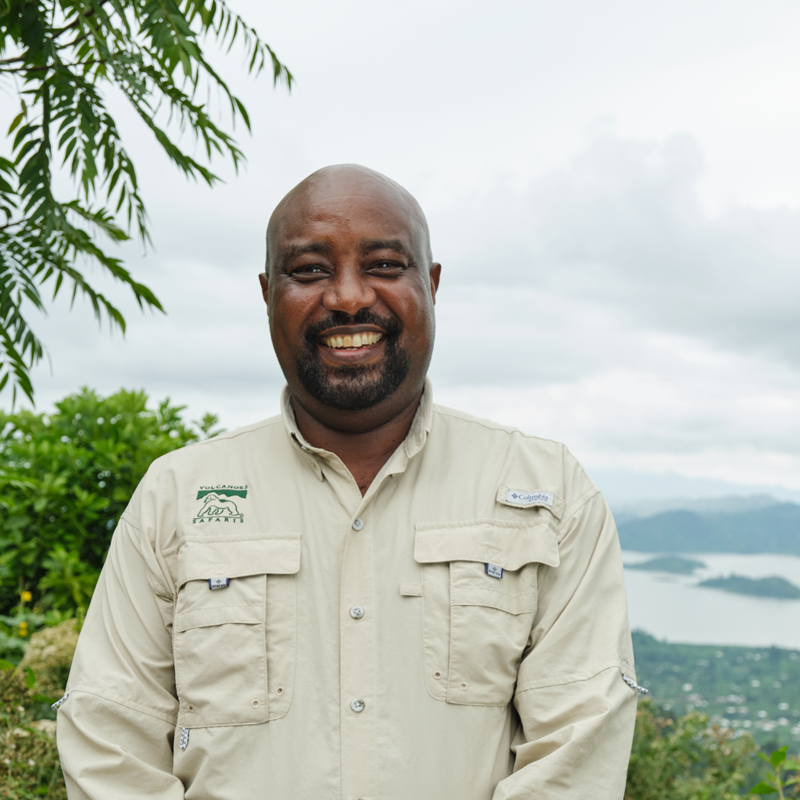
Denis Mugabo has guided for more than two decades across East Africa. He was born in western Uganda as a Rwandan refugee and grew up there, then returned to Rwanda after the genocide. He mostly guides at Virunga Lodge and Mount Gahinga Lodge, both run by Volcanoes Safaris. He guides in English, Kinyarwanda, Swahili, Luganda and most of the languages of Uganda, and his specialities are primate tracking, mountain hiking expeditions, birdwatching and custom overland wildlife safaris.
25° SOUTH: Tell us about a sighting you’ll never forget, the one you still tell other guides about.
Denis: I was guiding a morning trek through the misty bamboo zones of Volcanoes National Park when our habituated mountain gorilla family unexpectedly found themselves in the middle of an intense, vocal interaction between two silverbacks. One dominant male stood upright against a massive Hagenia tree, chest-beating and breaking branches with raw power, while the other held his ground just metres away with the entire family looking on.
The reverberation of the chest beats through the damp volcanic soil, the breathless silence of our guests, and a curious blackback casually walking past within arm’s reach made it a masterclass in raw wilderness power that stays with you forever.
25° SOUTH: Have you ever been genuinely scared in the bush? What happened?
Denis: I was tracking on foot through thick brush in Akagera when a breeding herd of Cape buffalo materialised unexpectedly from the dense mist at extremely close range. One mature cow gave a sudden warning snort, lowered her head and held her ground while the rest of the herd bottlenecked behind her. In those few heart-stopping seconds, you realise that respect for unpredictable wildlife is the only thing keeping you alive, and that smooth, measured stillness is your only viable tool.
25° SOUTH: The animal guests always want to see, versus the animal you most love showing them. Same or different?
Denis: Completely different. Guests arrive with their hearts set on mountain gorillas and big cats like lions and leopards. What I most love showing them is the intricate, interconnected world of smaller species and birdlife: watching the cooperative hunting strategies of a pair of fiscal shrikes, observing the architectural brilliance of weaverbird nests, or tracking the subtle footprints of smaller forest mammals that reveal the hidden pulse of the ecosystem.
25° SOUTH: Is there a specific individual animal you’ve come to know over the years, one you’d recognise anywhere?
Denis: Yes, multiple silverbacks in Mgahinga Gorilla National Park, in a family called Nyakagezi in Uganda. This group is famously known for having several dominant silverbacks and still maintains a peaceful life, which is not common in other gorilla families.
25° SOUTH: A moment where an animal did something that surprised even you, after all these years?
Denis: Watching a mature chimpanzee in Nyungwe National Park in Rwanda methodically build and use a tool: selecting a specific flexible stem, stripping the bark with its teeth, and probing a deep termite nest with surgical precision, while teaching an adolescent the exact same sequence. Seeing that level of knowledge passed between generations, and that level of problem-solving, never loses its capacity to astonish.
25° SOUTH: What does the bush smell like at 5am?
Denis: Fresh, cool mountain air with the smell of wet volcanic soil, wild plants, eucalyptus trees and fresh grass covered in morning dew under a cloudy sky.
25° SOUTH: What do most visitors walk right past without noticing?
Denis: The small wonders living on the forest floor: plants, mushrooms growing on old logs, spider webs covered with morning dew, and tiny chameleons that blend in perfectly with the moss-covered trees.
25° SOUTH: Is there a sound in the bush that still stops you in your tracks, no matter how many times you’ve heard it?
Denis: The sudden, sharp alarm call of a turaco or a startled bushbuck echoing through a silent forest canopy. It is an instant, visceral signal that a predator is moving unseen through the shadows.
25° SOUTH: What made you become a guide? A single moment, or did it creep up on you?
Denis: It was a gradual awakening rooted in a lifelong fascination with the landscapes and wildlife of East Africa. Growing up surrounded by this natural heritage, I realised that my greatest joy came from bridging the gap between the wilderness and visitors, translating the complex language of the bush into stories that change people’s perspectives.
25° SOUTH: If you weren’t guiding, what would you be doing?
Denis: I would likely be deeply involved in wildlife conservation advocacy, ecological research, or developing sustainable community-based tourism initiatives that protect natural habitats while empowering local people.
25° SOUTH: What’s something you know now that you wish you’d known on your very first game drive?
Denis: That silence is often far more powerful than words. When I first started, I felt an anxious need to fill every quiet moment with facts and figures. Now I know that letting guests simply sit in stillness and absorb the atmosphere creates the most profound memories.
25° SOUTH: What’s the hardest part of the job that guests never see?
Denis: The endless hours of logistical preparation, vehicle maintenance and route planning, and the emotional energy required behind the scenes to make a complex multi-day expedition look effortless and seamless for the traveller.
25° SOUTH: What’s a skill this job has given you that surprises people?
Denis: Being very aware of my surroundings and paying close attention to everything around me, showing kindness and patience, and noticing small signs from animals and nature: the sound of tourist vehicles, changes in the weather, distant sounds while driving on rough roads. It also means driving safely on those rough roads.
25° SOUTH: When a sighting goes quiet and nothing’s happening, what’s going through your mind?
Denis: I’m reading the surrounding landscape: scanning the posture of nearby impalas or baboons for signs of tension, listening for distant alarm calls, checking the wind direction, and anticipating where movement is likely to emerge next based on terrain and time of day.
25° SOUTH: Who taught you the most about the bush, and what’s the one thing they drummed into you?
Denis: Veteran local trackers and senior guides, who taught me that the bush talks to you if you slow down enough to listen. The core lesson they hammered home: never assume you know what will happen next, because nature always humbles those who think they have it figured out.
25° SOUTH: What’s the funniest thing you’ve seen out on a drive, animal or guest?
Denis: A confident traveller carefully setting up an elaborate, high-end camera rig on a tripod, only to be completely distracted by a clumsy young vervet monkey that climbed onto the bonnet and calmly inspected its own reflection in the wing mirror.
25° SOUTH: Is there a place in your reserve that’s special to you that guests rarely get to?
Denis: The upper slopes of Mount Karisimbi in Volcanoes National Park. Few guests reach this area because of the challenging hike, but it offers breathtaking views, rare plants, untouched forest and a true sense of wilderness.
25° SOUTH: What’s a common thing visitors get wrong about the bush before they arrive?
Denis: They often expect a safari to be like a well-choreographed wildlife documentary where animals line up on cue. They are frequently surprised to learn that patience, quiet spells and searching are fundamental parts of the authentic experience.
25° SOUTH: After all these years, is there still something you’re hoping to see for the first time?
Denis: An elusive forest buffalo in Volcanoes National Park. They are very shy and rarely seen by visitors.
25° SOUTH: What do you do on your days off?
Denis: Exploring new regional trails, catching up on wildlife conservation literature, maintaining 4×4 expedition vehicles, and spending quality time with my four kids.
25° SOUTH: What gives you hope?
Denis: Seeing younger generations across East Africa taking ownership of conservation initiatives, community-run wildlife sanctuaries and sustainable tourism enterprises that prove local communities can thrive alongside protected ecosystems.
25° SOUTH: And what worries you?
Denis: Rapid habitat fragmentation, human-wildlife conflict along park boundaries, and the mounting pressure of climate change on delicate montane and savannah ecosystems.
25° SOUTH: If you could ask visitors to do one thing differently, what would it be?
Denis: To put down their cameras for at least ten minutes during every major sighting and simply experience the moment with their own eyes and ears.
Quickfire round
Short and instinctive, first thing that comes to mind.
- Sunrise or sunset drive? Sunrise drive.
- Big cat or big bird? Big cat.
- Most overrated animal? None. Every species plays a vital ecological role.
- Most underrated animal? Safari ants.
- Your camp meal after a long day? Ugali with fresh local greens and tender grilled meat.
- One word for the bush? Uncompromising.
- Coffee at dawn or sundowner at dusk? Coffee at dawn.
- Camera or binoculars? Binoculars.
- Walking safari or game drive? Walking safari.
- Full moon or pitch dark? Pitch dark.
A big thank you to Denis for taking part in our Q&A. If you want to safari with him, he guides mostly at Virunga Lodge in Rwanda and Mount Gahinga Lodge in Uganda, both part of Volcanoes Safaris.
