The coastal dunes outside Swakopmund — empty at first glance, but teeming with hidden life.
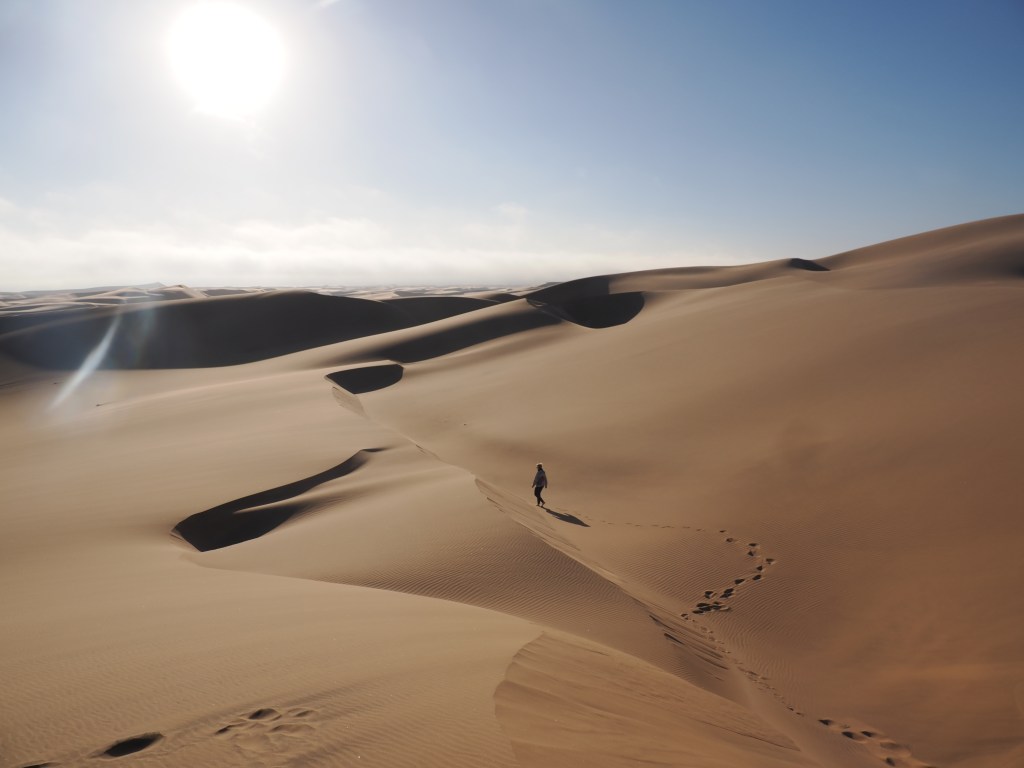
Stand on the edge of the dune belt just outside Swakopmund and the first impression is one of emptiness. Wave after wave of pale, wind-combed sand rolls toward the Atlantic, apparently lifeless under a soft coastal haze. We knew, of course, that the Namib isn’t truly barren — but nothing prepared us for how much life is hidden beneath that sand, or for the sheer variety of creatures our guide would coax into the open over the next few hours. By the end of the afternoon, those “empty” dunes had become one of the richest wildlife experiences of our entire time in Namibia.
This is the magic of the Living Desert Tour. While Namibia is famous for the “Big Five,” the Namib coast has its own celebrated cast: the Little Five, the small, superbly adapted animals of the dunes. Tracking them is the whole point of the tour. Here’s our first-hand account, woven together with everything you’ll want to know before you go — costs, timings, the wildlife, and how to make the most of your morning (or, in our case, afternoon) in the sand.
Reading the desert like a book
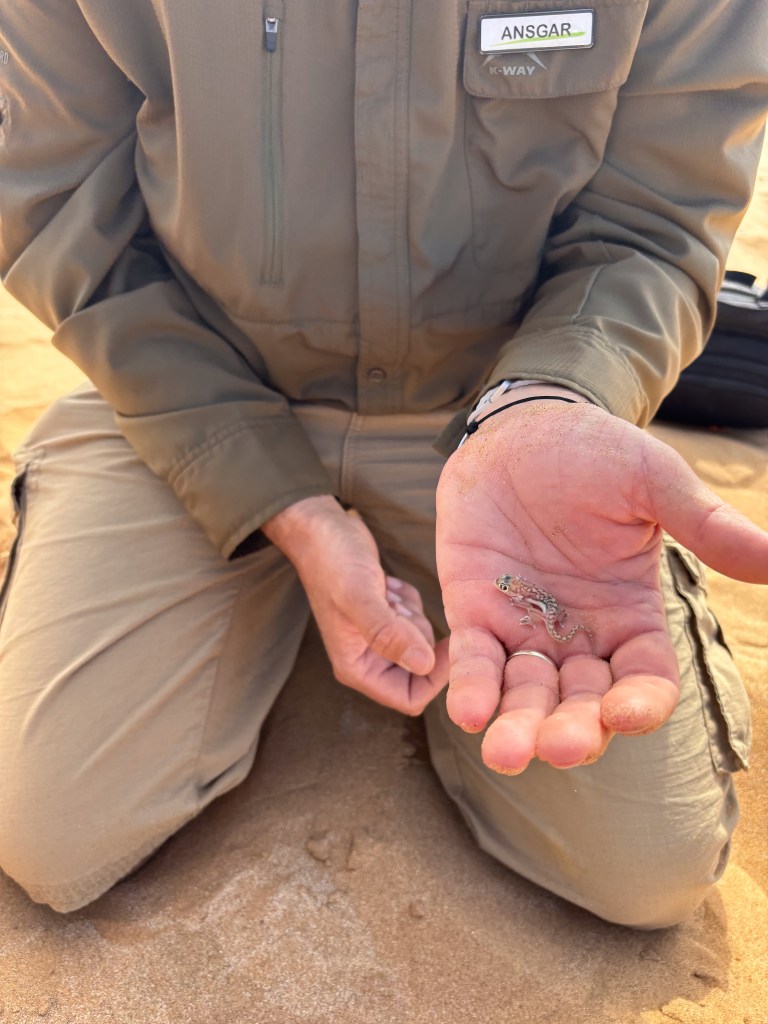
We joined the afternoon departure, and one of the first things that struck us was our guide, Ansgar. Rather than wandering the dunes at random, he seemed to read the desert like a book. He would stop the Land Cruiser, walk off alone, study a set of tiny tracks or a particular plant, sometimes dig carefully into the sand — and then call us over to reveal another perfectly camouflaged animal. Watching his tracking skills was almost as impressive as seeing the wildlife itself.
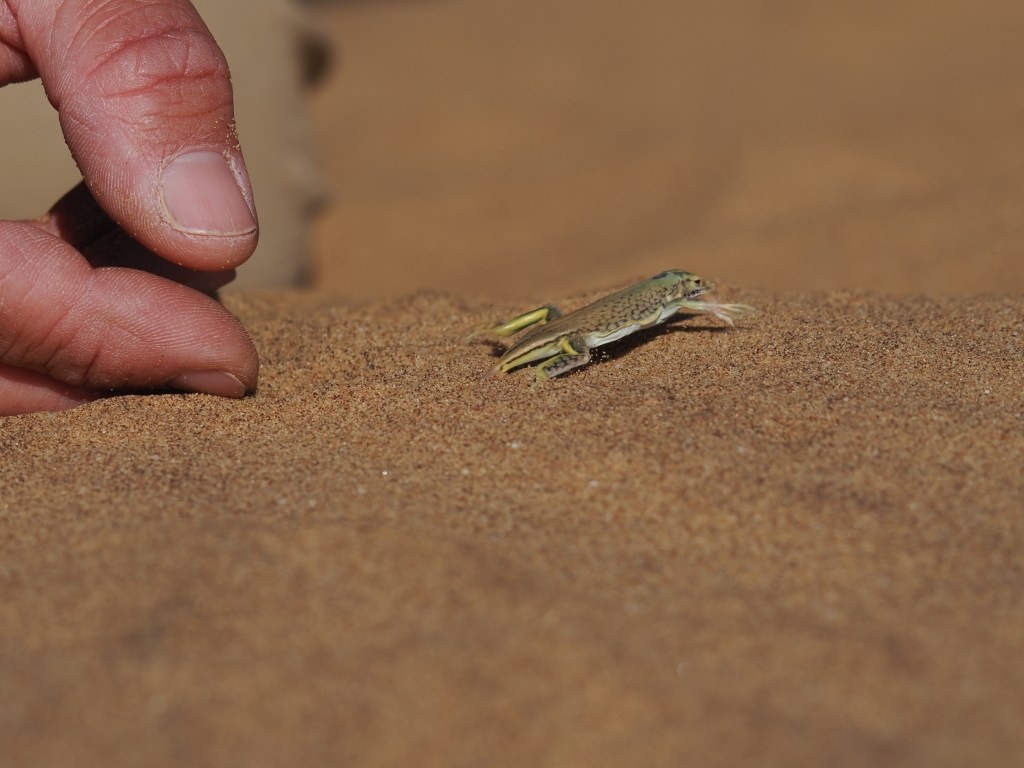
Reading the desert like a book — our guide Ansgar reveals a shovel-snouted lizard from the sand.
Ansgar was entertaining, approachable and exceptionally knowledgeable, and his enthusiasm for the Namib was obvious throughout. He explained the complex desert ecosystem in a way that was easy to follow without ever becoming overly technical — how the Atlantic fog that rolls in off the cold ocean almost every morning sustains the whole dune system, how different animals draw moisture from it, and how the entire food chain fits together, from the smallest beetle up to the jackals and birds. The tour felt genuinely educational, but it was also a lot of fun.
That fog, we learned, is the real secret of the place. It is the lifeblood of the dunes: beetles harvest it, plants drink it, and life that should by rights be impossible here clings on, finely tuned to a sliver of daily moisture.
What the Living Desert Tour is
The Living Desert Tour is a half-day, small-group 4×4 excursion into the coastal dunes between Swakopmund and Walvis Bay, inside the protected Dorob National Park. Rather than chasing big game across open plains, the experience is intimate and ground-level: you spend the time learning to spot the tracks, holes and tell-tale ripples in the sand, and then meet the animals that made them — geckos, lizards, snakes, spiders, beetles and the remarkable Namaqua chameleon.
The “Little Five” dune tour was pioneered in the 1990s by Tommy Collard, a former nature-conservation officer who developed the original guided dune drive that so many operators now follow. We went with Tommy’s Tours and Safaris (trading online as Living Desert Tours), the company he founded in 1997. Tommy’s background — military survival and tracking training, an agriculture diploma, and years with the Department of Nature Conservation — shaped a style of guiding that is equal parts naturalist, conservationist and storyteller, and it clearly lives on in guides like Ansgar. Tours run in English, German, or a seamless mix of both.
Good to know: Tommy’s isn’t the only operator. Living Desert Adventures, led by conservationist Chris Nel, is the other long-established favourite, and smaller eco-dune and quad-bike variations exist too. All share the same conservation-first ethic, so you’re in good hands whichever you choose.
Cost, timings and practical details
Prices vary a little between operators and change over time, so always confirm when you book. As a current guide:
Adult price: around N$900–N$1,000 per person (roughly US$50–US$55).
Children: around N$450–N$550 (typically children 12 and under).
Duration:4 to 5 hours.
Departures: morning pick-up around 08:00; afternoon tours (around 14:00) run on request, weather and minimum numbers permitting. We did the afternoon and loved the light (more on that below).
Included: professional guide, 4×4 vehicle, Dorob park access, plus water, soft drinks and light snacks.
Pick-up and drop-off: included for accommodation in Swakopmund; a meeting point can usually be arranged if you’re staying further out.
A few booking notes worth knowing. Most operators have no card facilities in the field — you either pay cash (Namibian dollars, with euros or US dollars often accepted) or settle via a pre-payment link sent by email. Tours generally run daily except 1 January and 25 December, usually with a minimum of two adults for a departure, and cancellations within 24 hours typically incur the full charge. Group sizes are kept small — often two eight-seater vehicles — so it pays to book a day or two ahead, especially in the busy season (roughly June to October).
If you want to combine experiences, several operators offer a full-day Living Desert + Sandwich Harbour combo (around N$3,700 per person, lunch included), pairing the dune wildlife with the dramatic place where the Namib dunes plunge straight into the Atlantic.
Wildlife highlights: our personal Little Five
Sightings are never guaranteed — this is wild nature, not a zoo — but Ansgar knew exactly where and how to look, and we came away having met most of the dunes’ headline residents. As wildlife photographers, we especially appreciated that there was never any sense of being rushed: we had plenty of time to observe each animal, ask questions and take photographs. Three encounters stood out above the rest.
The translucent, web-footed Namib gecko — one of the most extraordinary reptiles we’ve ever seen.
The Namib web-footed gecko (Pachydactylus rangei) was our number one. This small, nocturnal gecko has translucent, salmon-pink skin so delicate you can sometimes see the organs beneath it, and oversized webbed feet that work like snowshoes on loose sand and help it dig. It’s endemic to the Namib — found nowhere else on Earth — and gets much of its water by licking fog from its own eyes. Seeing one up close was reason enough to take the tour.
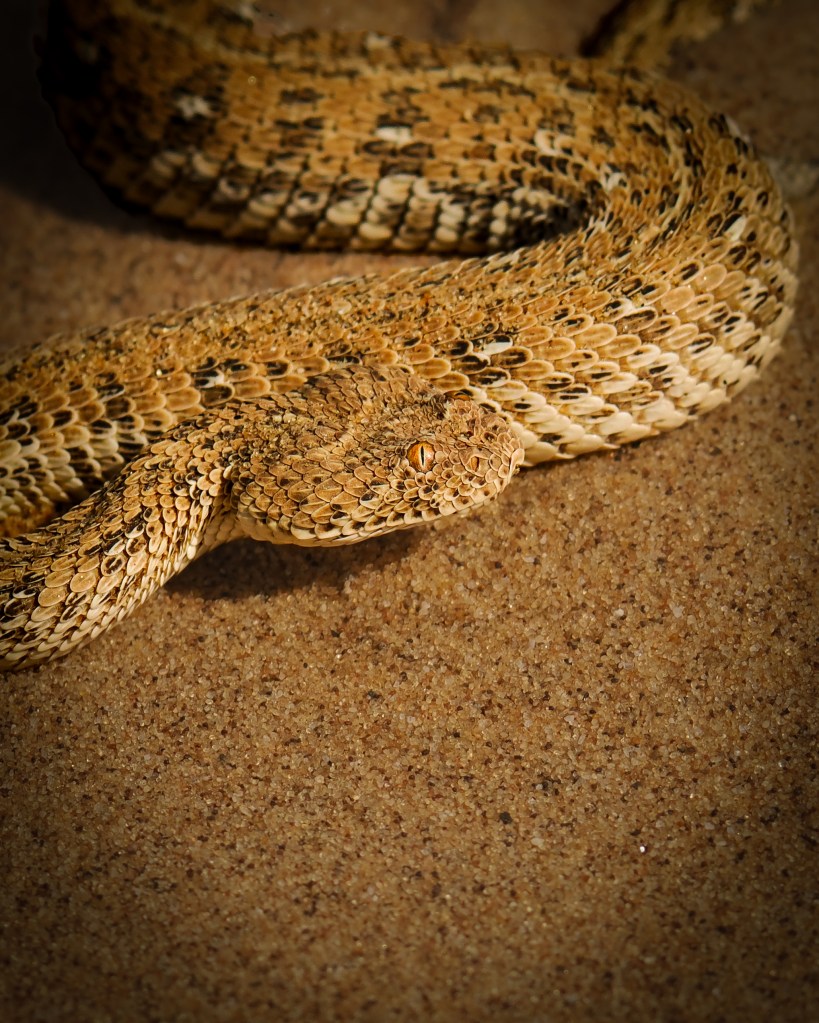
Péringuey’s adder, buried with only its eyes showing — a masterclass in desert camouflage.
Péringuey’s adder (Bitis peringueyi) was our second highlight, perfectly camouflaged beneath the sand and a fascinating example of desert adaptation. The Namib sidewinder is one of the smallest adders in the world. It “swims” sideways across loose sand and buries itself with only its upward-facing eyes exposed, twitching its dark tail-tip as a lure to draw curious prey within striking distance.
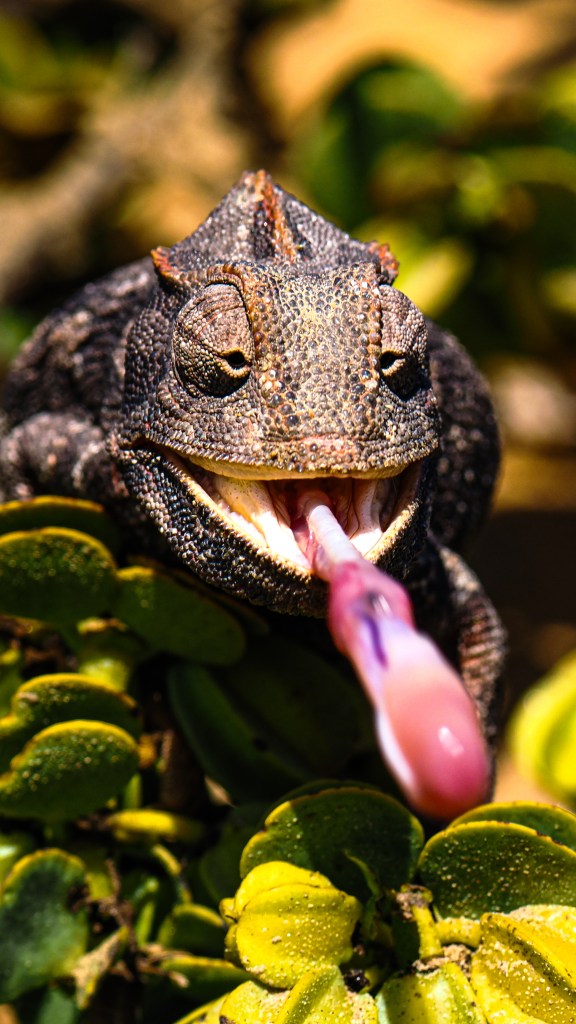
The Namaqua chameleon — our favourite photographic moment came as it shot out its tongue to catch an insect.
The Namaqua chameleon (Chamaeleo namaquensis) gave us our favourite photographic moment of the day, when we watched it extend its tongue to snatch an insect. It’s one of Africa’s largest and fastest chameleons and a true desert specialist, changing colour not only to communicate but to regulate temperature — turning dark to soak up the morning sun and pale to reflect the midday heat.
The rest of the cast
The dunes hold two more members of the classic Little Five. The shovel-snouted lizard (Meroles anchietae) is the famous “dancing” lizard, lifting its feet in an alternating rhythm to keep them off the scorching sand and diving snout-first beneath the surface to escape heat and predators. The dancing white lady spider (Leucorchestris arenicola) has one of nature’s most extraordinary escape tricks: when threatened it tucks in its legs and cartwheels down the dune face, rolling many times a second to outrun a predator.
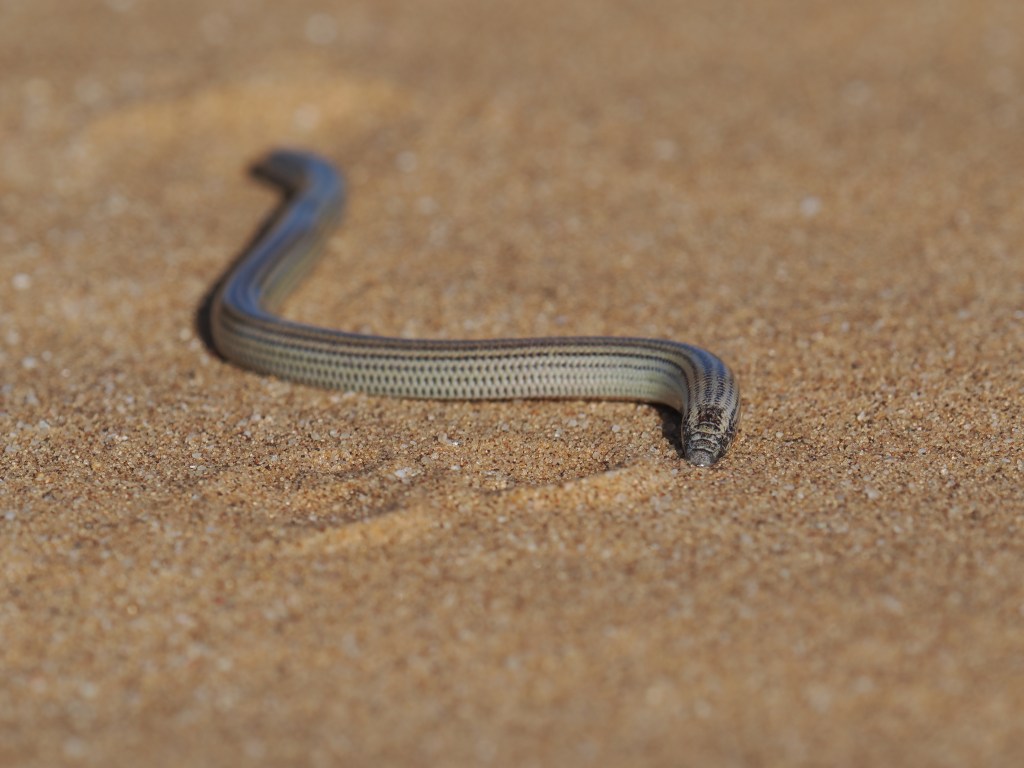
The shovel-snouted lizard “dances”, lifting its feet to keep them off the scorching sand.A short blind dart skink — one of the Namib’s sand-diving specialists.
Ansgar also pointed out the tok-tokkies — the black tenebrionid beetles that scuttle across the sand and sit at the very base of the dune food chain. Some species perform an astonishing “fog-basking” routine, climbing a dune at dawn, standing on their heads and letting ocean fog condense on their ridged backs before channelling the droplets down to their mouths. Along the way we also learned about sand-diving skinks, the clever desert plants, and how every thread of this ecosystem connects to the next.
Photography on the tour
For us, this was a photographer’s dream. Ansgar let us get remarkably close to many of the animals while always treating them with respect, and we were often able to lie flat on the sand and shoot from eye level, creating intimate, ground-level perspectives you simply can’t get otherwise. Most animals stayed still long enough to photograph properly — only one small lizard vanished almost the instant it appeared.
Doing the afternoon tour turned out to be a happy accident: the warm, low light was excellent for photography, giving the sand a golden glow and the animals soft, flattering illumination. If you’re serious about your images, we’d genuinely recommend the afternoon slot.
Animal welfare came first
Throughout the experience we had the clear impression that conservation came first. Ansgar obviously cared about the animals, handling each species confidently and appropriately only when it was necessary to move one briefly for a closer look, and always returning it to where it was found. At no point did we feel the wildlife was being treated carelessly or paraded simply for entertainment — which, for us, made the whole tour easier to enjoy and easy to recommend.
The scenic finale
While the Little Five are the headline act, one of our favourite memories came in the second half of the tour. Driving the classic Land Cruiser across the dunes was an experience in itself — and then we stopped on top of one of the high dunes and looked out across the endless golden sand toward the Atlantic Ocean. It was simply breathtaking. That contrast between desert and sea created one of the most beautiful landscapes we saw anywhere in Namibia, and a perfect way to end the afternoon.
Tips for the best experience
A little preparation goes a long way:
Eat a good meal beforehand (or bring a snack); you’ll be out for several hours.
Dress in layers. The coast can be chilly and foggy and then hot within the same outing. Add a hat and sunglasses.
Bring sunscreen and a charged camera or phone with a spare battery — you’ll want close-ups of the gecko and chameleon.
Footwear can be casual. You won’t walk far; some people even go barefoot, though the sand gets hot.
Consider the afternoon tour for warmer light if photography matters to you.
Carry cash in case card payment isn’t available, and book a day or two ahead in peak season.
Final thoughts
After the grand scale of Namibia’s elephants, lions and endless gravel plains, the Living Desert Tour gave us something refreshingly different: a chance to slow down, look closely, and marvel at survival on the smallest scale. It completely rewired how we see the desert. Those miles of “empty” sand we’d driven past elsewhere suddenly read as a living, breathing community of specialists — each one perfectly tuned to a place that should be uninhabitable.
For nature lovers, photographers, families, and anyone curious about how life clings on at the very edge of possibility, Tommy’s Living Desert Tour from Swakopmund was among the most memorable few hours of our trip — and the ideal gentle counterpoint to the big-game drama elsewhere in Namibia.
📍 Tommy’s Living Desert Tours — Contact & Booking
Tour: Living Desert “Little Five” Tour (Swakopmund) · 4–5 hours · morning & afternoon departures
Tours run daily except 25 December and 1 January. Pick-up and drop-off from Swakopmund accommodation included. Booking ahead is recommended, especially in peak season.
Disclosure: We paid for this tour in full ourselves. This is not a sponsored post and we received no payment, discount or free service in exchange for it — all opinions are our own.
Regions, driving techniques, and the 10 major rental companies compared (2026).
NamibiaGuide
Why Namibia Is the World’s Great Self-Drive Country
Photo: Olga Ernst & Hp.Baumeler / CC BY-SA 4.0, via Wikimedia Commons
Namibia is built for the self-drive traveller. It is vast, sparsely populated, politically stable and spectacularly scenic, with a road network that is good enough to be safe but wild enough to feel like a real adventure. You can leave the capital in the morning and be alone among red dunes, gravel plains or desert-adapted elephants by the afternoon. A well-prepared 4×4 is your hotel, your kitchen and your freedom all in one.
But Namibia also punishes the unprepared. Distances are enormous, fuel and mobile signal disappear for hundreds of kilometres, gravel roads roll vehicles every season, and deep sand swallows drivers who do not understand it. The single most important thing to know before you book is this: the country is not dangerous, but it is unforgiving of carelessness. Drive slowly, plan your fuel and water, respect the gravel, and Namibia is one of the most rewarding road trips on earth.
This guide covers everything a first-time self-driver needs: how the different regions drive, the distances and infrastructure you will deal with, the techniques for gravel, sand and off-road driving, a clear set of dos and don’ts, and a detailed comparison of the ten major 4×4 rental companies — their fleets, camping options, indicative 2026 pricing, and how they rate online.
Part 1: Understanding Namibia’s Regions
Namibia is roughly the size of France and Spain combined, but with only about 2.6 million people. What “driving” means changes completely depending on where you are. Below is a region-by-region breakdown of what to expect behind the wheel.
Central Namibia & Windhoek
Almost every trip begins here. Windhoek sits on the central plateau at around 1,700 m, and the main arteries radiating from it — the B1 (north-south) and B2/B6 (towards the coast and east) — are tarred, well-maintained and easy. This is the gentlest driving in the country. Use the first day or two on tar to get comfortable with the vehicle before you hit gravel. Note that leaving Windhoek you will pass suburbs and one or two police checkpoints, so allow extra time.
Sossusvlei & the Namib-Naukluft (the Southwest Desert)
Photo: Giles Laurent / CC BY-SA 4.0, via Wikimedia Commons
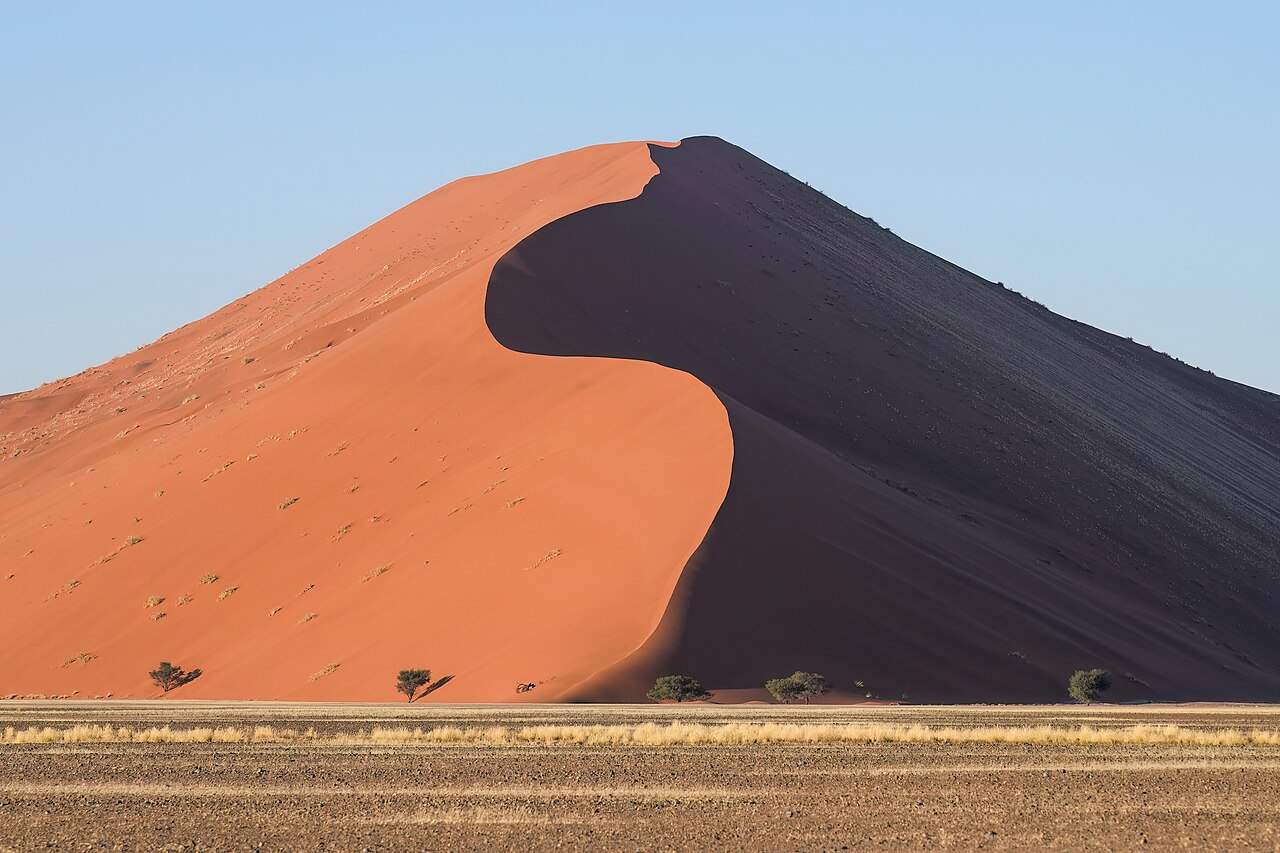
The headline destination: towering red dunes, the Sesriem Canyon and the dead-tree pan of Deadvlei. The drive in from Windhoek is mostly good gravel (the C19/C14 corridor). The final stretch inside the park from Sesriem to Sossusvlei is 60 km of tar, but the last 5 km to the 2×4 car park is genuine deep sand that requires a real 4×4 in low range and deflated tyres — this is where many tourists get stuck. Get there early; the sand is firmer in the cool morning.
The Skeleton Coast & Central Coast (Swakopmund, Walvis Bay)
Photo: Domenico Convertini from Zurich, Schweiz / CC BY-SA 2.0, via Wikimedia Commons
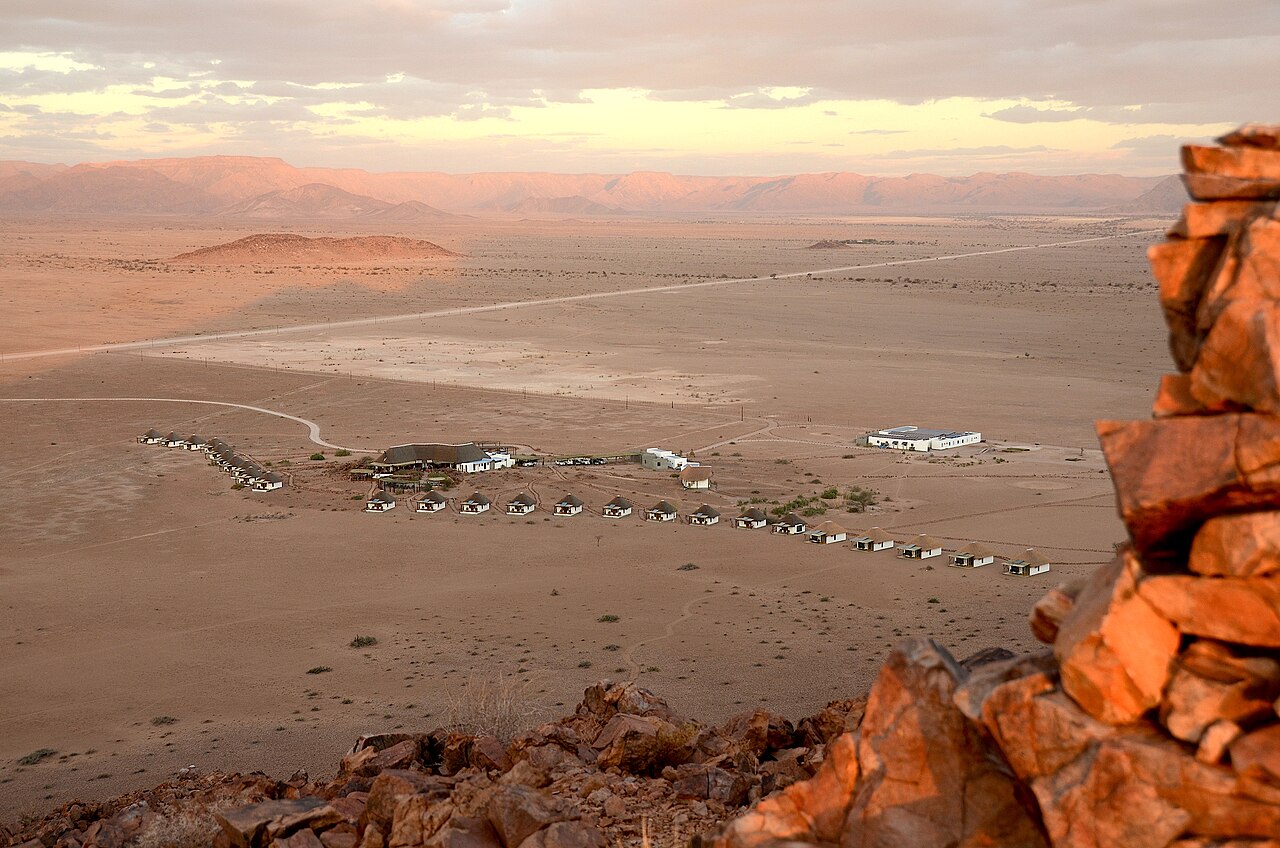
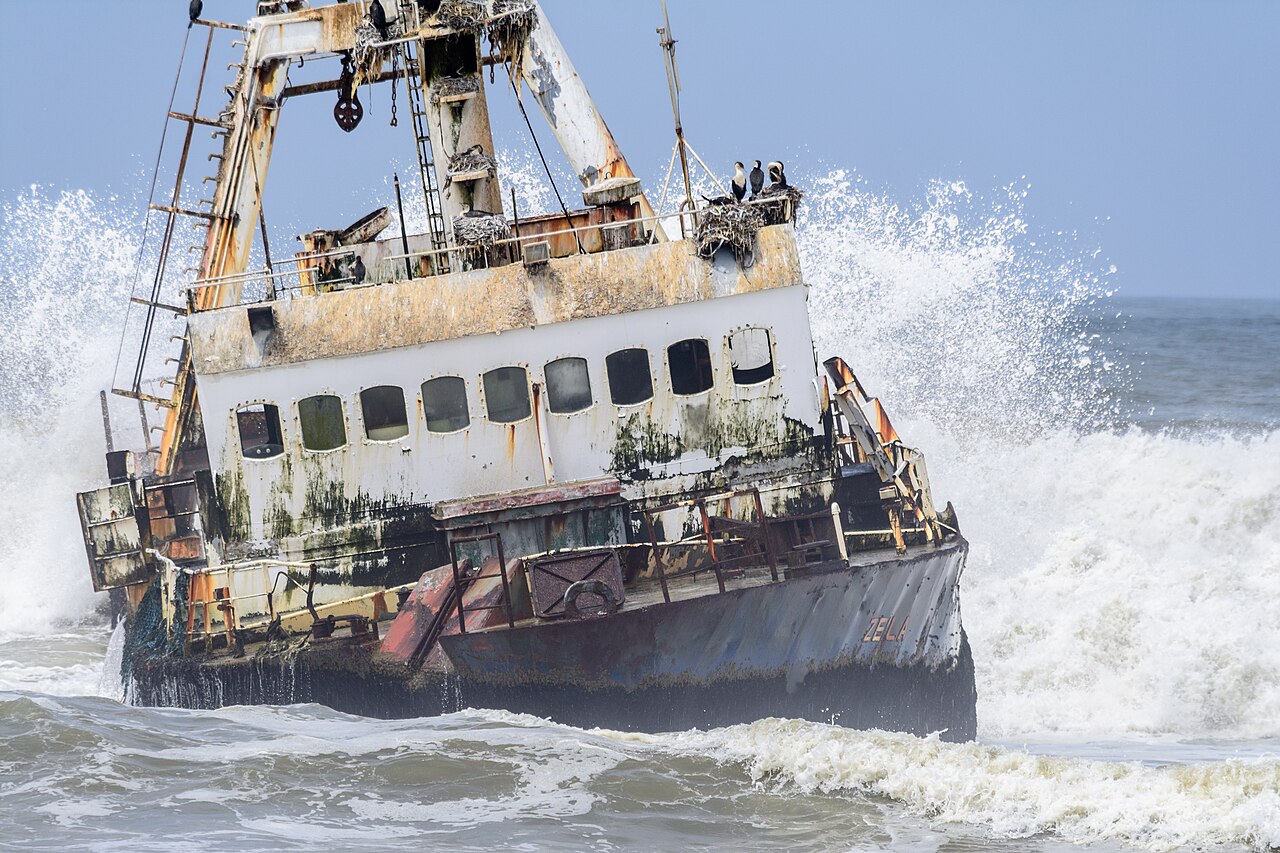
Swakopmund and Walvis Bay are relaxed coastal towns with full infrastructure, tar access and fuel. North of here the Skeleton Coast is a 500 km long, roughly 40 km wide belt of fog-bound desert, salt roads and shipwrecks — hauntingly beautiful and utterly empty. Salt roads are smooth when dry but become greasy in coastal fog, so ease off the throttle. Beyond the Ugab gate, much of the northern Skeleton Coast requires permits or fly-in access.
Damaraland (the Northwest)
Photo: Daniel Kraft / CC BY-SA 3.0, via Wikimedia Commons
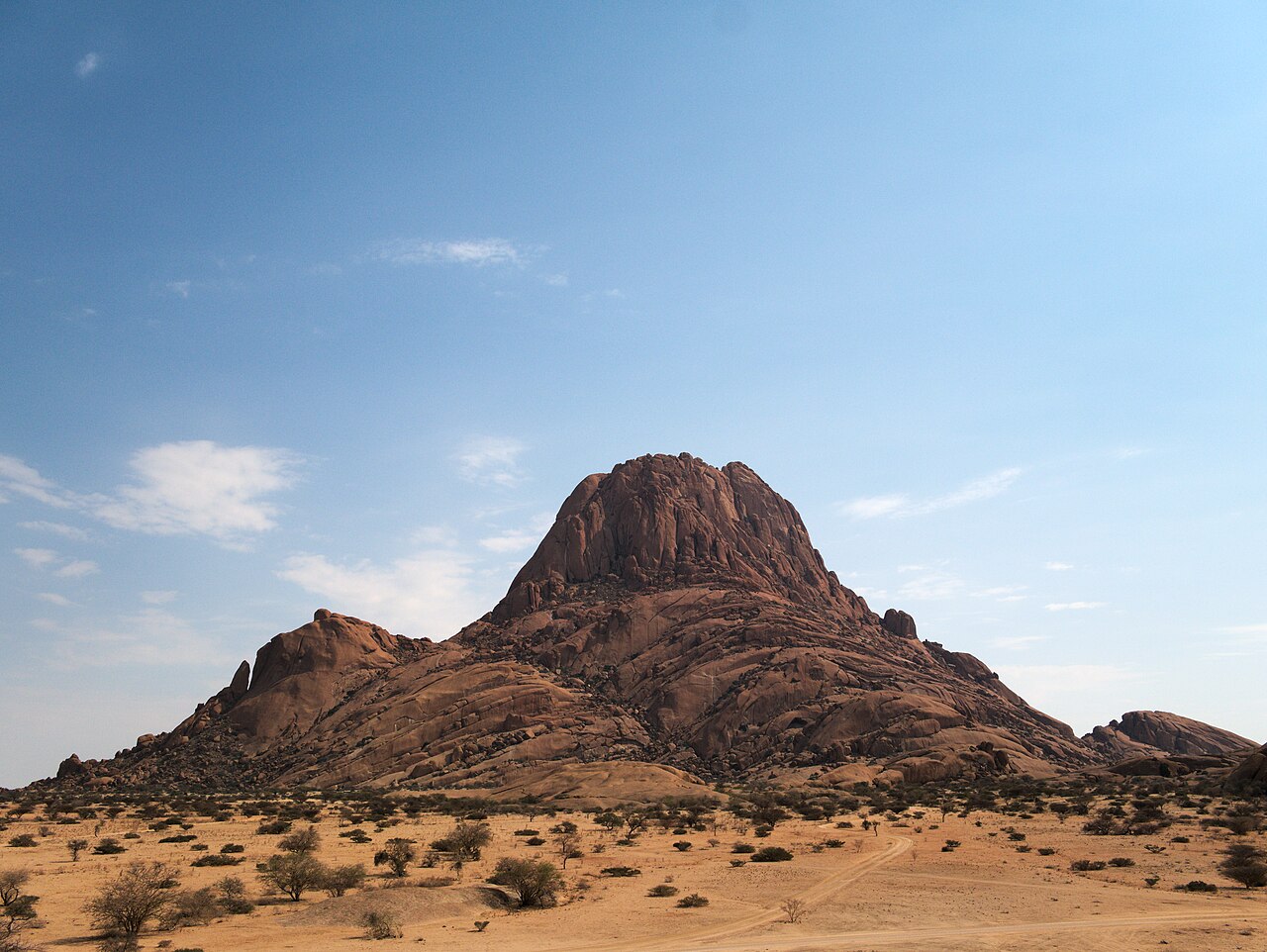
A rugged, photogenic landscape of ancient rock (Twyfelfontein), table mountains, the Brandberg and desert-adapted elephant and rhino. Damaraland stretches roughly 200 km inland from the Skeleton Coast and around 600 km south from Kaokoland. Roads here move from good gravel to rough, rocky tracks and dry riverbeds. A high-clearance 4×4 becomes genuinely necessary, and some routes should only be done in convoy.
Kaokoland / Kaokoveld (the Far Northwest)
Photo: Lidine Mia / CC BY-SA 4.0, via Wikimedia Commons
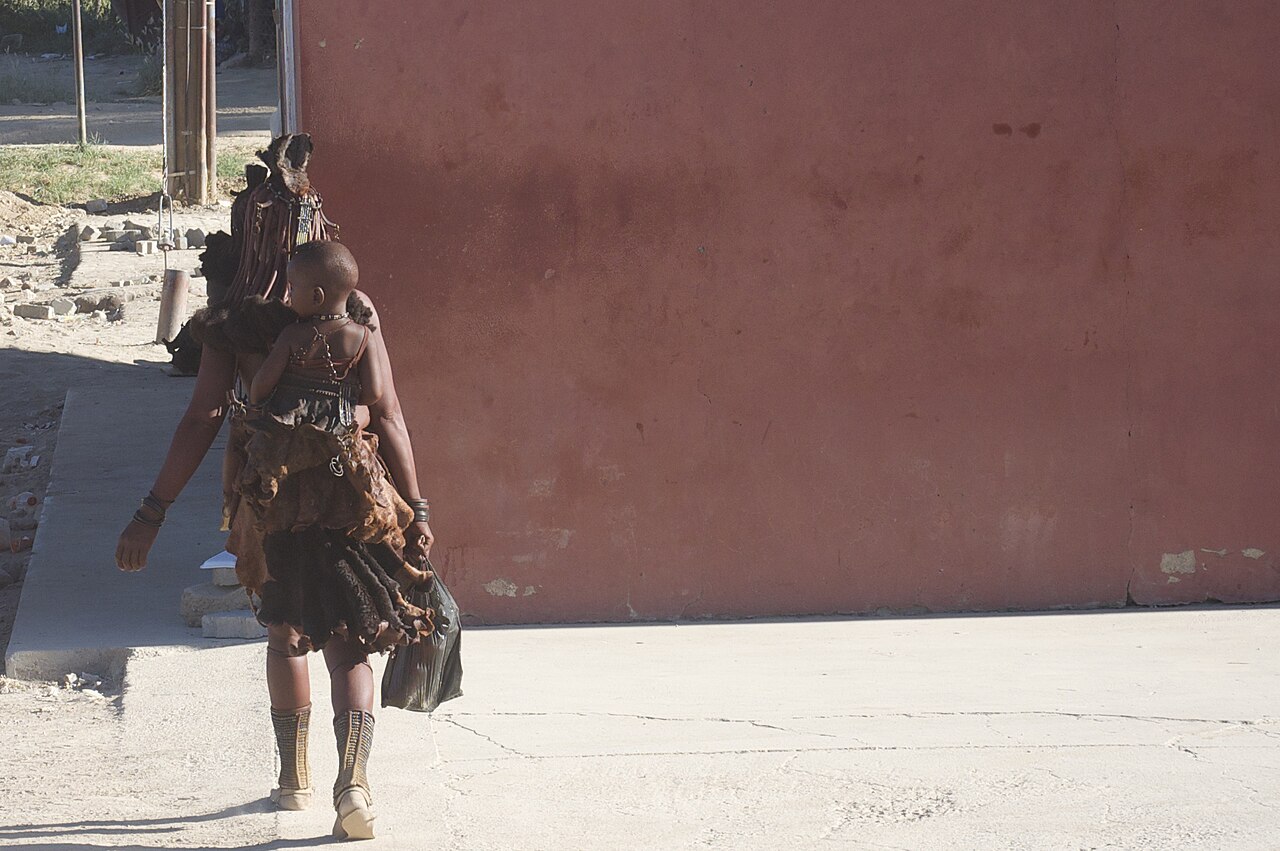
This is Namibia’s true wilderness — Himba country, with about one person per two square kilometres and almost zero infrastructure. Epupa Falls, the Marienfluss and Hartmann’s Valley are the rewards. Tracks are severe: rock, deep sand, river crossings and steep passes such as Van Zyl’s Pass (one-way, expert-only). Do not drive Kaokoland alone, in a single vehicle, or without recovery gear, extra fuel and water. This is the one region where the standard tourist 4×4 and standard insurance are often not enough.
Etosha National Park (the North)
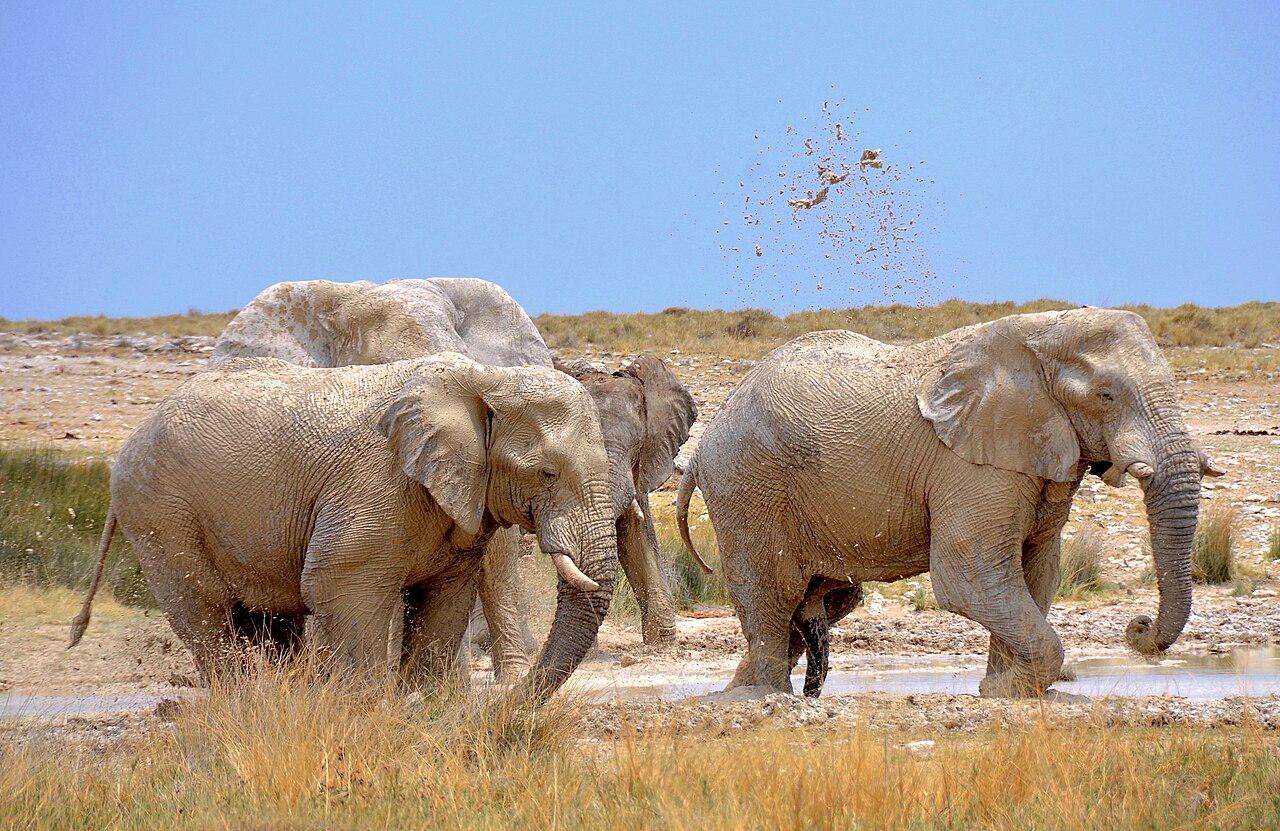
Photo: Olga Ernst / CC BY-SA 4.0, via Wikimedia Commons
Namibia’s great wildlife park is, by contrast, easy. Internal roads are graded gravel suitable for any vehicle, and the park is reached on good tar/gravel from the south and east. A 4×4 is not strictly required, but its height helps with game viewing. Stay in your vehicle, keep to the speed limit (often 60 km/h), and reach your camp gate before sunset — gates lock and night driving inside the park is prohibited.
The Zambezi Region (formerly the Caprivi Strip, the Northeast)
A complete change of scenery: lush, green, riverine and tropical, with rivers, woodland and big game including elephant, hippo and buffalo. The main Trans-Caprivi Highway (B8) is tar and good, but side roads into the parks (Bwabwata, Mudumu, Nkasa Rupara) are sandy and can flood in the wet season (Dec–Mar). Watch for animals and pedestrians on the highway, and never camp or walk near rivers at dawn or dusk because of hippos and crocodiles.
The South (Fish River Canyon, Kalahari, Lüderitz)
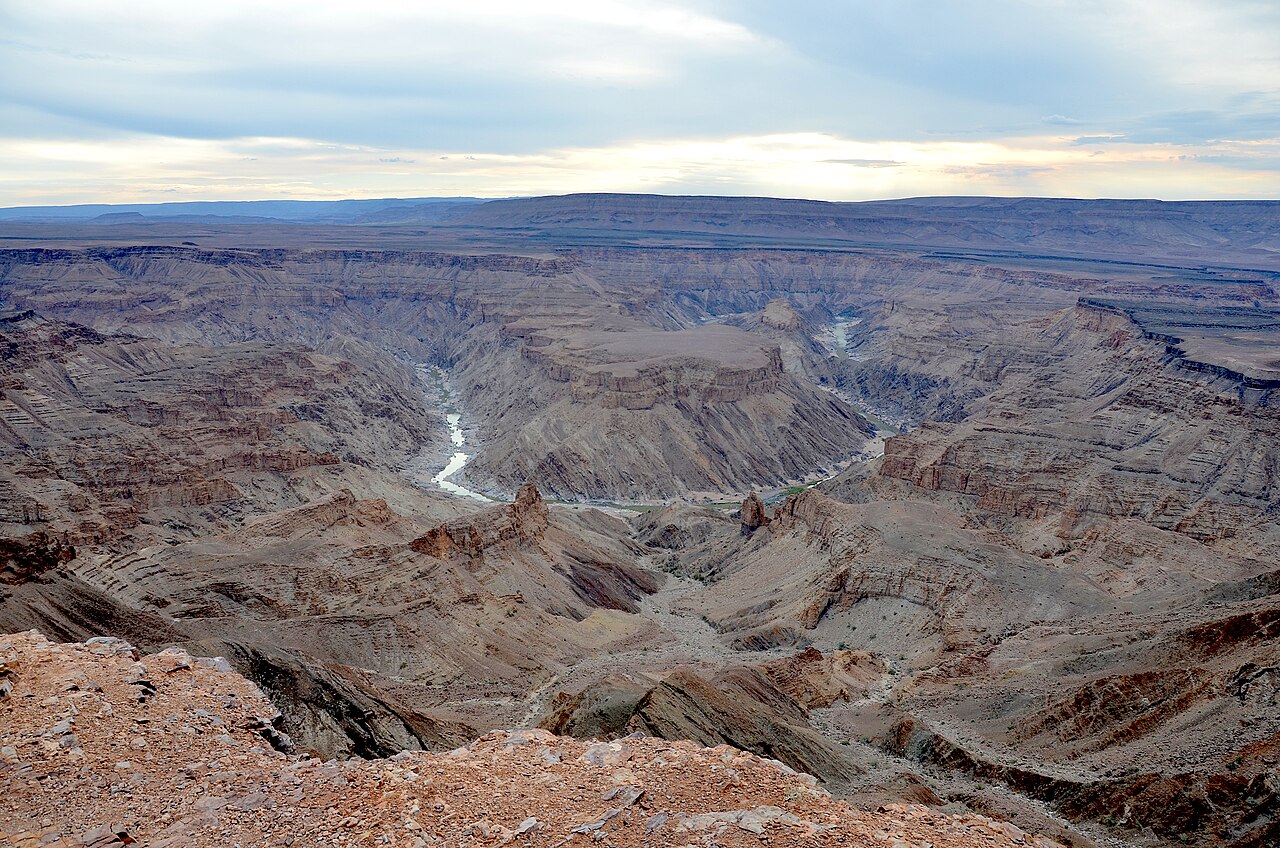
Photo: Olga Ernst / CC BY-SA 4.0, via Wikimedia Commons
The deep south holds the Fish River Canyon (the second-largest canyon in the world), the Kalahari’s red sand, and the ghost town of Kolmanskop near Lüderitz. Distances between points are long and lonely, fuel stops are sparse, and the gravel can be sharp on tyres. The road to Lüderitz is tar but notorious for wind-blown sand drifts across the carriageway.
Part 2: Distances, Infrastructure & Trip Planning
Distances Are the Thing People Underestimate
Namibian distances are deceptive on a map. A “short hop” between two sights can be a five-hour gravel drive. As a rule, plan on covering gravel at an average of 60–80 km/h including stops, not the 100+ km/h you might assume. A typical two- to three-week loop covers 2,500–3,000 km.
The lesson: build a route with two nights in major spots (Sossusvlei, Swakopmund, Etosha), drive one major leg per day, and always plan to arrive before dark. The distance matrix below gives you the point-to-point figures to plan each leg.
Distance Matrix — Major Hubs (approximate road km)
Use this point-to-point chart to plan any leg of a Namibian loop, not just trips out of Windhoek. Figures are approximate road distances in kilometres, rounded; actual driving time depends heavily on surface (reckon roughly 120 km/h on tar and 80 km/h on gravel, before stops). Read it like a mileage chart — find one place down the left, the other across the top, and read off where they meet.
From / To
Windhoek
Sesriem
Swakopmund
Etosha (S)
Twyfelfontein
Fish R. Canyon
Lüderitz
Sesriem (Sossusvlei)
320
—
Swakopmund
360
340
—
Etosha (Okaukuejo)
440
560
550
—
Twyfelfontein
430
480
280
370
—
Fish River Canyon
680
480
900
1,110
1,090
—
Lüderitz
815
490
730
1,250
1,010
340
—
Katima Mulilo (Zambezi)
1,200
1,520
1,380
900
1,150
1,880
2,010
Etosha (S) = the south of the park around Okaukuejo / Andersson Gate. Distances are indicative and route-dependent; confirm in Tracks4Africa or Google Maps for your exact stops.
A few planning takeaways from the chart: the core “golden triangle” legs (Windhoek–Sesriem–Swakopmund–Etosha) are each a comfortable single day of 320–560 km, which is why most itineraries are built around them. Anything reaching into the far south (Fish River Canyon, Lüderitz) or the far northeast (Katima Mulilo / the Zambezi) is effectively a multi-day commitment — a Windhoek–Katima run alone is ~1,200 km — so those regions are best added as a dedicated extension rather than squeezed into a short loop.
Fuel: Plan Every Tank
Fuel is the variable that catches people out. Towns and key junctions have stations, but between them you can drive 200–350 km with nothing. The classic example is the Sesriem–Swakopmund run, where Solitaire (about 80 km from Sesriem) is the only fuel between the two — miss it and you are in trouble. Rules of thumb:
Fill up whenever you pass a station, even at half a tank.
Many rental 4x4s carry a long-range tank and/or a jerry can — use them on remote legs.
Fuel is widely cash-and-card, but carry some Namibian dollars; small-town pumps occasionally have card outages. Stations are attendant-served (tip a few dollars).
Diesel is the norm for 4x4s and is available everywhere fuel is sold.
Mobile Signal, Navigation & Communication
Cell coverage (MTC is the main network) is good in towns and along main tar roads, and absent across large rural stretches. Do not rely on Google Maps alone:
Use Tracks4Africa (offline GPS maps/app) — it is the standard for Namibia and shows tracks, campsites and fuel that Google misses.
Download offline maps before you leave a town.
For Kaokoland and other remote areas, consider renting a satellite phone (several companies offer them) and always leave your itinerary with someone.
Road Categories — What the Letters Mean
B roads: national tar highways. Easy, fast, fine for any car.
C roads: main gravel routes, usually well-graded and the backbone of a self-drive trip.
D roads: minor gravel/district roads, more variable — some smooth, some rough or sandy.
Tracks (no number / “MR”/4×4 routes): require real off-road capability and experience.
Most headline destinations (Sossusvlei, Swakopmund, Etosha, Fish River Canyon) are reachable on B, C and good D roads. A true 4×4 with low range is essential only for the last stretch to Sossusvlei, Kaokoland, deep Damaraland and wet-season side roads — but renting one is still strongly advised everywhere for clearance, dual spare wheels, sturdier tyres and peace of mind.
Crossing into Botswana with a rental 4×4 — what you need
Taking your Namibian hire car across into Botswana is straightforward if you sort the paperwork in advance. The one essential item is a cross-border permission letter from your rental company — without it you will be turned back at the border.
What to consider when booking:
Tell the rental company every country you intend to enter (Botswana, and Zambia/Zimbabwe if relevant) so they issue the correct cross-border documents — give them a few days’ notice.
Confirm in writing that your insurance and damage waiver stay valid in Botswana.
Expect a cross-border administration fee, and ask for a certified copy of the vehicle registration.
Check for regional restrictions — some companies exclude remote areas from their cover.
Documents required at the border:
A valid passport (at least six months’ validity and a blank page).
Your driver’s licence (an International Driving Permit is recommended).
The rental company’s cross-border permission letter / letter of authority.
The vehicle registration papers (original or certified copy) and proof of insurance.
Fees & formalities at the crossing:
Botswana levies a road permit / road tax and a third-party insurance fee on entry — carry cash (Botswana Pula or South African Rand), as card facilities are unreliable.
You’ll complete a temporary vehicle-import form and a gate pass; keep them for your exit.
Foot-and-mouth controls: expect veterinary checkpoints with a disinfectant mat and shoe-dip, and you cannot carry raw red meat or fresh dairy across veterinary fences.
Border posts keep fixed hours (e.g. Mamuno/Trans-Kalahari, Ngoma, Mohembo) — check opening times and don’t arrive late in the day.
Part 3: How to Drive a 4×4 in Namibia
Most accidents involving visitors in Namibia are single-vehicle rollovers on gravel — no other car involved, just too much speed and a moment’s loss of control. Master the techniques below and you remove the large majority of the risk.
Gravel Road Driving (the skill you will use most)
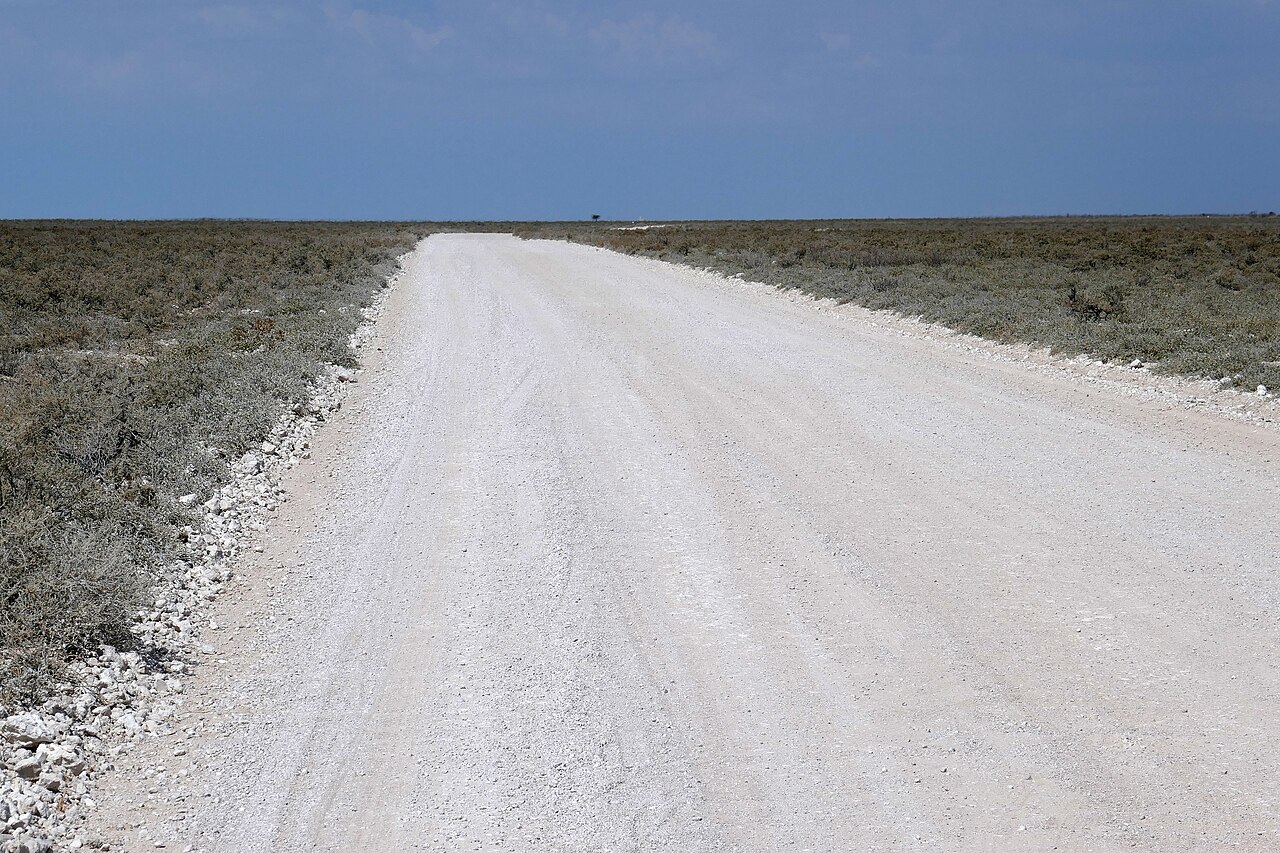
Photo: Ji-Elle / CC BY-SA 4.0, via Wikimedia Commons
Gravel is 80% of a Namibian road trip. It behaves nothing like tar.
Slow down. Treat 80 km/h as an absolute maximum and drop well below it where the surface is loose, corrugated or cresting a blind rise. Speed is the number-one killer here.
Smooth inputs only. Brake early and gently, steer gently, and avoid sudden changes of direction. Sharp braking or swerving on gravel is how cars spin and roll.
Reduce tyre pressure slightly for long gravel sections — around 1.6 bar improves grip and ride comfort and reduces puncture risk (more on pressures below).
Beware corrugations (the “washboard” ripple). There is a tempting speed at which they smooth out, but it reduces grip dramatically — resist it.
Soft edges and oncoming traffic: the road edge is often soft sand or loose stone. Don’t drift onto it at speed. When a vehicle approaches, slow down, move left, and expect a cloud of dust and flying stones — many windscreen chips happen here.
Crest blind rises slowly and to your side of the road — oncoming traffic, animals or washaways may be just over the top.
Deep Sand Driving (Sossusvlei, Kaokoland, Zambezi side roads)
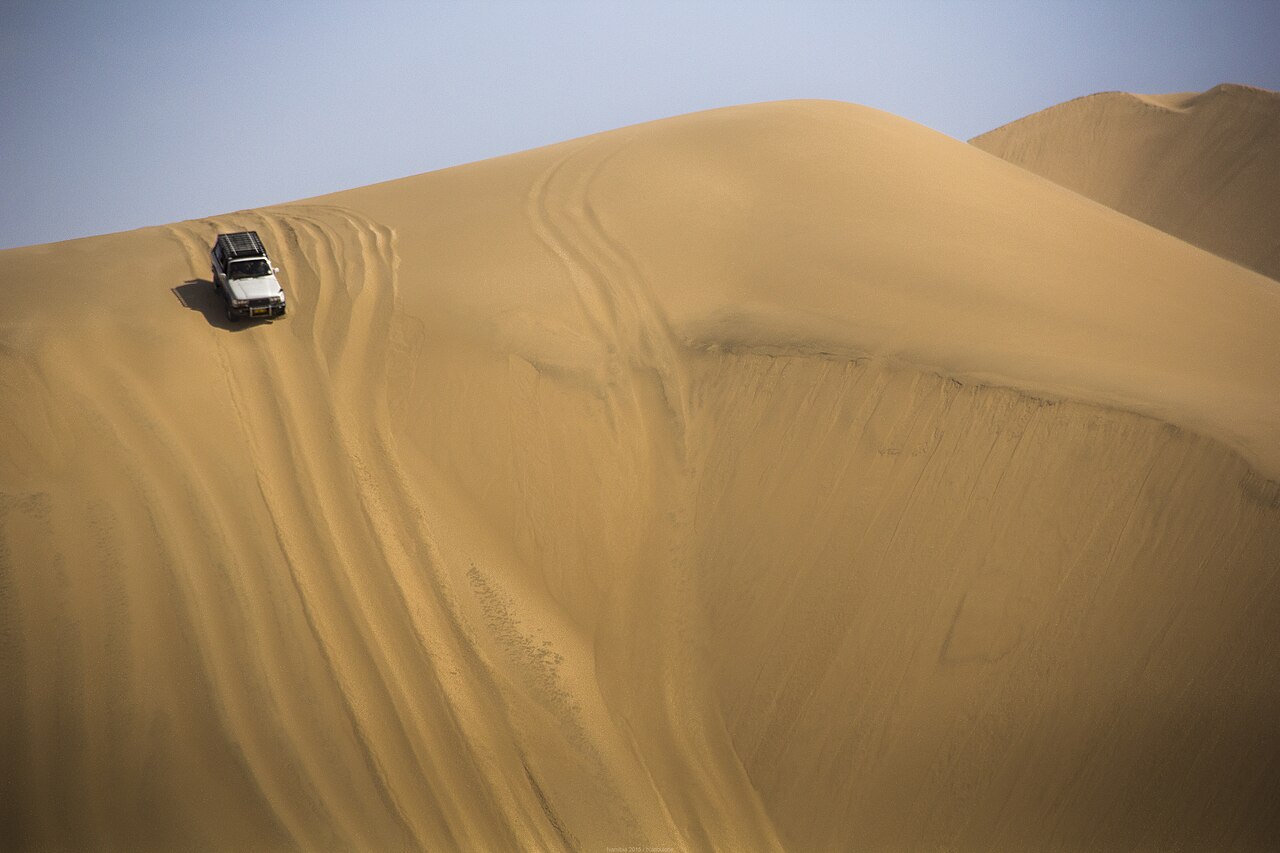
Photo: Buiobuione / CC BY-SA 4.0, via Wikimedia Commons
Sand is about momentum and tyre pressure, not power.
Deflate your tyres. This is the single most important sand technique. Drop to roughly 1.2 bar (sometimes lower) for genuine soft sand. A wider, softer footprint floats over sand that a hard tyre digs into.
Engage 4×4 low range before you reach the sand, not after you’re stuck.
Keep momentum, stay smooth. Maintain steady, continuous forward motion in a higher gear; avoid sudden acceleration, braking or gear changes that break traction.
Follow existing tracks where they look firm, and drive in the early morning when cooler sand is more compact and far easier than hot, churned afternoon sand.
If you must stop, stop facing downhill so you can roll forward to get going again. Never park nose-up in deep sand.
If you get stuck: don’t spin the wheels (it digs you in deeper). Reverse out along your tracks, deflate tyres further, clear sand from in front of the wheels, and use sand tracks/recovery boards if you have them.
Reinflate as soon as you’re back on firm gravel or tar (see the warning below).
The Tyre-Pressure Rule Everyone Forgets
Deflating for sand and gravel is essential — but driving on tar with low-pressure tyres builds dangerous heat and risks a blowout. Always reinflate to the recommended road pressure as soon as you return to a hard surface. This is exactly why your rental should include a 12V compressor (most reputable companies provide one) and why you should check pressures every time you refuel.
Off-Road, River Crossings & Rocky Tracks
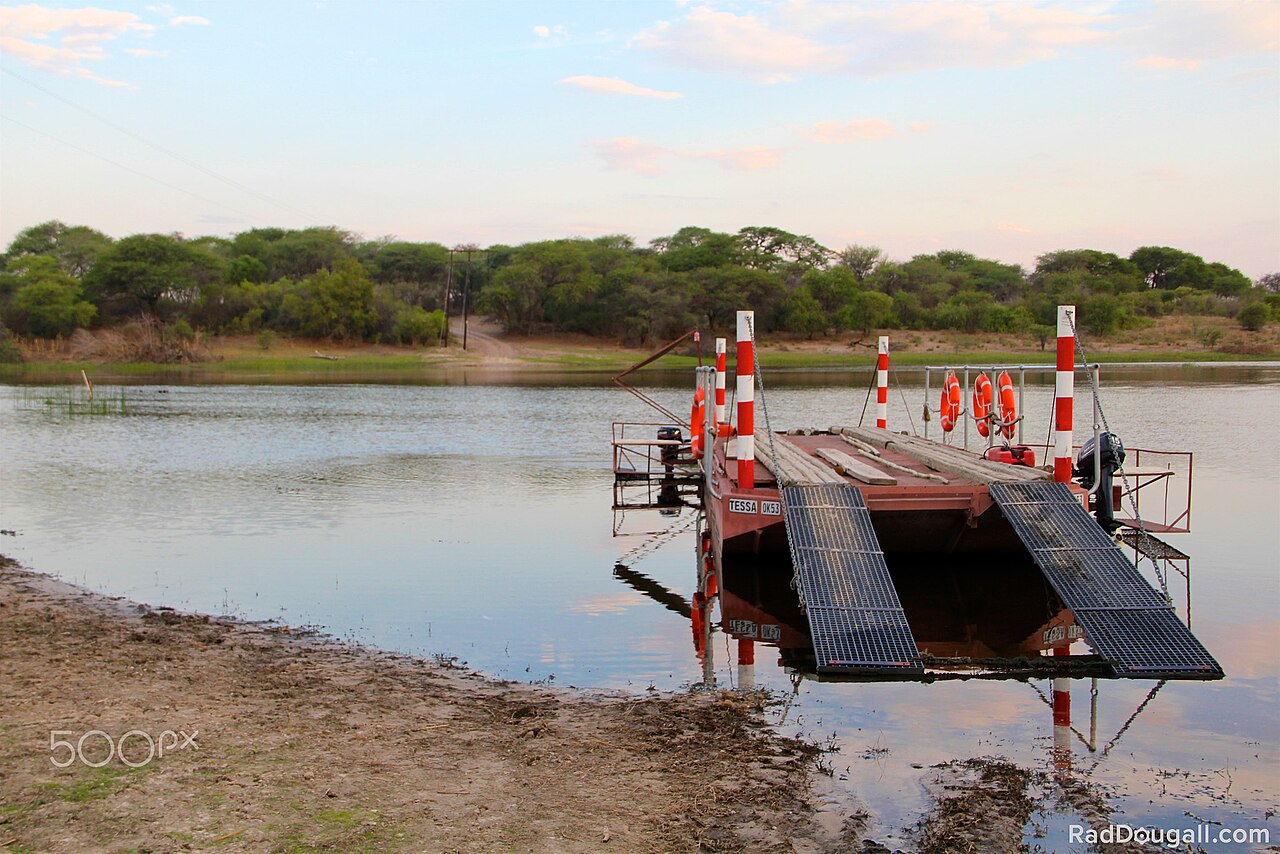
Photo: Rad Dougall / CC BY 3.0, via Wikimedia Commons
For Damaraland and Kaokoland:
Walk water crossings first if at all possible to gauge depth and bottom firmness; cross slowly and steadily in low range, never fast (a bow wave can flood the engine).
On rock, go slow and pick your line, letting the suspension articulate; protect the undercarriage and sidewalls.
Convoy in remote terrain. Two vehicles can recover one; a single stuck vehicle far from help is a genuine emergency.
Carry and know your recovery kit: tow rope, shackle, shovel, jack with a base plate for sand, sand tracks, and a tyre repair kit.
Wildlife & Night Driving
Photo: Robur.q / CC BY-SA 4.0, via Wikimedia Commons
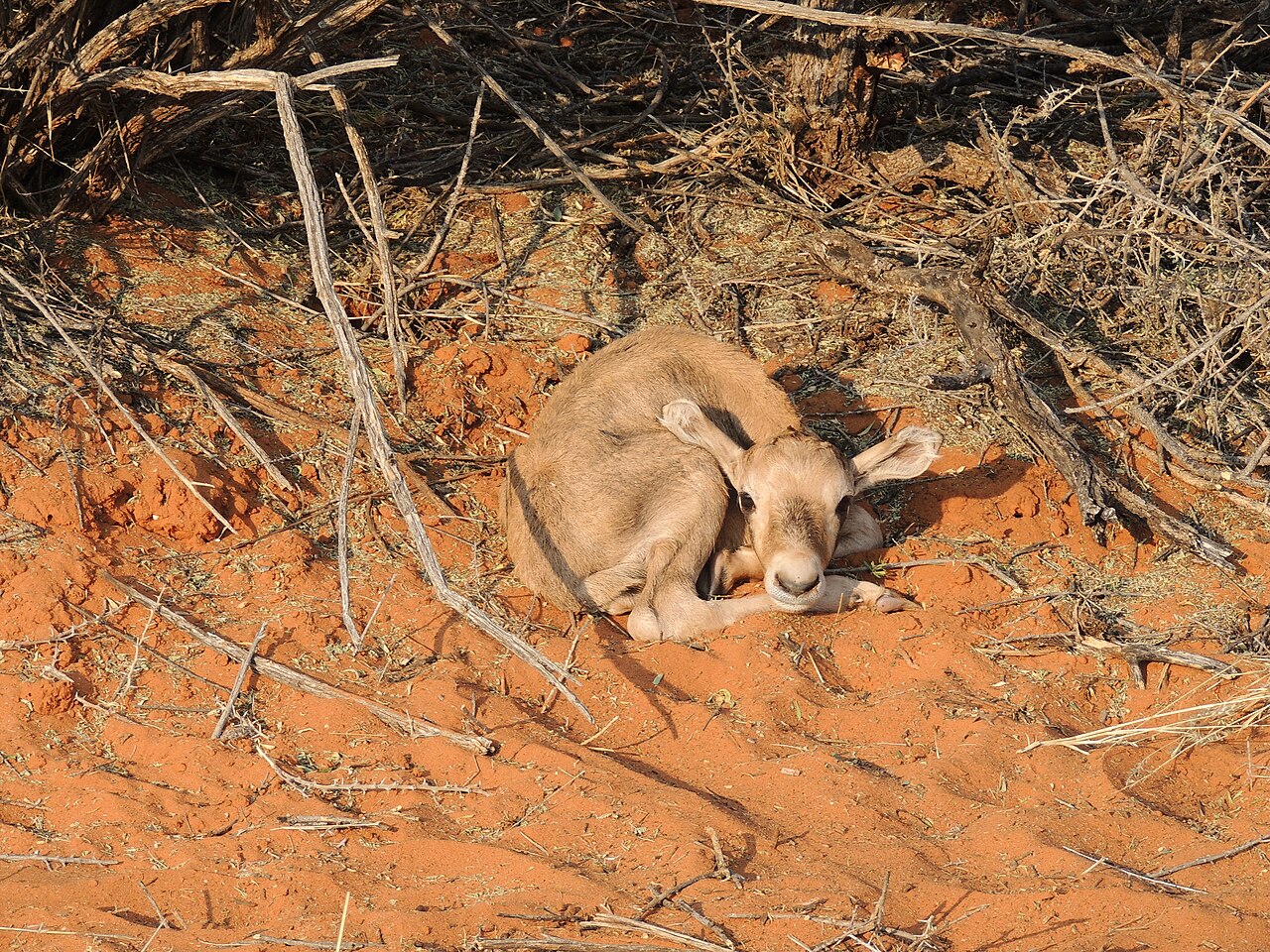
Do not drive after dark. This is the most important single rule in Namibia. Kudu, oryx, warthog and livestock move onto roads at dusk and night, and a collision at speed with a large antelope is often fatal — to the animal, the car and sometimes the occupants. Animals are also unpredictable: kudu in particular leap into headlights. Plan every day to arrive at your destination before sunset, and if you are caught out, slow right down.
Part 4: Dos and Don’ts at a Glance
Do:
Do rent a proper 4×4 with two spare wheels, a compressor and good tyres.
Do drive slowly on gravel — 60–80 km/h, slower when loose.
Do reduce tyre pressure for gravel and sand, and reinflate for tar.
Do fill up with fuel at every opportunity and carry water (at least a few litres per person, more in remote areas).
Do download offline maps (Tracks4Africa) and leave your itinerary with someone.
Do wear seatbelts at all times — rollovers are survivable belted.
Do take rest breaks; the monotony and heat cause fatigue.
Do check tyre pressures and walk around the vehicle each morning.
Don’t:
Don’t drive at night, ever, if you can avoid it.
Don’t speed on gravel or brake/steer sharply.
Don’t overtake into dust clouds; you can’t see what’s ahead.
Don’t tackle Kaokoland, Van Zyl’s Pass or serious sand solo or without recovery gear.
Don’t drive on tar with deflated tyres.
Don’t let the fuel gauge drop below half on remote legs.
Don’t underestimate distances or try to “make up time” by speeding.
Don’t drink and drive, and don’t drive tired.
Part 5: The 10 Major 4×4 Rental Companies Compared
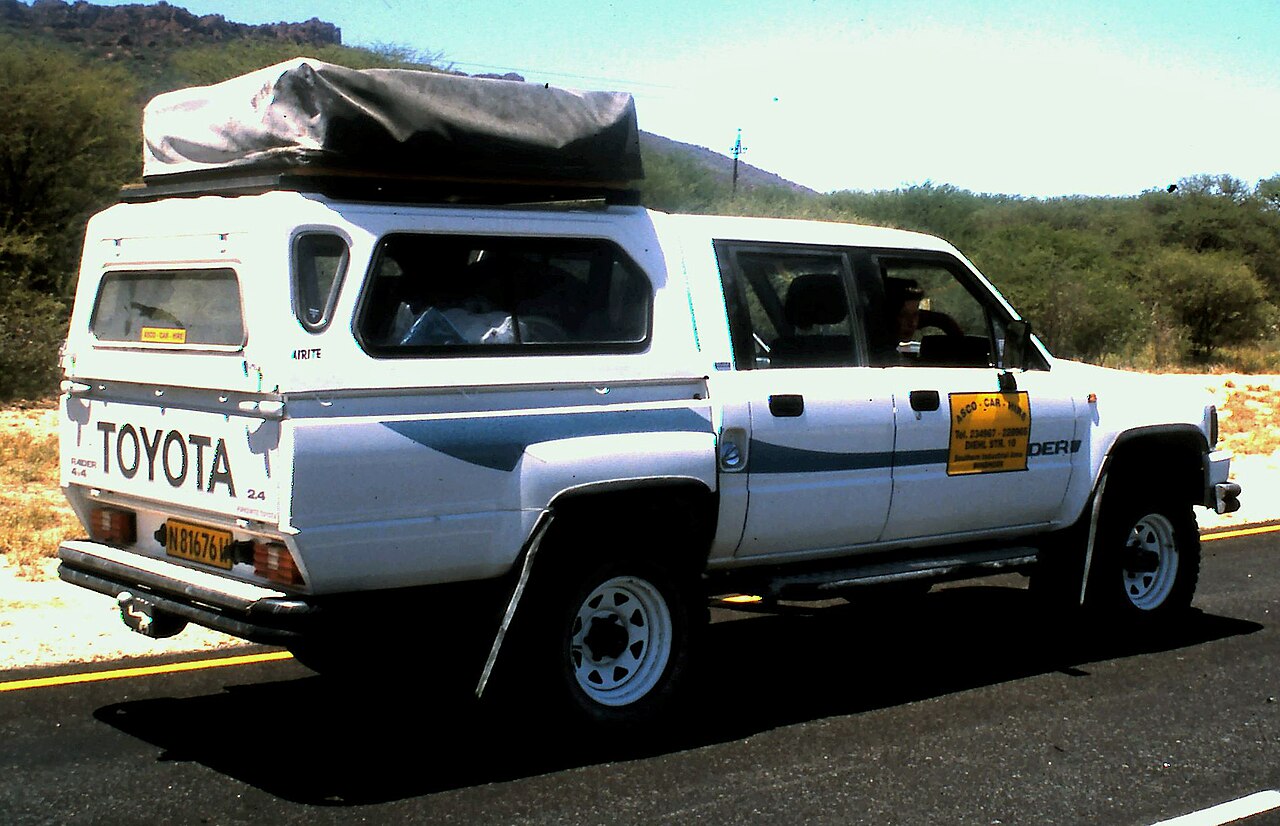
Photo: corinna1411 from Dormagen, Germany, cropped and li / CC BY-SA 2.0, via Wikimedia Commons
Namibia has a deep, competitive market of specialist 4×4 hire firms, most based in Windhoek with airport pick-up. Below are ten of the most established and well-reviewed operators for self-drive, with their fleets, camping options, indicative 2026 pricing and online reputation.
A note on pricing: rates below are indicative per-day ranges for a camping-equipped Toyota Hilux double-cab (the typical self-drive vehicle), in 2026 currency as published or quoted by each company. Namibian rentals are highly seasonal — high season (roughly July–October, plus the Nov–March festive peak at some firms) can cost 50–100% more than low season, and longer rentals (16+ days) earn lower daily rates. Most quoted rates include VAT, unlimited mileage, basic insurance (CDW) with a high excess, airport transfers and 24-hour assistance; fuel, excess-reduction waivers and cross-border permits are extra. Always request a written quote for your exact dates.
Pricing & Ratings Summary
Company
Typical 4×4 (camping) per day*
Camping options
Online reputation
Savanna Car Hire
~N$1,700–3,000 (quote)
With & without camping
Excellent — our pick: we used them on a 4,000 km Namibia–Botswana trip (May 2026); superb value & service.
Asco Car Hire
~€80–€210 (≈N$1,600–4,100)
1–2 & 3–5 pax; standard & budget
Long-established, large fleet; generally positive, some mixed reviews
High volume; service reviews mixed (Trustpilot ~2.9/5)
Caprivi Car Hire
from ~N$1,890 (high season)
With & without camping
Established 1996; mixed (loyal fans + some complaints)
Kalahari Car Hire
~N$1,800–3,000 (quote)
With & without camping
Generally very positive
Melbic 4×4 Car Rentals
~N$1,700–2,900 (quote)
Roof & ground tents, 1–5 pax
Positive, well-regarded mid-market
Bushlore Self-Drive
~N$2,565–4,005
Fully equipped, Hilux & Land Cruiser
Strong, regional overland specialist
*Indicative, season-dependent; confirm with a live quote. N$ = Namibian dollar (pegged 1:1 to the South African rand).
1. Savanna Car Hire
A long-standing, well-run Windhoek operator (established 1994) with a large, in-house-serviced fleet of 200+ vehicles, offering Hilux and Ford Ranger double-cab 4x4s with and without camping.
Indicative pricing: competitive mid-market — roughly N$1,700–3,000/day for a camping 4×4 depending on season and duration; request a quote. Consistently good value for the spec.
Reputation: largely positive. Reviewers repeatedly highlight strong value, friendly and helpful staff, and excellent roadside backup — immediate assistance through associated garages or a quick replacement vehicle. As with any rental, confirm the written terms and inspect the vehicle on collection.
Our experience: we used Savanna Car Hire ourselves for a 4,000 km self-drive through Namibia and Botswana in May 2026 — both the vehicle and the service were excellent, with a smooth handover, a well-prepared 4×4 and responsive support throughout. They are our top recommendation.
2. Asco Car Hire
One of the largest and longest-running rental companies in Namibia, with a big, regularly serviced fleet and an unusually transparent online rate card. Asco runs an all-Toyota line-up: Hilux 2.4 TD, Safari 2.8 TD and Land Cruiser 2.8 TD double-cabs, plus a Land Cruiser “Bushcamper”, in both “standard” and cheaper “budget” trims, with or without camping for 1–2 or 3–5 people.
Indicative 2026 pricing (camping-equipped Hilux double-cab, 6–15 days): roughly €110–€205/day depending on season (low season around €110–€127, high season up to ~€205), with budget-trim camping Hiluxes from about €79–€138/day. Rates include 15% VAT, airport transfers, CDW, unlimited mileage, 24-hour service, a compressor, a second spare wheel and one additional driver. Standard excess is N$40,000, reducible for €8–€25/day; note that undercarriage, tyre and single-vehicle damage are excluded from the cheaper waivers, and Kaokoveld/Damaraland are excluded even from the top “Super Cover”.
Reputation: widely used and generally well regarded for fleet quality and service, with reviewers reporting cars that handled remote deserts, sand and water crossings well. Like all big operators it has a minority of negative reviews, typically around damage/excess disputes — read the insurance terms carefully.
3. Go Rent Namibia 4×4 Rentals
A highly rated specialist running new (2024–2025) Toyota Hilux double-cabs in 2.4 and 2.8 automatic, fitted out to a high standard with Alu-Cab drawer systems, dual batteries, long-range fuel, two new spare tyres, rooftop tents and complete camping kits for 2 or 4 people.
Indicative 2026 pricing (Hilux 2.4, camping): low season (Dec 2025–Mar 2026) about N$2,590–2,640/day (2–4 pax), high season (Apr–Nov 2026) about N$3,290–3,370/day; longer hires drop to ~N$1,680–2,190/day. No-camping rates start around N$2,310 (low) / N$2,940 (high). Rates include maintenance, GST, unlimited mileage and 24-hour breakdown assistance; insurance excess options run N$30,000 down to zero (N$184–546/day), with free airport transfers.
Reputation: among the best-reviewed in Namibia — a 5-star Trustindex score across 400+ customer reviews and a TripAdvisor Travellers’ Choice award, with consistent praise for pre-trip communication, vehicle condition and equipment.
4. Advanced 4×4 Car Hire
A Windhoek operator with a strong reputation for service and near-new vehicles, kitted for overlanding with rooftop tents, full kitchen setups, camp furniture, LED lighting and gas cooking, in 2- and 4-person configurations.
Indicative pricing: broadly in line with the premium pack (≈N$1,800–3,200/day for a camping Hilux depending on season and duration); request a quote for exact dates. Vehicles carry tracking devices, and airport/city pick-up and drop-off are included.
Reputation: excellent — a TripAdvisor Travellers’ Choice winner with many reviews calling it the best rental experience in Windhoek. The main recurring gripe is that their in-vehicle GPS enforces conservative speed limits on gravel, which some travellers find slows them down (arguably a safety feature).
5. Bushbundu Car Rental
A boutique Windhoek firm focused on a small, near-new fleet of fully equipped Toyota Hilux double-cab 4x4s, each fitted with canopy, long-range fuel tank, water tank, dual-battery system and two spare wheels, with camping kit for up to four people.
Indicative pricing: roughly N$1,900–3,000/day for a camping-equipped Hilux depending on season; prices include free airport transfers (Hosea Kutako to depot and back), unlimited mileage and 24-hour backup. Request a live quote.
Reputation: very strong word of mouth — reviewers single out brand-new, well-equipped vehicles and exceptional personal customer service. The review base is smaller than the big operators, which is typical of a boutique firm.
6. Namibia2Go (Gondwana Collection)
The car-hire arm of the large Gondwana travel group, offering one of the biggest and most varied fleets — 4×4 Hiluxes and Fortuners with and without camping, plus larger people-movers — and a “no-deposit, zero-excess” insurance model that appeals to travellers wanting simplicity.
Indicative pricing: entry 4x4s from around N$1,000/day (≈US$50) for two people, rising for camping-equipped and larger vehicles; every rental bundles premium zero-excess cover, unlimited mileage, unlimited additional drivers and 24/7 assistance.
Reputation: very high volume (the group cites 6,000+ travellers a year) and convenient, but service reviews are mixed — Trustpilot sits around 2.9/5 with some complaints about charges and communication, even as many individual trips go smoothly. A good option for the insurance model; read the terms and document the vehicle carefully at handover.
7. Caprivi Car Hire
One of the most established names, family-run since 1996, with an in-house workshop and a fleet of around 70 vehicles — well-equipped Toyota Hilux 4x4s with and without camping kit.
Indicative pricing: from about N$1,890/day for a 2-person camping Hilux in high season on a 14–21 day hire (around N$1,720 without camping); shorter hires cost more per day. Includes 24-hour breakdown service and a choice of insurance options.
Reputation: mixed but with a loyal following — fans praise the personal, friendly family service and in-house servicing, while a minority of reviews report mechanical issues on the road and support concerns. Strong value, especially for longer hires.
8. Kalahari Car Hire
A well-regarded Windhoek firm offering a range of 4×4 rental cars with camping equipment, popular with self-drivers for reliable vehicles and smooth airport handovers.
Indicative pricing: broadly mid-market, around N$1,800–3,000/day for a camping 4×4 depending on season; request a quote.
Reputation: generally very positive — reviewers describe vehicles as “reliable and able to take all the abuse of the Namibian roads”, with good email communication, airport handover and helpful staff. A solid, lower-profile alternative to the big names.
9. Melbic 4×4 Car Rentals
A mid-market specialist offering well-maintained 4x4s with or without camping gear — rooftop or ground tents, sleeping kit, tables, chairs and cooking equipment — in configurations for 1–5 people, with tour and travel support.
Indicative pricing: competitive, roughly N$1,700–2,900/day for a camping Hilux by season; request a quote.
Reputation: positive and well-regarded, with reviewers noting reliable vehicles, good equipment and helpful service. A good value-for-money choice.
10. Bushlore Self-Drive Safaris
A regional overland specialist (operating across southern Africa) with Namibia depots, building its fleet mainly around the Toyota Land Cruiser and Hilux 4×4 fully kitted for self-drive camping. A strong choice for longer, more remote or multi-country trips.
Indicative pricing: around N$2,565/day in low season to N$4,005/day in high season for a fully equipped 4×4 — at the premium end, reflecting heavier-duty kit and Land Cruiser options.
Reputation: strong, with loyal repeat customers and a good name among serious overlanders; particularly worth considering if you plan to cross borders or tackle tougher terrain.
Part 6: How to Choose — Practical Advice
Match the vehicle to the route. For the classic Sossusvlei–Swakopmund–Etosha loop, a camping-equipped Hilux double-cab from any reputable firm is ideal. For Kaokoland, deep Damaraland or border crossings, step up to a Land Cruiser and a heavier-duty outfitter (Bushlore, Asco’s Land Cruiser line, Advanced).
Read the insurance fine print. The headline rate usually carries a high excess (often N$40,000) and excludes tyres, undercarriage, water damage and single-vehicle accidents. For gravel- and sand-heavy trips, buying down the excess is usually money well spent — but check what is still excluded (Kaokoveld/Damaraland often are).
Confirm what’s included: two spare wheels, a working compressor, a jack and base plate, recovery basics, and a vehicle briefing/test drive. The good operators provide all of this as standard.
Book early for high season (July–October and the festive peak). The best-rated firms and their newest vehicles sell out months ahead.
Document everything at handover. Photograph the vehicle inside and out, note every existing chip and scratch on the form, and test the fridge, tyres and 4×4 engagement before you leave the yard. This is the single best way to avoid an excess dispute on return.
Get a written quote for your exact dates. Because Namibian pricing is so seasonal and duration-based, the only reliable price is a live quote — use the ranges above to sanity-check it.
Final Word
Namibia rewards the prepared self-driver like almost nowhere else. Choose a reputable, well-reviewed operator; take a proper 4×4 with camping kit suited to your route; drive slowly and smoothly on gravel; respect sand, fuel ranges and the rule against night driving — and you will have one of the great road trips of your life. Safe travels from 25 South.
Sources
The following sources were used in compiling this guide (accessed June 2026):
Rental companies & pricing: Asco Car Hire (ascocarhire.com); Go Rent Namibia 4×4 Rentals (4x4namibia.rentals); Advanced 4×4 Car Hire (advancedcarhire.com); Bushbundu Car Rental (bushbundu.com); Namibia2Go / Gondwana (namibia2go.com); Caprivi Car Hire (caprivicarhire.com); Savanna Car Hire (savannacarhire.com.na); Kalahari Car Hire (kalaharicarhire.com); Melbic 4×4 Car Rentals (melbic.com); Bushlore Self-Drive Safaris (bushlore.com); Epic Namibia 4×4 rentals overview (epicnamibia.com); goArid company profiles (goarid.com).

 25South