
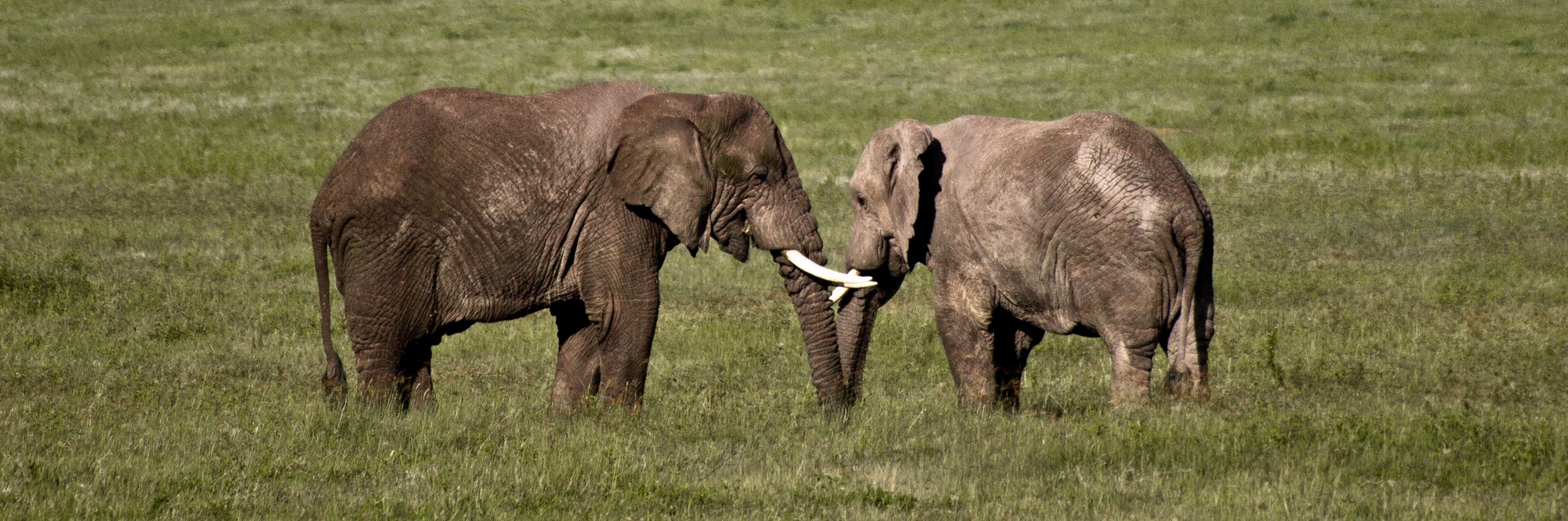
Spend long enough sitting quietly in the bush and you start to notice it: the African wilderness is not silent, and it is not random. It is a conversation. A monkey barks and an entire hillside of animals reacts as one. A meerkat makes a particular chirp and its family dives underground. A pack of wild dogs sneezes its way to a decision. Beneath the obvious sounds runs a constant, sophisticated exchange of information — warnings, votes, roll-calls, rumbles below the range of human hearing. Once you learn to read it, every game drive becomes richer, because the animals are telling you what is out there before you can see it. Here is some of what they are saying.
Vervet monkeys have words
The most famous discovery in animal communication came from the vervet monkeys of Amboseli in Kenya. Researchers found that vervets give acoustically different alarm calls for different predators — and, crucially, that the other monkeys respond appropriately to each call even when they cannot see the danger themselves.
A “leopard” alarm sends the troop bolting up into the trees, where a leopard struggles to follow. An “eagle” alarm makes them look up and dive into bushes. A “snake” alarm makes them stand tall and scan the ground. In other words, the call does not just mean “danger” — it means a specific kind of danger, with a specific correct response. This was hailed as the first solid evidence of something like symbolic, word-like communication in a non-human animal, and it changed how scientists think about animal minds.
For the safari-goer, there is a practical payoff: a troop of monkeys barking and crashing into trees is one of the bush’s most reliable leopard alarms. Guides watch and listen for exactly this.

Lions roar to hold ground
The most iconic sound in the African night is not really aimed at you at all. A lion’s roar can carry up to five miles across open bush, and it is less a display of ferocity than a piece of real-estate law: it tells every other lion in earshot exactly who holds this ground, and how many of them there are to back that claim up.
Prides often roar in chorus, several animals together, which advertises pride size to rivals and makes the group sound larger and more formidable than a single lion ever could. Roaring peaks at dawn and dusk, when prides are most active, and each individual has a distinctive enough voice that researchers — and, with practice, guides — can identify specific lions purely by ear. Cubs cannot manage a full roar until they are around two years old; until then, the deep, chest-shaking call belongs only to the adults. So when a roar rolls across camp at 4 a.m., what you are hearing is a boundary being redrawn in real time, and a headcount being broadcast to anyone who might be listening.

Meerkats post a guard — and have a code
The meerkats of the Kalahari run one of the animal kingdom’s great cooperative systems. While the group forages, heads down and vulnerable, one individual takes a turn as sentinel — standing upright on a mound or bush, scanning the sky and horizon, and giving a soft, constant “all-clear” murmur to let the others feed in peace.
When the sentinel spots trouble, it switches to an alarm — and like the vervets, meerkats use different alarms for different threats. A call for an aerial predator (an eagle or hawk) sends the group flattening and bolting for the nearest bolt-hole; a call for a predator on the ground produces a different response, with the meerkats grouping and scanning toward the threat rather than simply diving. The sentinel role rotates, and a well-fed meerkat will volunteer for guard duty more readily — a small, daily act of cooperation that keeps the whole group alive.

Hyenas gossip through giggles and whoops
The spotted hyena’s notorious “laugh” has nothing to do with amusement. Researchers studying giggling hyenas found that each animal’s giggle is acoustically unique — a kind of vocal fingerprint that broadcasts identity, age and social rank to every other hyena within earshot. Older hyenas giggle at a lower pitch; dominant animals sound noticeably more controlled and even, while subordinates giggle in a higher, more ragged register.
Tellingly, the giggle surfaces most often during conflict — typically a scramble over a fresh kill, when several hyenas are competing at once. In the chaos of a feeding frenzy, where nobody has time to look up and check who is where, the giggle lets a clan sort out who’s who by sound alone. It is one part of a much larger vocabulary: hyenas are known to use at least fourteen distinct calls, from low groans to the famous long-distance whoop, a rising and falling call used to rally scattered clan members back to a kill or a den from kilometres away. Next time you hear that eerie, rising whoop-whoop-whoop carry across the dark, know that it is less a horror-movie sound effect than a roll call.

Wild dogs vote by sneezing
Here is one of the most charming findings in recent African wildlife science. African wild dogs are intensely social, and before a hunt the pack performs an excited greeting ceremony — a swirl of nuzzling, leaping and squeaking. Researchers studying packs in Botswana noticed something odd buried in the chaos: sneezing.
It turned out the sneezes were not random. They function as a kind of vote. The more dogs that sneeze during the rally, the more likely the pack is to actually set off and hunt — the sneezes tally up to a quorum. And the threshold is not fixed: when a dominant, high-ranking dog initiates the rally, only a few sneezes are needed to carry the motion; when a lower-ranking dog starts it, many more sneezes are required. It is, in effect, a weighted democracy conducted through the nose — a collective decision about when the group is ready to move.

Elephants speak below your hearing
Much of what elephants say to one another, you will never hear. Elephants communicate over long distances using infrasound — deep rumbles at frequencies largely below the threshold of human hearing, which carry for kilometres across the savannah and can even travel through the ground as seismic vibrations that other elephants detect through their feet.
Through these rumbles, scattered family groups coordinate movement, females advertise their reproductive state, and herds stay in contact across distances far greater than they can see. Elephants also produce clearly audible alarm calls, and remarkably, they distinguish between types of threat: studies have shown elephants give different vocal and behavioural responses to the sound of bees versus the voices of cattle-herding peoples they have learned to associate with danger — even retreating from the mere recordings. When you watch a herd suddenly grow still and orient together for no reason you can detect, you are very likely watching the visible end of a conversation happening below your ears.

Giraffes were never actually silent
For decades, giraffes were assumed to be essentially mute — their long necks and 13-foot tracheas seemed to make vocal communication so mechanically difficult that scientists concluded they simply relied on sight instead, watching one another’s movements across the open plains. It turns out researchers just were not listening at the right hour.
A study out of the University of Vienna recorded giraffes at three European zoos for nearly a thousand hours and discovered that, after dark, giraffes hum — a low, sustained, almost musical sound sitting right at the edge of human hearing, in the same infrasonic territory elephants use. The humming appears to happen only at night, and researchers are refreshingly honest that they are not yet certain what it means: it may be, like elephant rumbles, a way of broadcasting age, sex, social status or reproductive condition to other giraffes out of sight in the dark. It might take another thousand hours of listening to know for sure. For now, the discovery alone rewrites something safari-goers have long taken for granted: stand quietly near a tower of giraffes after sunset, and you may be standing beside a conversation you were never meant to hear.

Dung beetles navigate by the Milky Way
Not all communication is between animals — some is between an animal and the sky. The humble dung beetle, rolling its prize away from the competition at the dung pile, needs to travel in a dead-straight line to escape fastest. To do it, the beetle performs a little “dance” on top of its ball to take a bearing — and astonishingly, it steers by the stars. Experiments showed that dung beetles can orient using the band of the Milky Way itself, the first animals proven to navigate by the galaxy. A creature the size of a thumbnail, reading the night sky: the bush keeps its wonders at every scale.

Rhinos borrow a bird’s ears
Black rhinos have famously poor eyesight, and researchers working in South Africa’s Hluhluwe–iMfolozi Park put a number on just how poor. Approaching 11 rhinos on foot across 86 separate trials, scientists found that rhinos travelling alone detected an approaching human only 23% of the time. Rhinos travelling with their usual hitchhikers — red-billed oxpeckers — detected the same approach 100% of the time, and at more than double the distance: roughly 61 metres, versus 23 metres without a bird on board.
The oxpeckers are not deliberately protecting the rhino; they are simply sounding their own alarm when a person comes into view, since the bird has every reason to want warning of a human too. But the rhino has learned to eavesdrop on that alarm and act on it instantly, standing alert and turning to face downwind — its weakest sense — before deciding whether to investigate or bolt. With black rhino numbers reduced to only around 5,500 animals left in the wild, conservationists have started discussing something that would have sounded far-fetched a decade ago: reintroducing oxpeckers to unguarded rhino populations specifically as a low-tech, feathered early-warning system against poachers.

Honeyguide birds and humans have a working language
Not every conversation on this list happens between two wild animals. In Tanzania and Mozambique, a small brown bird called the greater honeyguide leads human honey-hunters to wild bee colonies — and does so by understanding a real, spoken signal. Hadza honey-hunters in Tanzania use a melodic whistle; Yao honey-hunters in Mozambique use a loud trill followed by a distinctive grunt. Both work. The honeyguide flies ahead, calling and waiting, flies ahead again, and stops only once it has led its human partner to a hive — after which the humans crack it open, take the honey, and leave the wax behind for the bird, which cannot digest honey itself but thrives on wax.
What is remarkable is that researchers from Cambridge and UCLA found honeyguides actually learn the local human dialect: in Tanzania, birds responded to the Hadza whistle roughly three times more readily than to the foreign Yao call, while in Mozambique the same pattern reversed in favour of the Yao trill-grunt. It is one of the only documented two-way communication systems between humans and a free-living wild animal anywhere on Earth, likely refined over hundreds of thousands of years, and it is still practised today by honey-hunting communities across the region. Wild honey can provide up to a fifth of a hunter’s calories — proof that some of the oldest, most productive conversations in the bush are the ones between two different species entirely.

Learn to listen
You do not need a science degree to use any of this. On your next drive, treat the bush as a network of informants. Alarm-barking monkeys or a chorus of agitated birds often mean a predator is moving nearby — guides routinely find leopards and lions by following the alarm. The explosive snort of an impala is a warning broadcast to the whole herd. A still, suddenly silent waterhole is its own message. Switch off the engine, open the windows, and listen. The animals have been talking the whole time — the only thing that changes is whether you are paying attention.
If reading all this has you hooked on animal behaviour, it’s worth knowing that hearing an animal is one thing — actually seeing some of them is another matter. We’ve ranked the Elusive Eleven, Africa’s hardest animals to spot, for exactly that reason.
Sources
- Seyfarth, Cheney & Marler, “Monkey responses to three different alarm calls: evidence of predator classification and semantic communication”, the original vervet alarm-call study
- Roaring and social communication in African lions: the limitations imposed by listeners — lion chorus roaring and territorial function
- Kalahari Meerkat Project, the long-running Cambridge-affiliated field study behind the sentinel research
- Just Giggling? Information Content of the Hyena’s Laugh — UC Berkeley research on individually distinct hyena giggles
- Walker et al., “Sneeze to leave: African wild dogs use variable quorum thresholds facilitated by sneezes in collective decisions”, Proceedings of the Royal Society B, 2017
- King, Soltis et al., elephant infrasound communication and threat-specific alarm calls (bee and human-voice playback studies), PLOS ONE
- Baotic, Sicks & Stöger, “Nocturnal ‘humming’ vocalizations: adding a piece to the puzzle of giraffe vocal communication”, BMC Research Notes, 2015, University of Vienna
- Dacke et al., dung beetle navigation by the Milky Way, Current Biology, 2013
- Plotz & Linklater, “Black rhinos eavesdrop on the alarm calls of hitchhiking oxpeckers to avoid humans”, Current Biology, 2020, Hluhluwe–iMfolozi Park
- Spottiswoode, Wood et al., “How humans and wild birds collaborate to get precious resources of honey and wax”, Science, 2023, University of Cambridge / UCLA