
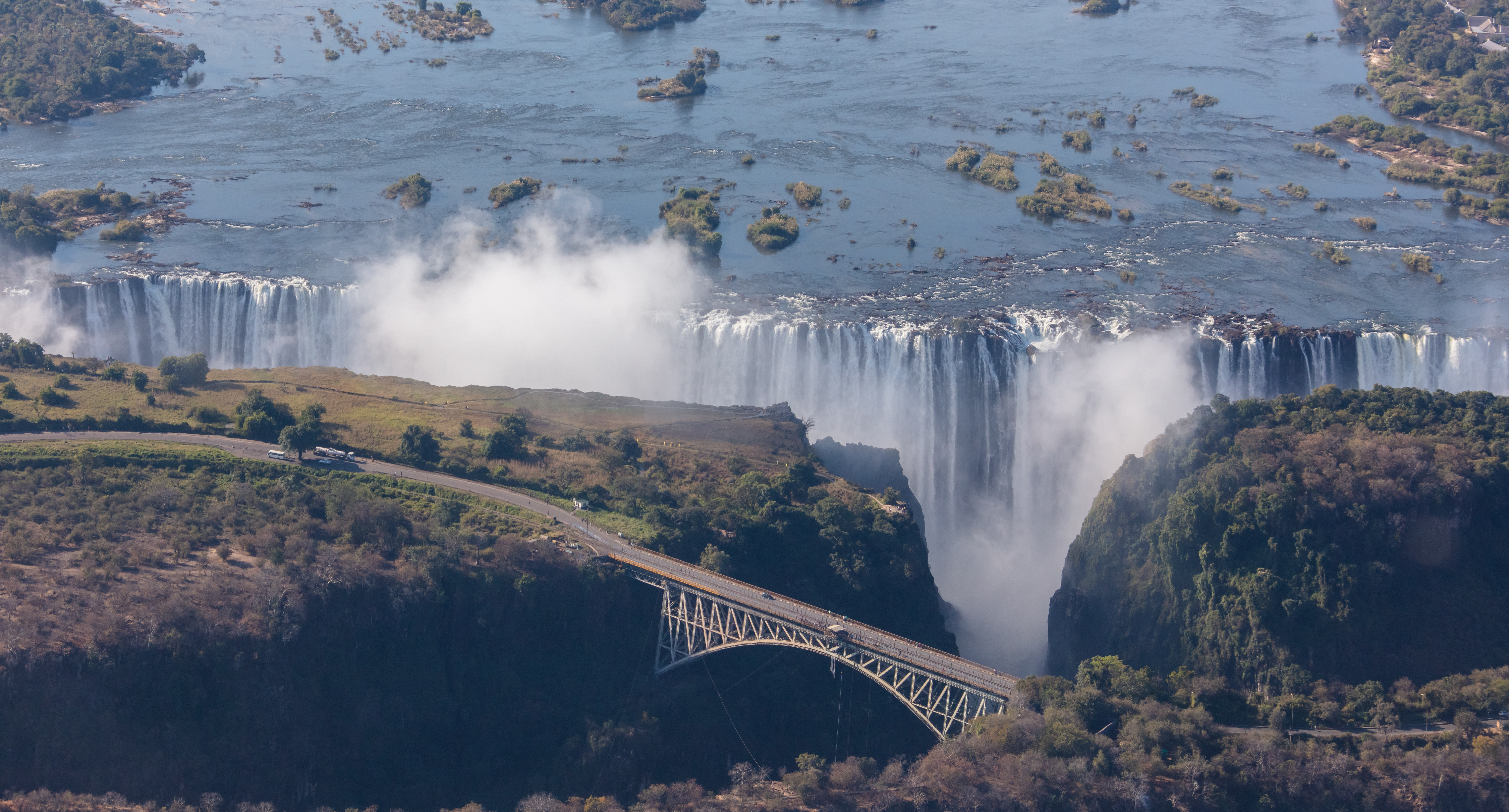
The local name says it best: Mosi-oa-Tunya, “the smoke that thunders.” More than a kilometre and a half wide and, at its highest, over a hundred metres tall, Victoria Falls is the largest single sheet of falling water on earth — and at full flood you hear it, and feel it, long before you see it. The plume of spray rises hundreds of metres into the sky and can be seen from fifty kilometres away.
The complication, and the opportunity, for travellers is that the falls sit on a border. The Zambezi River splits Zimbabwe and Zambia right at the lip of the drop, so the falls belong to two countries at once. Which side should you stand on? When should you go? How do you cross between them, what will it cost, and what else is worth doing while you are there? This guide answers all of it — from the best viewpoints and the wildest activities to visas, money, health, when to come and how to build the perfect trip.
- Local name: Mosi-oa-Tunya — “the smoke that thunders”
- Width: 1,708 m — the world’s largest sheet of falling water
- Height: up to 108 m (Rainbow Falls, the highest point)
- Peak flow: up to ~500 million litres per minute (April–May)
- Shared by: Zimbabwe & Zambia, divided by the Zambezi River
- Protected status: UNESCO World Heritage Site since 1989
- First recorded European sighting: David Livingstone, 16 November 1855
Table of Contents
- A short history, and how the falls were formed
- Zimbabwe or Zambia? The honest answer
- The viewpoints, one by one
- When to go: high water vs low water
- The activities
- Getting there
- Visas, fees and crossing the border
- Money, health and safety
- How long do you need? Sample itineraries
- Add a safari: parks within easy reach
- Travelling responsibly
- Practical tips and what to pack
- Where to stay
A short history, and how the falls were formed
For the San and later the Lozi and Tonga peoples, the falls were long known as Mosi-oa-Tunya. The name that stuck internationally came in November 1855, when the Scottish missionary-explorer David Livingstone was paddled to a small island on the lip of the drop — now called Livingstone Island — and became the first European on record to see the falls. He named them for Queen Victoria, but wrote that “scenes so lovely must have been gazed upon by angels in their flight.”
The geology is just as dramatic as the history. The Zambezi here flows across a broad sheet of hard basalt threaded with softer, cracked seams. Over hundreds of thousands of years the river has torn the falls backwards along one crack after another, carving the zig-zag chain of sheer gorges that snake away below the bridge. Each gorge marks a place where the falls once stood. The curtain you see today is simply the youngest in a long line — and, in geological time, the river is already at work on the next one.
Zimbabwe or Zambia? The honest answer

The falls belong to both countries, and the best trips use both. But if you have to choose, the difference comes down to views versus adventure.
The Zimbabwe side offers the broader, more complete view. Its national park runs along roughly three-quarters of the falls’ width, with around sixteen viewpoints along a rainforest path that look straight into the face of the water. If your priority is simply seeing the falls in their full, jaw-dropping breadth — and getting good photographs — Zimbabwe wins. It is also the more developed tourist town, with more hotels, restaurants and an easy, walkable feel.
The Zambia side is the adventure side. Its views are narrower and more intimate — you get closer to the water, even out onto Knife-Edge Bridge into the spray — but in low-water months the Zambian section can slow to a trickle. What Zambia offers instead is access: this is the side for swimming in Devil’s Pool, stepping onto Livingstone Island, and the leap off the bridge. The town of Livingstone is quieter and more laid-back, though it sits about 10 km from the falls themselves.
The short version: for views, choose Zimbabwe; for adrenaline and getting in the river, choose Zambia; for the full experience, do both — the two sides sit either side of the bridge, an easy walk apart (the towns themselves are about 10 km, or 15 minutes, by road).
| Zimbabwe side | Zambia side | |
|---|---|---|
| The view | ~75% of the falls, ~16 face-on viewpoints | Narrower but intimate; out into the spray |
| Base town | Victoria Falls town — larger, walkable | Livingstone — quieter, ~10 km from the falls |
| Signature experience | Rainforest walk, panoramic photography | Devil’s Pool, Livingstone Island |
| Holds up best in | High water (still viewable through spray) | High water for power; can dry to rock at low water |
| Park entry (approx.) | ~US$50 | ~US$20 |
| Overall vibe | Buzzing tourist hub | Relaxed adventure base |
The viewpoints, one by one

Most visitors walk the paths without realising the falls are actually a sequence of distinct cataracts, each with its own character. From west to east, here is what you are looking at.
Devil’s Cataract (Zimbabwe) is the first you reach and the lowest section, which means it keeps flowing even when the rest is low — often the best single view in the dry months. A statue of Livingstone stands nearby. Main Falls, next along, is the thundering heart of it: the widest, most powerful curtain, and in flood an almost total whiteout of spray. Horseshoe Falls curves gently and is the first to slow to a trickle as water drops. Rainbow Falls, the tallest point of the whole system at around 108 m, throws up the rainbows that give it its name — and, on the right nights, the moonbow.
On the Zambian side, Danger Point is an unfenced rock platform with a heart-in-mouth view down into the gorge, while the Knife-Edge Bridge is the star: a footbridge that takes you out through the spray for a face-on look back at Rainbow Falls and the Eastern Cataract (expect to get soaked in high water). Below, where the two currents collide, the Boiling Pot churns at the entrance to the gorges and the bridge.
When to go: high water vs low water
Victoria Falls is a completely different place depending on the season, and there is no single “best” time — only the right time for what you want.
High water (roughly February to May, peaking April–May). The Zambezi is in full flood, the falls roar at maximum power, and the spray rises hundreds of metres — visible from miles away. It is spectacular and primal. The trade-off: that same spray can completely obscure the view, soaking you and your camera and hiding the falls behind a wall of mist, particularly on the Zambian side. This is the time to favour the Zimbabwe viewpoints and bring a waterproof.
Low water (roughly September to December). The flow drops, the spray clears, and you can see the rock face and the structure of the gorge. The Zambian side can dry out substantially — October and November are the lowest, and the Zambian section may be reduced to bare rock — but this is exactly when the adventure opens up: Devil’s Pool, the famous natural infinity pool right on the lip of the falls, is only safely accessible in the low-water months (roughly August to January). Rafting is also at its best.
The shoulders (June to August) are a fine all-round compromise: strong but not blinding flow, good views from both sides, and pleasant dry-season weather — which is also why these are the busy months.
| Month | Water level | Weather | Crowds | Best for |
|---|---|---|---|---|
| Jan | High, rising | Hot, wet | Low | Green scenery, Devil’s Pool (early) |
| Feb | Rising | Hot, wet | Low | Quiet, lush, few crowds |
| Mar | High | Warm, humid | Low–med | Building power and spray |
| Apr | Peak flood | Warm | Med | Maximum thunder and spray |
| May | Peak / high | Mild, drying | Med–high | Full power with better weather |
| Jun | High–moderate | Cool, dry | High | Great all-round; cold nights |
| Jul | Moderate | Cool, dry | High | Peak season, clear skies |
| Aug | Dropping | Warming, dry | High | Good views; Devil’s Pool opens |
| Sep | Lower | Warm, dry | Med–high | Devil’s Pool and rafting prime |
| Oct | Low | Hot, dry | Med | Adventure season; hottest month |
| Nov | Lowest | Hot, first rains | Low | Bare rock on the Zambian side |
| Dec | Low, rising | Hot, wet onset | Low | Quiet, green returning |
Victoria Falls is one of only a handful of places on earth where you can reliably see a lunar rainbow — a rainbow cast by the light of a full moon through the spray. For a few nights around each full moon, both national parks open after dark for moonbow viewing (a separate ticket). If your dates line up with a full moon in the higher-water months, it is an unforgettable add-on.
The activities

Beyond the viewpoints, this is one of Africa’s great adventure hubs — and the range runs from gentle to genuinely heart-stopping.
For the adrenaline seekers, the Zambezi below the falls delivers some of the best commercially rafted white water in the world, tumbling through the Batoka Gorge (best in the low-water months). The Victoria Falls Bridge is the launch point for a 111-metre bungee jump, a gorge swing and a zip line strung across the chasm. On the Zambian side in low water, Devil’s Pool lets you slide into a natural rock pool on the very lip of the drop, with the river pouring over beside you — always with a guide, usually combined with a visit to Livingstone Island and its famous “picnic on the edge.”
For a gentler pace, a helicopter “Flight of Angels” is the only way to truly grasp the scale, banking over the full width of the falls and the zig-zag gorges. Back on the water, sunset cruises on the upper Zambezi serve sundowners among hippos, elephants and birdlife; canoeing and tiger fishing fill a relaxed half-day; and guided rainforest walks, a historical bridge tour and cultural village visits round out the picture. (If a scenic flight is on your list, you may enjoy our take on a very different one in our Okavango Delta helicopter feature.)
| Activity | Approx. price (per person) | Notes |
|---|---|---|
| White-water rafting (full day) | US$150–180 | Batoka Gorge; best at low water |
| Bungee jump (111 m, the bridge) | ~US$160 | +US$40–60 for video |
| Gorge swing / bridge swing | ~US$120 | Freefall into the Batoka Gorge |
| Zip line / flying fox | ~US$65 | Across the gorge |
| Helicopter “Flight of Angels” | US$150–320 | 12–25 minute options |
| Devil’s Pool + Livingstone Island | US$100–170 | Zambia; low water only (~Aug–Jan) |
| Sunset river cruise | US$50–80 | Sundowners, hippos, birdlife |
| Guided falls / rainforest tour | US$20–60 | Plus park entry |
| Canoeing (upper Zambezi) | US$100–150 | Half or full day |
Getting there
Victoria Falls is remarkably easy to reach for somewhere so wild, served by three airports across two-and-a-bit countries.
- Victoria Falls Airport (VFA), Zimbabwe — the main gateway, ~22 km (30 min) from town.
- Harry Mwanga Nkumbula Airport (LVI), Livingstone, Zambia — ~6 km from Livingstone, ~25 km from the falls.
- Kasane Airport (BBK), Botswana — ~2 hours by road via the Kazungula border; handy if you are combining with Chobe.
Most visitors connect through Johannesburg, from where it is about a 90-minute flight (Airlink, Fastjet and others), with further links via Nairobi and Addis Ababa. On arrival, a pre-booked lodge or hotel shuttle is how most guests travel; licensed taxis run about US$30–40 into town, and the major car-hire firms have airport desks. For something more romantic, luxury rail journeys such as Rovos Rail arrive into Victoria Falls in grand style.
Visas, fees and crossing the border

This is where a little planning saves money and hassle. Two costs are easy to confuse: the visa that lets you into the country, and the park entry fee paid at each falls gate. They are separate, and you pay both.
- KAZA UniVisa — ~US$50. The smart buy if you’ll see both sides: covers Zimbabwe and Zambia for 30 days with unlimited crossings, and allows Botswana day trips at Kazungula (for Chobe). Around 65 nationalities are eligible.
- Single-entry visas: Zimbabwe ~US$30; Zambia ~US$50.
- Park entry (separate, per side): Zimbabwe ~US$50; Zambia (Mosi-oa-Tunya) ~US$20.
- Pay in cash US dollars. UniVisa availability can vary — check its current status before you travel.
The crossing itself is straightforward: the historic Victoria Falls Bridge spans the gorge between the two countries, and you can walk, taxi or take a transfer across with your passport and the appropriate visa. On foot it takes only five to ten minutes, with a passport stamp on each side. The bridge is also a sight in its own right — and the bungee platform.
Money, health and safety
None of this is difficult, but a few local quirks are worth knowing before you arrive.
The US dollar is king on both sides of the border — bring clean, small notes (US$1, 5, 10) for tips, markets, visas and park fees. Zimbabwe’s local currency is the gold-backed ZiG (introduced 2024); Zambia uses the kwacha. You may receive local currency as change. Cards work at hotels and larger operators, but ATMs mostly dispense local currency, not USD — so don’t rely on them for dollars.
- Malaria is present year-round (higher in the wet months) — take prophylaxis and use repellent.
- A yellow-fever certificate is only required if you are arriving from a risk country.
- Drink bottled or filtered water; the sun is fierce — hat, sunscreen, water.
- The towns are relatively safe, but wild animals move through them — elephants, buffalo, baboons and warthogs. Keep your distance, never feed them, and take care after dark.
How long do you need? Sample itineraries

Two full days is the sweet spot for most visitors, but the falls flex from a whistle-stop to the anchor of a fortnight.
One day (a stopover). See one side — Zimbabwe for the full panorama — in the morning, then a sunset cruise to round it off. Enough to say you’ve been, not enough to feel it.
Two days (the sweet spot). A day for each side of the falls, with one signature activity slotted in — a helicopter flight or a rafting run. You’ll cross the bridge, see the falls in two moods, and still have time to breathe.
Three to four days (do it properly). Add Devil’s Pool (in season), a full rafting day, and a Chobe day trip into Botswana for the elephants and a river cruise — then an overnight in Hwange or at a Zambezi lodge to fold a genuine safari into the trip.
Longer still, Victoria Falls is the perfect hinge for a wider Southern Africa journey — pairing naturally with Hwange, Chobe, the Okavango Delta or a Zambezi houseboat.
Add a safari: parks within easy reach
One of Victoria Falls’ quiet advantages is that it doubles as a safari hub — you don’t have to choose between the waterfall and the wildlife. Several excellent parks and reserves sit within about a two-hour radius on both sides of the river.
Three of them are right on the doorstep, easily done in a morning or an afternoon. Zambezi National Park (Zimbabwe) begins barely five kilometres upstream of the town — under ten minutes from the falls — with riverfront game drives for elephant, buffalo, lion, sable, giraffe and zebra, and more than 400 recorded bird species. On the Zambian side, Mosi-oa-Tunya National Park wraps around the edge of Livingstone and shelters Zambia’s only white rhino: a small, closely guarded population you can track on foot or by vehicle, alongside giraffe, zebra, buffalo and elephant. There are no large predators here, which is exactly what makes those rhino walks possible. Back in Zimbabwe, the Victoria Falls Private Game Reserve — the Stanley & Livingstone reserve, about ten minutes from town — protects the region’s only viable breeding herd of critically endangered black rhino, and rhino tracking on the reserve is its signature experience.

For a bigger day out, two heavyweight parks are within a couple of hours. Chobe National Park, entered at Kasane in Botswana, lies roughly 80 kilometres away — about 90 minutes including the Kazungula border crossing — and is famous for its enormous elephant herds and its unforgettable river cruises; it is the classic Victoria Falls day trip, and with a KAZA UniVisa an easy fourth-country add-on. Hwange National Park, Zimbabwe’s largest, is around a two- to two-and-a-half-hour drive to the Main Camp gate: huge elephant populations, lion, wild dog, buffalo and giraffe make it the closest thing to a full Big Five safari in the region, and it pairs naturally with the falls as an overnight extension.

Travelling responsibly
Victoria Falls is a place where your choices matter. Give a wide berth to captive-wildlife attractions — “walking with lions,” cheetah petting and elephant-back rides all carry serious welfare and conservation concerns, however they are marketed. Choose established, accredited operators for activities; tip fairly; and buy from the craft markets directly, where a little friendly bargaining is expected and your money reaches the maker. Keep your distance from the elephants and baboons in town, take your litter with you, and remember that your park fees and conservation levies are part of what keeps this World Heritage Site — and its wildlife — protected.
Practical tips and what to pack

A little preparation goes a long way. Book Devil’s Pool, helicopters and rafting well ahead in peak season, and sort your UniVisa strategy before you arrive rather than at the bridge.
- Lightweight rain jacket and a dry bag for phone and camera (the “rainforest” earns its name in high water)
- Shoes with grip — the paths get slick with spray
- Small US dollar notes for fees, tips and markets
- Sun hat, sunscreen, insect repellent and antimalarials
- Swimwear (Devil’s Pool, hotel pools) and quick-dry clothes
- Binoculars and a camera — weather-sealed if you have one
- Neutral colours if you’re adding a game drive
Where to stay
Victoria Falls has one of the richest accommodation scenes on the safari circuit, and it splits cleanly by side of the river — grand hotels and riverside lodges around Victoria Falls town in Zimbabwe, and a livelier mix of camps and lodges around Livingstone in Zambia.
Zimbabwe side — Victoria Falls town & Zambezi National Park
Victoria Falls Hotel
A grand Edwardian-era hotel dating to 1904, a short walk from the falls and the historic bridge, with sweeping lawns, resident vervet monkeys and colonial-era afternoon tea on the terrace.


Matetsi Victoria Falls
A family-owned riverside lodge set within a private concession on the Zambezi upstream of the falls, built around the River House and a scattering of suites overlooking the water. Days here mix sundowner drives with quiet stretches of private river frontage, away from the town’s bustle.


Victoria Falls River Lodge
Part of the Zambezi Crescent collection, this lodge sits on a broad bend of the Zambezi within Zambezi National Park, with unfenced river frontage and wildlife often passing along the banks. It’s a short drive from Victoria Falls town, pairing bush setting with easy access to the falls.


Palm River Hotel
A Palm Hospitality property on the banks of the Zambezi, combining polished hotel-style service with a riverside garden setting a short drive from Victoria Falls town. Rooms open onto the river frontage, with the water and its wildlife as a constant backdrop.


Ilala Lodge
Sister property to Palm River Hotel under Palm Hospitality, Ilala Lodge sits in landscaped gardens within walking distance of both the falls and Victoria Falls town, with elephant and other wildlife regularly passing through its unfenced grounds.


Anantara Stanley & Livingstone Victoria Falls Hotel
A sophisticated hotel set within the Victoria Falls Private Game Reserve, about ten minutes from town, where black rhino tracking is the signature experience. Elegant suites open onto the bush, with candlelit terrace dinners and sundowners over the plains a regular feature of a stay.


Bayete Guest Lodge
A 30-room owner-run lodge in a quiet residential pocket of Victoria Falls, built around a tropical garden and teardrop pool with a Zambezi-style tavern at its centre. Rooms range from twin/double suites to a family cottage, with breakfast and Wi-Fi included — a relaxed garden base a short drive from the falls themselves.


Zambia side — Livingstone & Mosi-oa-Tunya National Park
Royal Livingstone Hotel by Anantara
A five-star classical hotel on the Zambian riverbank inside Mosi-oa-Tunya National Park, close enough to the falls that you can walk there through the spray. Zebra and giraffe wander the grounds, and its riverside pool and sundowner terrace look straight out over the Zambezi.


AVANI Victoria Falls Resort
A large, lively resort on the Zambian riverbank in Livingstone, popular with families and groups and a regular venue for conferences and destination weddings. Its buffet-style Theatre of Food restaurant is a highlight, and the Mukuni Boma dinner and drum show is an easy stroll away.


Wilderness Toka Leya
A Wilderness camp set on the banks of the Zambezi within Mosi-oa-Tunya National Park, a short game drive from Livingstone. Its riverfront rooms look out over island channels upstream of the Falls, with elephant and hippo often visible from the deck.


Victoria Falls Waterfront
A Safpar property spread along the Zambezi just upstream of the Falls in Livingstone, popular as a base for river and adventure activities as well as a stay in its own right. River-facing rooms sit right on the water’s edge, with the sound of the river as a constant backdrop.


Taita Falcon Lodge
An Everwild lodge perched on the edge of the Batoka Gorge below Victoria Falls, named for the rare falcon that nests on the cliffs nearby. Its chalets look straight down into the gorge and the Zambezi’s white water, a dramatic contrast to the riverfront lodges elsewhere in the area.


Maramba River Lodge
An independent lodge on the banks of the Maramba River just outside Livingstone, set in gardens that draw regular visits from vervet monkeys and birdlife. It offers an easy, laid-back base close to town, with the Falls and the Zambezi’s activities a short drive away.


Mukwa River Lodge
A Residence Collection property on the Zambezi just outside Mosi-oa-Tunya National Park, combining a boutique, design-led feel with a riverside setting close to Livingstone. Rooms open onto the water, with the river and its passing wildlife as the main draw.

