The cat that loses
Cheetahs are the fastest land animal, and the least equipped to keep what they catch. They can’t fight off lions, can’t drag a kill up a tree like a leopard, and can’t afford an injury. That combination, more than anything, explains why there are so few of them.
It also explains why a cheetah sighting is different: they hunt in daylight, in the open, which makes them the one big cat you have a realistic chance of watching hunt.
How few are left
The IUCN lists the cheetah as Vulnerable, with about 6,500 mature individuals left and a declining trend, in an assessment made in 2021.
The landmark study is Durant and colleagues, published in 2017, which put the total at roughly 7,100 adults and adolescents and found cheetahs occupy just 9% of their historic range. Two thirds of them live outside protected areas, on farmland and communal land, where they run into people and livestock.
The biggest single population, more than half the world total, is a transboundary one spread across Angola, Botswana, Mozambique, Namibia, South Africa and Zambia.
In Asia the picture is bleaker. The Asiatic cheetah survives only in Iran, where a national count in February 2026 put the number at 27 animals.
Why so few
They live at low density. Even where they’re protected, cheetahs need vast areas. The Serengeti Cheetah Project, running since 1974, follows only about 50 adult females and 20 adult males on the southern plains at any one time.
Bigger predators take their food and their cubs. A cheetah that has sprinted needs to cool down before it can eat, and that’s the window when lions and hyenas move in. Research in the Serengeti found lone cheetahs bolt their food, while mothers stand guard so their cubs can eat slowly.


Cub survival is low, but not everywhere. In the Serengeti, a study found fewer than 1 in 20 cubs survived to 14 months. In the Kgalagadi, a later study found more than 1 in 3 did, and no evidence that lions were the cause. How much of the Serengeti loss lions really account for is disputed.
Most cheetahs live outside parks. That puts them in conflict with farmers, and it’s where organisations such as the Cheetah Conservation Fund concentrate their work.
Cubs are trafficked. The Cheetah Conservation Fund estimates that around 300 cubs a year are taken from the wild, mostly from the Horn of Africa and mostly destined for the Arabian Peninsula, and that around three in four die in transit. That is the organisation’s own estimate rather than a peer-reviewed figure, but the trade is well documented.
They have almost no genetic diversity. Cheetahs went through severe population bottlenecks, the most recent around 11,000 to 12,500 years ago. Today they retain a fraction of the genetic variation of a typical mammal, which affects fertility and leaves them vulnerable to disease.
How fast, really
The widely quoted 114 km/h comes from old, uncontrolled measurements. The best data on wild cheetahs comes from a study in Botswana published in Nature in 2013, which fitted five cheetahs with GPS collars and recorded 367 runs. The fastest was 93 km/h.
More interesting: most hunts happened at moderate speed, averaging around 50 km/h. What decided success wasn’t top speed but grip, acceleration and the ability to turn.

Where to see cheetahs
Maasai Mara and its conservancies, Kenya
The Maasai Mara is the best-known cheetah destination in East Africa: open, short-grass country where a cat on a termite mound is visible from a long way off. A 2014 survey, the first rigorous one there, estimated about 1.3 adult cheetahs per 100 km².
Where you stay matters. In the national reserve itself there is no limit on vehicles at a sighting, and it isn’t unusual to see more than 30 around one cheetah. The surrounding conservancies allow only five.

See our Maasai Mara Where to Stay page.
Serengeti and Ndutu, Tanzania
The southern Serengeti plains hold the longest-studied cheetah population anywhere, followed since 1974. The short-grass plains around Ndutu are at their best from December to March, when the wildebeest are calving and prey is everywhere.

Kgalagadi Transfrontier Park, South Africa and Botswana
Red dunes, dry riverbeds and very little cover. SANParks rates the chances of seeing cheetah in the Kgalagadi as excellent, and the dry riverbeds concentrate both the game and the tracks you drive.
It is also where researchers found much higher cub survival than in the Serengeti, in a landscape with far fewer lions and hyenas.

Namibia and Etosha
Namibia holds the largest national cheetah population, and most of those animals live on farmland rather than in parks. That is the context for the Cheetah Conservation Fund, based near Otjiwarongo, whose work with farmers is one reason the population has held on. In Etosha, the open pans and short grass give you long sightlines, which is exactly what you want for a cat that hunts by day.

South Africa’s fenced reserves

South Africa runs the most managed cheetah population in the world. The Endangered Wildlife Trust’s metapopulation project links 70 fenced reserves covering 14,204 km², holding roughly 540 cheetahs as of December 2025, with more than 700 translocations since 2012 to keep the genetics healthy.
For visitors that means reserves such as Madikwe offer some of the most reliable cheetah viewing in Africa. It is worth knowing that this is an actively managed population, not a naturally connected one.
Zambia: a comeback in progress
In July 2026, six cheetahs from South African reserves were released in North Luangwa, the first in the Greater Luangwa ecosystem since the late 1990s. Further releases are planned. It is a story worth following, not yet a place to go for cheetah sightings.
Watching cheetahs without harming them
This matters more for cheetahs than for other cats.
Research from the Mara Cheetah Project found that in high-tourism areas, female cheetahs raised on average one cub or none per litter to independence, compared with more than two in low-tourism areas. Vehicles crowding a cheetah can cost it a hunt, and a mother who can’t hunt can’t feed cubs.
What helps:
- Choose conservancies or private reserves with vehicle limits where you can. The Mara conservancies cap sightings at five vehicles.
- Keep back. Researchers there recommend at least 30 metres.
- Never park between a cheetah and its prey, and never surround one.
- If a cheetah climbs on your vehicle, which happens in the Mara, stay still and quiet and let it leave in its own time.
Explore more on 25South
- African Wild Dogs: the other endangered predator worth chasing.
- Leopards on Safari: where to see them.
- Etosha Self-Drive Guide: planning the Namibian side.
- Kgalagadi Transfrontier Park: the reserve profile.
Sources
- IUCN Red List assessment, cheetah (2021, CMS copy)
- IUCN Cat Specialist Group, cheetah
- Durant et al., 2017, PNAS: the global decline of the cheetah
- Cheetah Conservation Fund, about cheetahs
- Cheetah Conservation Fund, illegal pet trade
- Mongabay, the Asiatic cheetah (2026)
- Serengeti Cheetah Project
- Mills & Mills, 2014, cheetah cub survival revisited
- ScienceDaily on Hilborn et al., 2018, how cheetahs eat
- O’Brien et al., 2017, cheetah genetics
- Wilson et al., 2013, Nature: locomotion dynamics of hunting cheetahs
- Broekhuis & Gopalaswamy, 2016, cheetah density in the Maasai Mara
- The Conversation, cheetahs in the Maasai Mara and tourism
- SANParks, Kgalagadi mammals
- Endangered Wildlife Trust, cheetah metapopulation
- Mongabay, cheetahs reintroduced to Zambia’s Greater Luangwa (2026)
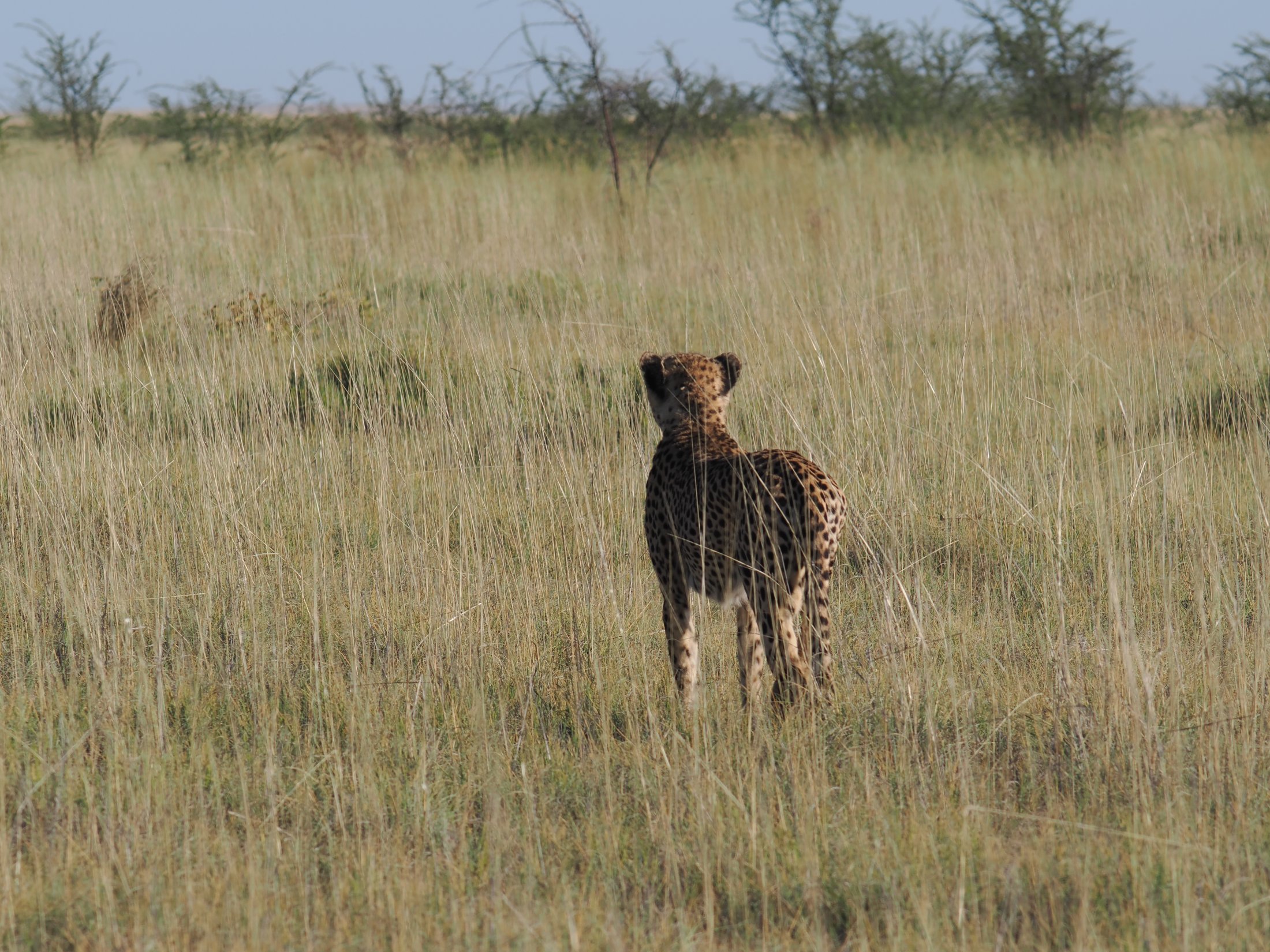
Top photo: cheetah, Etosha National Park, Namibia. Photo by 25° South