The rarer animal is doing better than the common one. That is the part almost nobody expects.
At the end of 2024 Africa held 22,540 rhinos. Black rhinos, the critically endangered ones, were up 5.2 percent on the year, to 6,788. White rhinos, the conservation success story everyone cites, were down 11.2 percent, to 15,752.
Both animals are grey. Neither is white. They are two different species with different mouths, different diets, different temperaments and different futures, and once you know what to look for you will never mix them up again.
How we report on rhinos
Rhino horn is worth killing for, which makes writing about rhinos different from writing about any other animal on this site. Three rules apply here and to every rhino photograph we publish.
We name reserves and national parks, because the parks name themselves and their own conservation work depends on visitors knowing where to go. We do not publish rhino numbers for any individual reserve. That follows Save the Rhino International, which never publicises the size of a rhino population in a particular location. And we publish nothing that narrows a location further than the reserve: no roads, waterholes or hides, no dated sightings, no ranger positions, and no GPS data left in any image we upload.
The continental and national figures in this article come from the IUCN Species Survival Commission’s African Rhino Specialist Group. Poaching figures come from the governments that publish them.
If you photograph a rhino yourself, switch geotagging off before the game drive. Kruger National Park asks visitors to do exactly that.
Telling them apart
The mouth is the whole thing. Everything else follows from it.
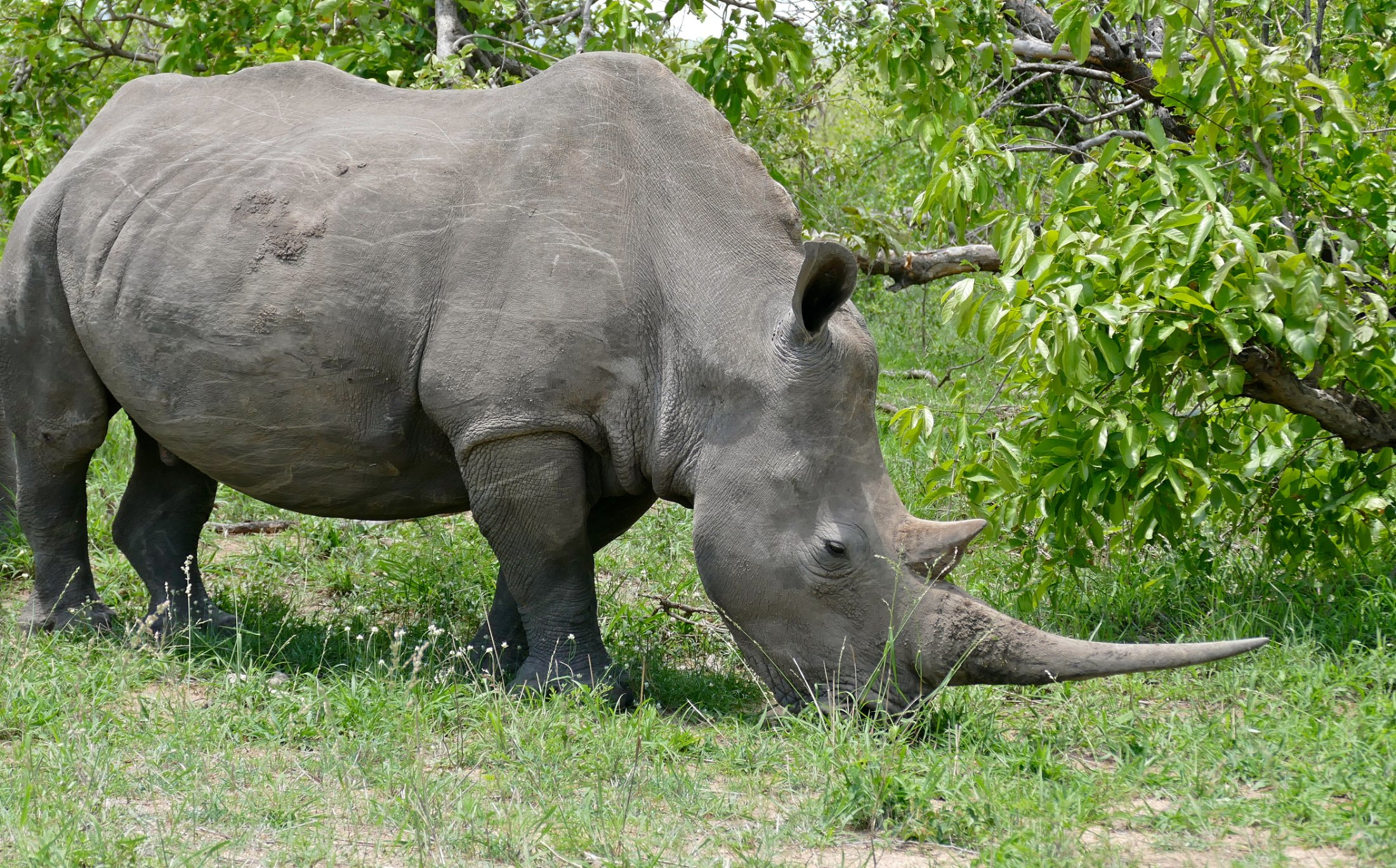
A white rhino has a broad, square, straight-lipped mouth, which is essentially a lawnmower. It is a grazer, built to crop short grass, and it spends about half its day doing exactly that. A black rhino has a pointed, prehensile upper lip that works like a finger, hooking leaves and twigs off woody plants. It browses, taking from more than 200 plant species, and chooses quality over quantity.

Because a white rhino eats off the ground, it carries its head low, with a heavy muscular hump on the neck to hold that enormous head up. A black rhino feeds at chest height, so it carries its head high. At any distance where you cannot make out the lips, head carriage tells you which animal you are looking at.
Size follows too. A white rhino bull runs 3.7 to 4 metres long and weighs 2,000 to 2,300 kilograms, cows a little less. A black rhino stands 1.32 to 1.8 metres at the shoulder and weighs 800 to 1,400 kilograms. The white rhino is the second largest land mammal alive, after the elephant.
Temperament splits the same way. Grassland animals can see what is coming, so white rhinos are relatively placid and sociable, forming groups of up to fourteen, usually cows and calves. Bulls are mostly solitary and mark territory with dung middens. Black rhinos live in thick bush where a threat arrives at ten metres, and they have a reputation for charging first. They will charge tree trunks and termite mounds too. They are largely solitary.
Two field notes worth carrying. The old line about rhinos being nearly blind is wrong: black rhino eyesight is roughly as good as a rabbit’s, which is not brilliant but is a long way from blind. And guides across Southern Africa use the calf rule. A white rhino calf usually runs ahead of its mother, a black rhino calf behind her. It is a rule of thumb rather than a law, but it works often enough to be worth knowing.

Horns are keratin, the same material as a fingernail, and they are not attached to the skull. On a white rhino the front horn averages around 60 centimetres, and the longest reliably recorded reached 166 centimetres. Black rhino front horns are typically shorter, around 50 centimetres.
Why “white” has nothing to do with colour
You will be told, by a guide or a guidebook or a sign at a gate, that “white” is a mistranslation of the Dutch or Afrikaans wijd, meaning wide, for the animal’s wide mouth. It is a good story. There is no evidence for it.
Kees Rookmaaker reviewed the question in 2003 and found no written record of wijd ever being used to describe the rhinoceros. The English term “white rhinoceros” appears to have come first, and Dutch and Afrikaans then borrowed it back and translated it literally. The honest answer is that nobody knows where the name came from.
The black rhino’s name is simpler. It was almost certainly coined only to distinguish it from the white one.
What the numbers actually say
The 11.2 percent drop in white rhinos needs care, because the obvious reading of it is wrong. It does not mean two thousand animals were shot in a year.
The IUCN lists several causes together: illegal killing, extended droughts, management limitations, corrections to previous surveys, and poor population reporting from some countries and jurisdictions. South Africa, which holds the overwhelming majority of the world’s white rhinos, reported 14,074 at the end of 2024, more than 15 percent down. Part of that is real loss. Part of it is that some provinces did not update their estimates after 2023, and part is a suspicion that the survey method used in one major park had overestimated the population to begin with.
Poaching, meanwhile, is genuinely improving. Africa’s poaching rate fell to 2.15 percent in 2024, the lowest since 2011. South Africa lost 352 rhinos in 2025, down 16 percent from 420 in 2024 and down from around 500 in 2023. The department announced those figures on 11 February 2026.
But the pressure moved rather than disappearing. Kruger National Park lost 174 rhinos in 2025, nearly double its 88 in 2024. KwaZulu-Natal went the other way, falling from 198 to 63. Poaching is a market with logistics, and it goes where the defences are thinnest.
Against that, the black rhino has been climbing for three decades. The species fell from around 70,000 in 1970 to 2,410 by the mid-1990s. Everything since has been slow, expensive, heavily guarded recovery, and 6,788 is the result. One subspecies did not make it: the western black rhino was declared extinct on 10 November 2011.
Why so many rhinos have no horn
If you see a rhino in Southern Africa with a flat stump where the horn should be, it has been dehorned, and it is far more likely to be alive because of it.
Dehorning is done under anaesthetic by a vet. The horn is cut above the growth plate, which does not hurt the animal, and it grows back over about eighteen months, so it has to be repeated.

Until recently the argument for it was intuitive rather than evidenced. That changed in June 2025, when Tim Kuiper and colleagues published a study in Science covering eleven reserves in the Greater Kruger between 2017 and 2023. Across eight of those reserves, 2,284 rhinos were dehorned. Poaching fell by 78 percent, achieved with 1.2 percent of the total rhino protection budget. Over the same period, 74 million dollars of reactive law enforcement showed no statistical evidence of reducing poaching at all.
The authors are careful about the limits. Dehorned rhinos are still killed for the stub and for regrowth, and that has been a growing problem through 2024 and 2025. Dehorning in one place may also push poachers towards horned populations elsewhere. It buys time. It does not solve anything.
It is worth knowing this before you see it, because a dehorned rhino looks like a diminished animal and it is not. It is a managed one.
Where to see them
At reserve level, these are the places where each species can still be found.
South Africa
Hluhluwe-iMfolozi in KwaZulu-Natal is the reason the southern white rhino exists at all. By the end of the nineteenth century the species was down to somewhere between 20 and 100 animals, all of them here. The Umfolozi Junction Reserve was proclaimed around them in 1895, one of Africa’s first protected areas, and by the 1950s the population had passed 400. Operation Rhino, begun by Ian Player in 1960, then moved founder groups out across the species’ former range, which is why almost every southern white rhino alive today traces back to this park. It holds both black and white rhino today. Kruger holds both as well, though both species have declined sharply there since 2011.
Namibia
Etosha is the core of the country’s black rhino range, and Namibia is one of the species’ strongholds. Further west, in the Kunene and around Damaraland and Palmwag, black rhinos live outside any national park on communal land, tracked on foot by Save the Rhino Trust, which describes them as the world’s last truly wild black rhino population. There is no white rhino equivalent to that anywhere. It is the most distinctive rhino experience in Africa.

Kenya
Kenya held 2,102 rhinos in September 2025: 1,059 black, 1,041 southern white, and the last two northern whites. That is a remarkable recovery from fewer than 400 black rhinos in the mid-1980s, down from perhaps 20,000 before the 1970s. The country’s rhinos live in a network of sanctuaries and conservancies, among them the Laikipia conservancies, Lake Nakuru, Meru, Nairobi National Park and Ngulia in Tsavo West.
Tanzania and Rwanda
The Ngorongoro Crater is the most reliable place in Tanzania to see eastern black rhino, though they are usually distant. Akagera in Rwanda has both species, rebuilt from nothing: African Parks moved 70 white rhinos there in 2024, from the 2,000-animal captive breeding herd it took over in 2023.
The last two

Najin and Fatu live at Ol Pejeta in Kenya. They are mother and daughter, and they are the only northern white rhinos left alive. Sudan, the last male, was euthanised on 19 March 2018.
The subspecies was presumed extinct in the wild in 2008. Neither female can carry a pregnancy. Whether anything comes of the embryo work being done is an open question, and some taxonomists argue the northern white was a full species all along, which would make this an extinction rather than the loss of a subspecies.
It is the clearest illustration available of why the rules at the top of this article exist. A species does not usually vanish in one dramatic moment. It goes one animal at a time, and the last stretch happens in full view of people who are trying very hard to stop it.
Sources
- IUCN SSC African and Asian Rhino Specialist Groups, African and Asian rhino population and poaching figures to the end of 2024, published August and September 2025.
- Department of Forestry, Fisheries and the Environment, South Africa, rhino poaching statistics for 2025, announced 11 February 2026.
- Kuiper, T. et al., “Dehorning reduces rhino poaching”, Science, June 2025.
- Rookmaaker, K., on the origin of the name “white rhinoceros”, 2003.
- Sheldrick Wildlife Trust, Kenya rhino population figures, September 2025.
- Save the Rhino International, rhino population figures and guidance on responsible rhino tourism.