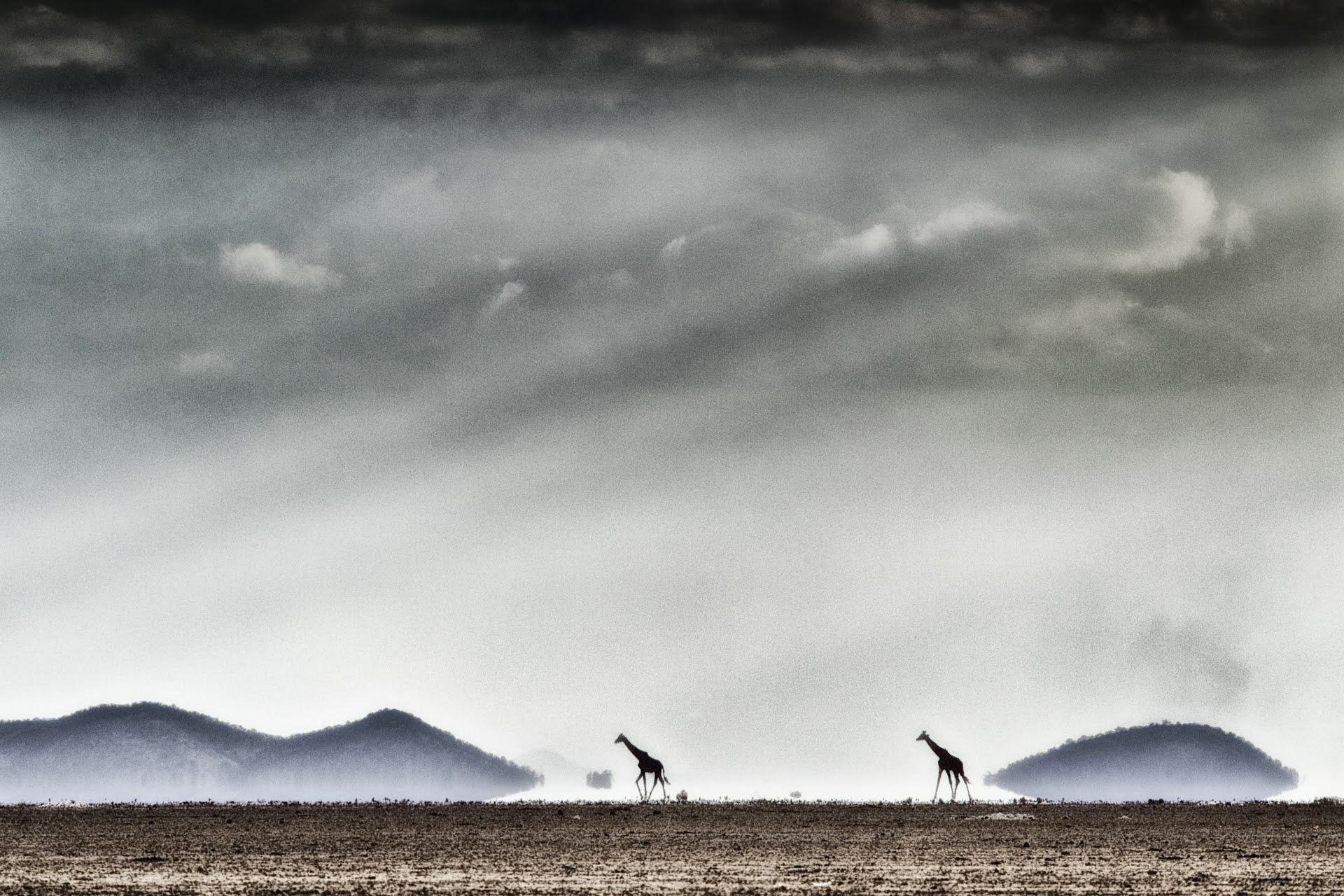
A good day starts before the light does. Out of camp pre-dawn, working the early morning mist, hoping for an elephant “as he disappears like a ghost”. Then find whatever they are working on that week, lions, leopards, cheetah or painted dogs, and sit with them. Not for an hour. For the day. “waiting, taking, thinking, working the light, working the action.” Then the golden hour, then back to camp, “just Dereck and me at the fire laughing about life and love and the future.”
That is what Beverly Joubert says a good day in the field looks like now, forty years in, compared with the early years in Botswana. Read it again and notice what is missing from it. There is no drive to the next sighting. Nobody moves on.

Beverly Joubert has spent forty years photographing Africa. With her husband Dereck she has made more than forty films for National Geographic, won multiple Emmys and a Peabody, published twelve books, and founded Great Plains Conservation and, with National Geographic, the Big Cats Initiative. Both are National Geographic Explorers at Large. Most people know them as a pair, and that shorthand hides a division of labour. Dereck runs the film cameras and writes the words. Beverly shoots the stills. The photograph you remember from a Joubert film is almost always hers, and until last year there was no book that said so.
Wild Eye: A Life in Photographs, published by National Geographic in November 2025, is that book. It runs to 416 pages and more than 250 photographs from four decades in Kenya, Botswana, Zimbabwe and Tanzania. Beverly took them. Dereck wrote the text that sits alongside. Many had never been published, for a reason less mysterious than it sounds: “There has never been the occasion to use some of these.”
Getting questions in front of a photographer of that standing does not happen often, and we are grateful she made the time. The answer we expected least is the one worth starting with.
The hardest animal in Africa

The cover of Wild Eye is Legadema, the leopard the Jouberts followed for four years in Botswana’s Okavango Delta and the subject of their 2006 film Eye of the Leopard. Her name means light of the sky in Setswana. Everyone asks about her, so we asked instead which animal Beverly finds herself returning to when Legadema is set aside.
Not a cat. Elephants, “both the most engaging and most challenging”, and for a reason that has nothing to do with how hard they are to find.
“Large grey animals are difficult to make look good, which is why Rings of Gold, a single bull in a lake with ripples from him but focussing the eye on him, is my way of working the frame and making an elephant look more exciting. It is easy to get an image of an elephant, and that is a handicap in itself… everyone has one…but then how to make it exceptional?”
Beverly Joubert
That is the trap, and it is worth naming because every one of us falls into it. The elephant stands still, fills the frame and photographs itself. The picture comes out grey, competent and identical to the one everybody else has. Ease is the handicap.
What she does about it is not a technique. It is a change of subject.
“What I reach for in the image is something that tells the viewer about what it is like to be an elephant. A trunk tip touches a baby as the family enters the Zambezi River and its strong current…a baby fondles and sucks on a mother’s tusk. Sometimes I look for the parallels between them and us… is the baby using an adult’s tail as a pacifier? Stories.”
Beverly Joubert
One word, at the end, doing all the work. She is not photographing an elephant. She is photographing a sentence about an elephant, and the animal happens to be in it.

Inside the golden rectangle
In 2025 she photographed humpback whales and grizzly bears in Alaska, a rare step off the continent for someone who has spent a working life on one. We expected the lesson to be about cold light or unfamiliar animals. It was about discipline.
“I was not capturing images, I was telling stories within the limited confines of a frame,” she wrote, “something I work on daily in Africa.” Then she turned the answer around and aimed it back at home, where the real difficulty is.
“I also think that in Africa the moments can be so overwhelming, with hyenas and lions fighting, blood everywhere, noise and dust, that it is easy to get distracted. So I learned to zone in and focus that frame and discard everything else. Same with whales. the boat may be rocking or rolling but what is happening inside that golden rectangle.”
Beverly Joubert
The golden rectangle is the frame itself, the proportions a picture is built inside. Anyone who has sat through a big sighting knows the feeling she is describing. The noise is thrilling and it is also the enemy. It pulls the camera around the scene instead of into the frame, and you come home with two hundred files and nothing you would print. Her fix is to shrink the problem until only the rectangle is left.

What surprised her lately
We asked what she had photographed in the last year or two that surprised her. The answer starts with a place we write about constantly, and she does not soften it.
“We worked in the Mara a lot and while the excessive tourism was horrifying it was also an opportunity to depict that. I see images everywhere even in sad events. A Dik Dik got really upset with a giant rock python and sniffed and barked right at his nose. A risky game. Elephants swimming across the Zambezi… I could spend every day photographing them.”
Beverly Joubert
Crowding in parts of the Maasai Mara is a documented problem and a familiar complaint. It is less familiar coming from someone whose own company operates camps there, and the second half of the sentence is the photographer’s instinct overruling the owner’s: point the camera at it.

What she is still hunting after four decades is not a species she has missed. It is a kind of moment: “animals that do not normal interact” doing exactly that, “like the leopard and the baby baboon”. Beyond that she wants an image that “transcends the wildlife and nature photographic paradigm”, which is a formal way of saying she is still trying to take a picture that does not look like wildlife photography.

The section that was hard to write
Her book Wild Eye is built in five parts: Awe, Compassion, Humility, Intimacy and Legacy. We assumed the hard part would be editorial, forty years of archive cut down to 250 frames. It was not.
“Legacy is always difficult because it is hard to let go of ego and hand over to the future and it’s been a discussion between us for years. It’s quite hard to deflect the conversation about what ‘we’ have done to what we hopefully should inspire others to do.”
Beverly Joubert
Two smaller answers sit either side of that one and are worth keeping. On working with Dereck’s words, she rejects the premise that they ever read an image differently: interpretation is a dialogue, “usually additive, not combative”. And asked whether there is a photograph in the book she would take differently today, she picked all of them. “Oh… maybe every one! Can an artist ever be completely happy?”
What a photograph can actually do
The last question was the one we most wanted answered. Of everything she has taken, which image has done the most for conservation, and how did she know it had worked.
She named Red Alert. A sedated rhino, black and white, a red scarf tied across its eyes and the only colour in the picture. The scarf is not a prop. Blindfolding is standard practice when a rhino is immobilised for a translocation, so what looks like an art direction decision is simply what the work looks like.

“I think it was Red Alert, the rhino with a red scarf because it is engaging, asked questions and then talks to action being taken by us, moving rhinos, saving species, rolling up our sleeves. People love this image and have donated because of it.”
Beverly Joubert
Note the test she applies. Not awards, not reach. Money arrived. The work behind the picture is Rhinos Without Borders, the Jouberts’ project moving rhinos out of high-poaching areas in South Africa to safer ground in Botswana; eighty-seven animals have been relocated. They also founded the Big Cats Initiative with National Geographic in 2009, after Legadema, and Great Plains Conservation itself in 2006. A photograph that “asked questions” is the front end of all of it.
Be ready

We finished by asking what she would tell someone arriving at one of the Great Plains camps with a camera, beyond the gear question everyone asks first. The answer is one sentence, and it is the same thing every good guide says, which is usually a sign that it is true.
“Be patience with what nature will give you, it will deliver but be ready, always ready for the surprise.”
Beverly Joubert
Which brings it back to the elephant in the mist. That frame is not luck and it is not equipment. It is the product of being out before dawn, of having decided in advance what the picture is, and of a willingness to sit in one place all day for it. The ghost only appears to people who are already there, waiting.


Wild Eye: A Life in Photographs is published by National Geographic. All wildlife photographs in this article are by Beverly Joubert. Our thanks to Beverly for answering our questions, and to Charlotte Rous for arranging it.
Sources
- Beverly Joubert, written Q&A with 25° SOUTH, September 2026
- National Geographic Books, Wild Eye: A Life in Photographs, published 11 November 2025, 416 pages, ISBN 9781426224096
- National Geographic, ‘Beverly and Dereck Joubert on what makes a good image and how photography has changed’, 17 October 2025
- Wikipedia, Beverly Joubert and Eye of the Leopard
- Great Plains Conservation press material, September 2026