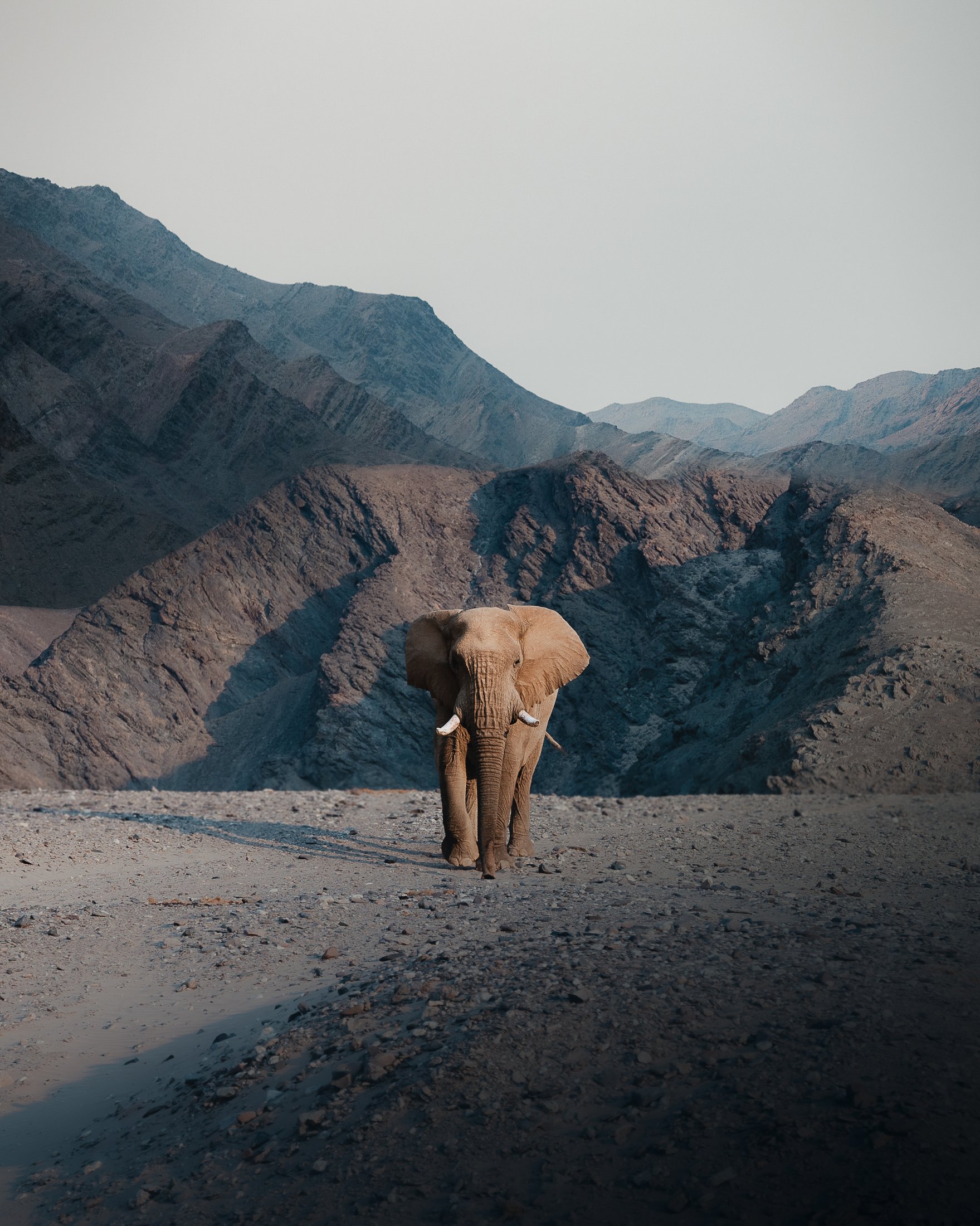
Namibia’s desert-adapted elephants aren’t a different kind of animal — they’re ordinary savanna elephants who learned to survive somewhere almost nothing should. This is their story, and the story of the people working to keep it going.
In April 2023, every elephant in the Hoanib River’s small resident herd did something researchers hadn’t seen in years: they crossed, as one group, into the lower Hoarusib River — a neighbouring drainage they hadn’t used in a long time. A week later, they walked back.
It doesn’t sound like much. But to the biologists who track every individual in this population by name, it read as something close to remarkable: a route, remembered. Decades of drought, poaching and the deaths of the older elephants who would once have known that path hadn’t erased it. Somewhere in the herd’s collective memory, the way to the Hoarusib had survived.
That’s really the story of Namibia’s desert-adapted elephants. It isn’t a story about a different kind of elephant. It’s a story about what a herd can hold onto — water sources, safe routes, the knowledge of where to go when the riverbed runs dry — and what happens when that knowledge is lost, or passed on, one generation at a time.
What “desert-adapted” actually means
Here’s the first thing worth knowing, because it runs against a lot of what gets written about them: Namibia’s desert elephants are not a separate species, or even a distinct subspecies. They’re African savanna elephants (Loxodonta africana) — the same species found in Etosha, the same species found across the continent. Genetic testing on animals from the Hoanib and Hoarusib found no meaningful separation from elephants living around Etosha National Park, a few hundred kilometres away.
What makes them different isn’t in their DNA. It’s in what they’ve learned to do.
You’ll often read that desert elephants have evolved longer legs and broader feet to cope with the sand — it’s a nice, tidy explanation, and it shows up in a lot of tourism writing. But no study has actually measured this. The more likely explanation, according to researchers who’ve followed these herds for two decades, is simpler: these elephants eat less than their savanna cousins, so they carry less bulk, which makes their legs look proportionally longer. And their footpads may genuinely spread wider over a lifetime of walking on soft sand — not because they were born that way, but because that’s what feet do when you use them differently for forty years.
The real adaptations are behavioural, and they’re arguably more impressive than a longer leg would be anyway. These elephants can go up to four days without drinking, and will feed in patches up to 70 kilometres from the nearest water. A family group’s territory can sprawl across almost 3,000 square kilometres — one of the largest home ranges recorded for any elephant population on Earth. Bulls range even further; one bull tracked by researchers moved more than 170 kilometres in a single journey. And they’ve learned to shift their daily rhythm around the heat, moving more at night and slowing to a near-standstill through the worst of the midday sun in the hottest, driest months.
The guides who follow these herds day after day describe the same thing from the ground.
“Our elephants here have great memory and are not feeding in one area for long, so they can maintain the vegetation. They don’t damage trees like the inland or savannah elephants. In short, they are unique and calm elephants we have here.”
Howard Groenewald, Field Guide at Hoanib Elephant Camp

The well-diggers
One behaviour is worth dwelling on, because it’s the kind of detail that makes you look at these animals differently: elephants here dig their own wells.
In a dry riverbed, with an open pool of water sitting right there, a desert elephant will sometimes walk past it, choose a spot a few metres away, and dig — using its feet and trunk to excavate a hole up to a metre deep. It looks almost superstitious, until you test the water. Researchers comparing paired samples found that freshly dug elephant wells consistently had far fewer faecal bacteria than the surface pools nearby. The elephants, it turns out, are finding — or filtering — genuinely cleaner water.
The wells don’t stay theirs for long. Jackals, baboons, springbok and other desert wildlife use the same excavations once the elephants move on. In a landscape this dry, a herd of elephants isn’t just surviving — it’s quietly building infrastructure for everything else that lives there too.
“They are amazing to observe, creatures of habit and calm nature. They know where to find food, water, shade and have close familial bonds. Gentle parents and fierce protector all rolled into one, and they’re not shy to get close enough to touch them — we don’t, but it proves how kind-natured they truly are.”
Job T. Haimbodi, Field Guide at Hoanib Elephant Camp

A fragile population
It would be satisfying to say this population crashed decades ago and has since recovered. The truth is messier, and more honest, than that.
Poaching and drought during and after Namibia’s independence war devastated elephant numbers across the northwest — the wider Kunene region held perhaps 600–800 elephants in the late 1960s; by the late 1980s that had fallen to around 250, and some herds in the Hoarusib were wiped out entirely. Since independence, community-based conservation and stronger law enforcement have allowed Namibia’s elephants to recover strongly at a national level — the country’s elephant population now stands at more than 24,000, one of conservation’s genuine good-news stories on the continent.
But the small, specialised river-valley populations that carry the “desert-adapted” name tell a more uneven story. Across the five ephemeral river systems where they live — the Hoanib, Hoarusib, Uniab, Huab and Ugab — the best rounded estimate is somewhere around 150 individually known elephants. That single number hides very different fortunes river by river. The Hoanib group has had a genuinely good few years: from 19 elephants in 2021 to 28 in 2025, after ten calves were born in a single stretch between May 2023 and July 2024. Nine of those ten survived — a striking reversal from the years before, when roughly half of all calves in the Hoanib and Hoarusib died in their first year.
The neighbouring Hoarusib hasn’t been as lucky. Its population has fallen from 16 in 2018 to just 10 in 2025, and researchers now believe the group has almost no remaining reproductive capacity without elephants moving in from elsewhere. Further south, the Ugab group has dropped from 32 in 2016 to 20 in 2024, with only a single calf from that entire period surviving to adulthood.
So this isn’t a triumphant recovery story, and it isn’t a story of collapse either. It’s a set of small, closely watched populations — some growing, some genuinely at risk of disappearing — held together by the same rivers, and by the people trying to keep the balance in their favour.

What they’re up against
Ivory poaching, once the dominant threat here, is no longer the main pressure on these herds — Namibia’s national poaching losses now run to a dozen or fewer elephants a year, out of a population above 24,000, and no poaching-related death has been recorded in the Hoanib–Hoarusib–Uniab study area since December 2021.
What’s replaced it is subtler, and in some ways harder to solve: drought, damaged water infrastructure, and the everyday friction of elephants and people sharing an increasingly dry landscape. When elephants and communities compete for the same handful of boreholes, the elephants sometimes win — and a family’s water tank, pump or fence pays the price. In one recent year, damage to water infrastructure and fences accounted for roughly two-thirds of all recorded conflict incidents in this region. It’s a real cost, borne largely by people who see relatively little of the tourism revenue elephants generate elsewhere — a tension worth being honest about rather than glossing over.
There have also been unexplained losses. In July 2026, a newborn calf in the Ugab River died within hours of birth, for reasons that are still under investigation by Namibian and international researchers. It’s a reminder that even the best-monitored elephant population in Africa still holds real uncertainty.

The people keeping the balance
What makes this landscape unusual isn’t just the elephants — it’s the system built around them.
Namibia pioneered a form of community-based conservation, unlike almost anywhere else on the continent, that gives communities living on communal land legal rights to manage and benefit from the wildlife around them. Since the mid-1990s, this has grown into a network of more than 80 registered conservancies covering an enormous stretch of the country, employing thousands of people as game guards, monitors and lodge staff, and channelling tourism revenue directly back into the communities who share their land with elephants, lions and everything else.
Around the Hoanib, that work is anchored by the Sesfontein Conservancy — registered in 2003, its game guards and local guides feed sightings into a photographic record so detailed that researchers can recognise every known Hoanib and Hoarusib elephant on sight. It isn’t abstract. In April 2025, guides spotted a 15-month-old calf with a badly swollen leg — likely a lion bite. Within days, a government vet, conservancy staff, a conservation NGO and camp staff coordinated to immobilise mother and calf together, clean and treat the wound, and fit the mother with a tracking collar before releasing them both. It’s a small story, but it shows the machinery working exactly as intended: a guide sees something, and a whole network responds.
Further south, the NGO Elephant-Human Relations Aid runs an even more hands-on programme — protecting rural water points from elephant damage (more than 250 protected to date), digging separate elephant-only waterholes away from villages, fitting tracking collars, and training communities to live alongside elephants safely rather than in conflict with them.
None of this is free, and it doesn’t run on goodwill alone. It runs, in large part, on tourism revenue — the fees paid by travellers who come to see these elephants funding the guards, the collars, the boreholes and the vets who keep the population monitored and, where possible, protected.

Where to see them: Hoanib Elephant Camp
That’s where a new camp in the Hoanib River Valley fits into this story, rather than sitting apart from it.
Hoanib Elephant Camp, opened in May 2026 by Natural Selection, sits inside the very landscape this article has been describing — ten guest suites in one of Namibia’s most remote corners, where the Hoanib River cuts through desert and mountain on its way toward the Skeleton Coast. Guests here spend their days tracking the desert-adapted elephants, alongside giraffe, oryx and the region’s elusive desert lions, in a landscape shaped over millions of years by wind, tectonics and the rare, dramatic floods that bring the riverbed briefly to life.
The camp partners directly with the Sesfontein Community Conservancy — the same conservancy whose game guards keep the photographic record of every elephant in the valley, and the same network that responded when the injured calf needed help in April 2025. A portion of every guest’s stay, on top of Namibia’s standard conservation fee, goes toward that conservation and community work.
It’s worth asking, of any lodge making a conservation claim, what that actually funds and who’s accountable for it — and that’s a question we’ll keep asking as we get to know Hoanib Elephant Camp better. But the basic picture is a sound one: a camp built inside the range of one of Africa’s most fragile elephant populations, working with the community conservancy that monitors them, in a system that only works if tourism revenue keeps showing up.

“In many ways, they’re like us. Adaptive, resourceful, keen intellect and even a little silly at times. Yesterday, Arnold got his tusk stuck trying to shake pods off an Ana tree. The small everyday mishaps we often take for granted — like when all the babies fell asleep at Presidents Dam after a long day’s walk, forcing the older siblings to stand around them and wait for them to wake up before they could continue their journey. They are a fine example of how ‘life, always finds a way’.”
Andrew M. Mange, Camp Manager at Hoanib Elephant Camp
Go back to that week in April 2023, when the Hoanib elephants crossed into the Hoarusib and came home again. It’s a small, ordinary-sounding event. But for a population this small, and this hard-won, an old route remembered is exactly the kind of thing worth celebrating — proof that something fragile is still, for now, holding together.
Whether it keeps holding depends on a lot of things outsiders don’t control: rainfall, drought cycles, the decisions of a handful of conservancy committees. But it also depends, in a very direct way, on people continuing to show up — to fund the game guards, to keep the boreholes protected, and to make it worth a community’s while to keep sharing its land with an animal that can flatten a water tank overnight. That’s not a small ask. It’s also, so far, working.
The same question — whether a remembered route survives the next generation — is playing out right across the continent, in places far greener than this one. We looked at it in Elephant Corridors Across Africa.

Sources
- Ishida et al., “Genetic connectivity across marginal habitats: the elephants of the Namib Desert,” Ecology and Evolution, 2016 — genetic comparison of Hoanib/Hoarusib elephants against Etosha populations
- Viljoen, “Spatial distribution and movements of elephants in the northern Namib Desert,” Journal of Zoology, 1989; Viljoen & Bothma, 1990 — home range, distance-from-water and daily movement data
- Leggett, “Home range and seasonal movement of elephants in the Kunene Region, northwestern Namibia,” African Zoology, 2006 — long-distance GPS tracking
- Ramey et al., “Desert-dwelling African elephants (Loxodonta africana) in Namibia dig wells to purify drinking water,” Pachyderm, 2013 — well-digging and water-quality comparison
- Brown & Ramey (Desert Elephant Conservation, with IRDNC) — ongoing photo-identification and demographic monitoring of the Hoanib, Hoarusib and Uniab populations
- Elephant-Human Relations Aid (EHRA), 2024 annual report — conflict incident data and mitigation programme outputs
- NACSO / Namibian Association of CBNRM Support Organisations — conservancy programme figures and Sesfontein Conservancy audit data
- Guide quotes supplied by Hoanib Elephant Camp via Imagine PR, August 2026