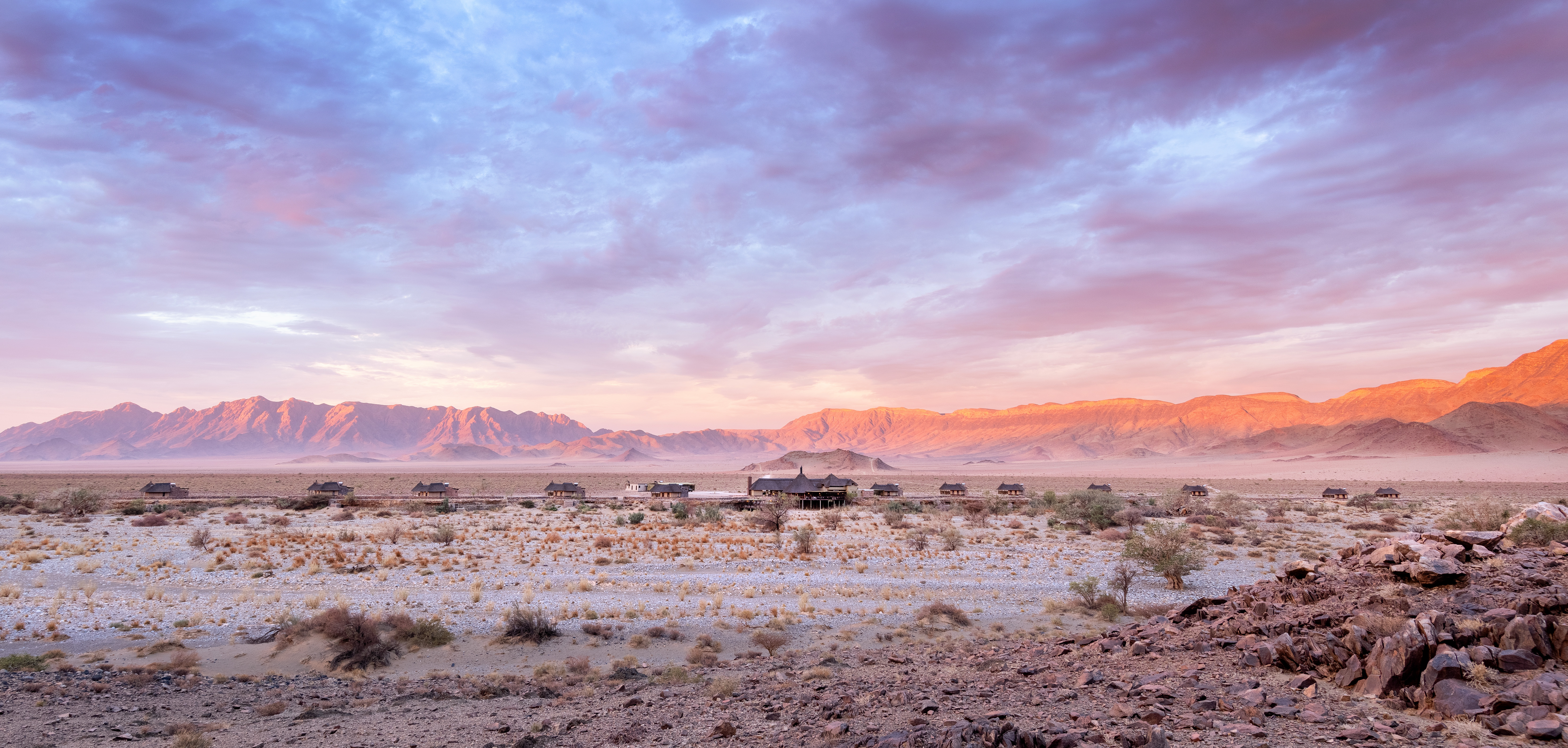
The Namib is the oldest desert on Earth — by most estimates, more than 55 million years old — and Sossusvlei, its most photographed corner, draws travellers from every continent to stand at the foot of dunes that rise higher than most skyscrapers. Getting there is one thing; finding somewhere quiet to actually stay is another. Hoodia Desert Lodge, a small, family-owned camp on the dry bed of the Tsauchab River a short drive from the Sesriem gate, has spent years quietly becoming one of the more loved answers to that problem — less a destination in its own right than a warm, well-run base from which to disappear into the dunes each morning and come back to a cold drink each evening.

Where is it, and why does everyone come here?
Hoodia sits on the eastern fringe of the Namib-Naukluft National Park, one of the largest conservation areas on the planet at close to 50,000 square kilometres — roughly the size of Switzerland — and the reason the whole region exists on the traveller’s map in the first place. The Namib Sand Sea within it was declared a UNESCO World Heritage Site in 2013, recognised as the only desert in the world with both a coastline and a vast, uninterrupted dune field, and as the oldest desert on the planet by a wide margin. Its dunes, some of the tallest on Earth, are stained the deep red-orange of iron oxide coating each individual grain of sand; younger dunes nearer the coast are a paler yellow-brown, so the colour of the sand itself tells you roughly how long it has been there.
The lodge is a short drive from the Sesriem gate, the single entry point that controls access to Sossusvlei and Deadvlei, and about 60 km from the dunes themselves — close enough to be inside the gate at sunrise, which matters more than almost anything else here. Most guests arrive by self-drive, on the roughly five-hour, 400 km run down from Windhoek via the B1, C24 and C19; a smaller airstrip at Solitaire, about 70 km away, lets fly-in guests skip the tarmac altogether and land within striking distance of camp.
A small, family-run retreat

Hoodia is family-owned and personally run, and it shows in the details rather than in any marketing line. It is a small operation by design — eleven chalets, not fifty — and years of guest reviews return again and again to the same theme: the warmth of the welcome and the sense that the people looking after you actually want you there. Returning guests write about being remembered by name, about staff who go out of their way to fix a problem rather than apologise for it, and about the particular value of a good guide who knows exactly when to talk and when to let the desert do the work. It is the kind of small-scale hospitality that is genuinely hard to fake, and it is the reason so many guests come back more than once.
Accommodation


The lodge’s eleven thatched luxury chalets are built to sit quietly in the landscape rather than announce themselves, spaced apart for privacy so that the silence of the Namib — genuinely one of its defining qualities — isn’t broken by a neighbour’s veranda. Inside, each chalet has air conditioning (not a luxury out here, but close to a necessity), tea and coffee facilities, a mini fridge and an en-suite bathroom pairing an indoor shower with an outdoor one, so you can rinse off the day’s dust under the open sky. Guest reviews describe the rooms as comfortable and well-appointed, if on the cosy side — in keeping with the lodge’s intimate scale rather than a mark against it.
Food and facilities


The main lodge building holds a cosy lounge, a bar and a dining room serving home-style meals built around fresh, local ingredients — and, according to reviewers, dinners good enough that more than one guest has called them the best meal of their Namibian trip. Outside, a swimming pool looks straight out over the desert, the obvious place to be in the heat of the afternoon between the morning’s dune walk and the evening’s sundowner drive.
Sossusvlei, Deadvlei and the dunes: what makes this desert so extraordinary

It is worth pausing on exactly why this small stretch of desert has become one of the most photographed landscapes in Africa. Sossusvlei itself is a clay and salt pan hemmed in by some of the tallest dunes on the continent — Big Daddy, the best-known of them, rises around 325 metres, and nearby Dune 7 climbs even higher. Deadvlei, a short walk further on, is stranger still: a bone-white clay pan where camelthorn trees have stood dead and blackened for six to nine hundred years, preserved rather than rotted away because the desert air here is simply too dry for decay. It is one of those places that looks unreal in photographs and somehow more so in person, with the white pan, the black trees and the towering orange dunes forming three-colour compositions that photographers travel a long way for.
On the way in, most guests also stop at Sesriem Canyon, a narrow gorge carved by the same Tsauchab River that runs past Hoodia — about a kilometre long, up to 30 metres deep and, in places, barely two metres wide, with a pool of water that survives even through the dry season and draws wildlife down into its shade.
Activities
Guided Sossusvlei & Deadvlei excursion


The lodge’s signature outing heads into the park before sunrise, timed to reach the dunes as the low light turns them their deepest red — the difference between a good photograph and a forgettable one out here is almost entirely a matter of timing. The route takes in Sossusvlei itself, Deadvlei’s ancient trees, and Sesriem Canyon, with a picnic lunch in whatever shade the camelthorn trees can offer. Along the way, Hoodia’s guides fill in the detail that makes the landscape make sense: how the dunes form and shift, why the sand changes colour with age, and how anything survives out here at all.
Sundowner drive

As the day’s heat breaks, a short drive brings guests to a scenic viewpoint set up with comfortable chairs and cold drinks for one of Namibia’s better traditions: watching the desert shift from brilliant orange through crimson as the sun drops behind the dunes. It is unhurried, and it is exactly the sort of thing that’s easy to dismiss on paper and hard to forget afterwards.
The wildlife of the Namib

This isn’t Big Five country, and it isn’t trying to be — the appeal is a different kind of wildlife story, built around the astonishing fact that anything survives here at all. Oryx (gemsbok), Namibia’s national animal, are the desert’s signature species: built to lose almost no water, able to let their body temperature climb several degrees above what would kill most mammals rather than waste moisture sweating to cool down. Springbok, ostrich, mountain zebra and the occasional brown hyena or jackal round out the larger wildlife, while over 200 recorded bird species make this a genuinely rewarding stop for birders, not just dune photographers.
The most remarkable adaptations, though, belong to the smallest residents. The Namib’s fog-basking darkling beetle has become a minor celebrity of desert biology: with almost no rainfall to rely on, it climbs to a dune crest at dawn, tips itself nose-down into the coastal fog rolling in off the Atlantic, and lets water condense on its back and run down into its mouth — a piece of natural engineering so elegant it has since been studied by materials scientists trying to copy it. Namaqua chameleons, sidewinding adders and a scattering of specialised geckos — like the one above — fill out a food web that runs almost entirely on fog and grit, in a place that receives less rain in a year than most cities see in a single afternoon storm.
Practical information

- Location: On the Tsauchab River, Namib-Naukluft Park, a short drive from the Sesriem Gate (entrance to Sossusvlei and Deadvlei) and about 60 km from the dunes.
- Getting there: Self-drive from Windhoek is roughly 400 km / 5 hours via the B1, C24 and C19; a smaller airstrip at Solitaire (~70 km away) serves fly-in guests and charter transfers.
- Accommodation: 11 thatched luxury chalets, air-conditioned, each with an indoor and outdoor shower.
- Facilities: Lounge, bar, dining room, swimming pool.
- Signature activities: Guided Sossusvlei & Deadvlei excursion (with Sesriem Canyon and a picnic lunch); sundowner drives to a scenic viewpoint.
- Best time to visit: April–September for cooler, cloudless days best suited to dune climbs; year-round otherwise.
- Booking & contact: hoodiadesertlodge.com · reservations via Exclusive Reservations & Marketing (hoodia@exclusive.com.na).
Explore more on 25South
- Namib Desert & Sossusvlei reserve profile — the dunes and Deadvlei on Hoodia’s doorstep.
- The Complete Guide to 4×4 Hire & Self-Drive in Namibia — for those driving themselves to Sesriem.
Last update: 07/30