
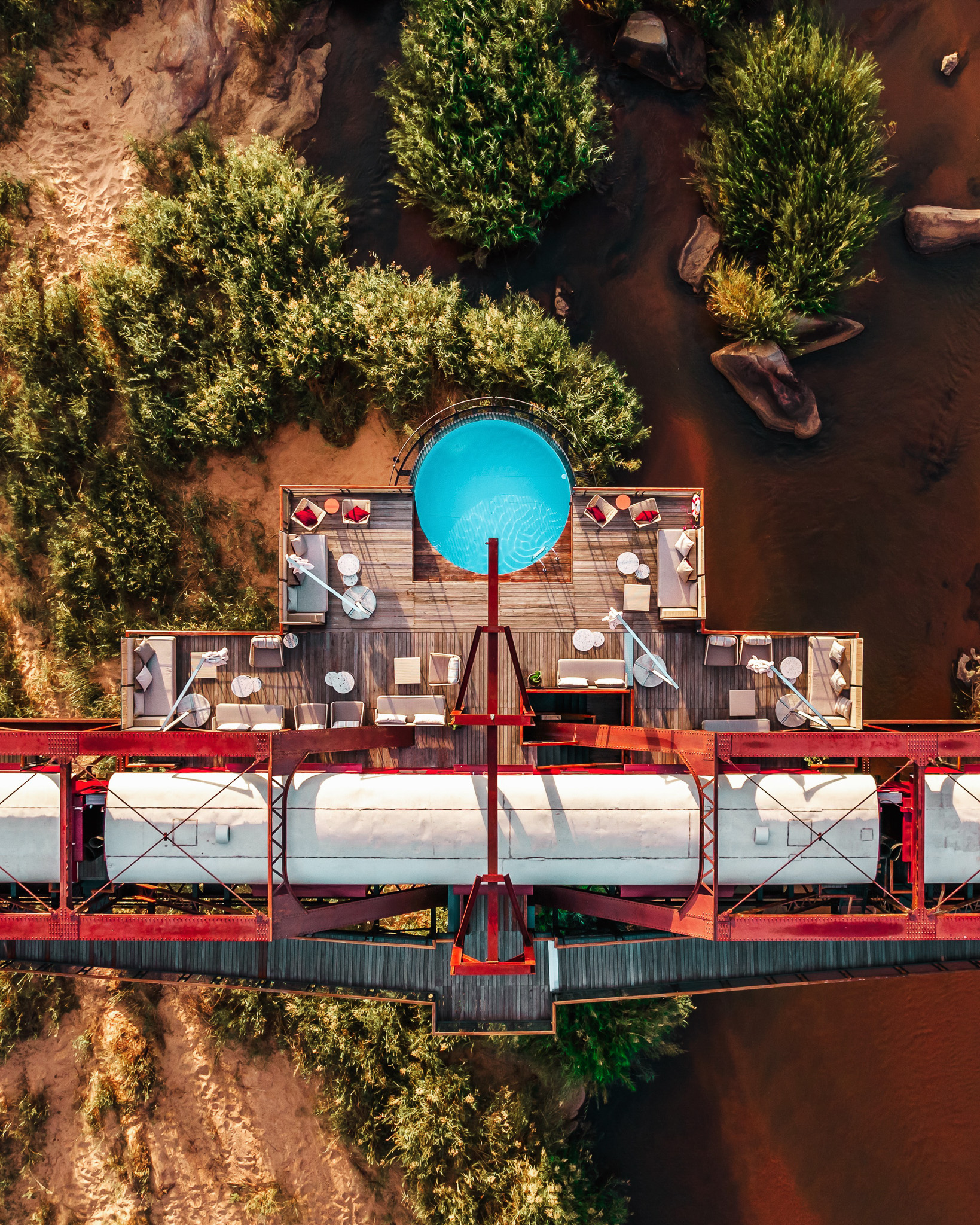
There is a train parked on a bridge in the middle of Kruger, and people sleep in it. Put like that it sounds like a gimmick, but it isn’t, and the reason has less to do with the train than with the bridge it stands on.

What it actually is
Kruger Shalati sits on the Selati Bridge where it crosses the Sabie River at Skukuza. The bridge runs about three hundred metres and the carriages stand some fifteen metres above the water, twenty-four suites strung out along its length, each one with a Juliet balcony over the river. A pool hangs off the side of the bridge with a deck beside it, and because it is heated you can actually use it on a July morning, when the rest of the lowveld is still waiting for the sun.
Seven more rooms sit on solid ground at the Bridge House, which is also where the restaurant and the shop are, bringing the property to thirty-one rooms in total. The train itself does not move and was never meant to. The carriages came out of a 1950s passenger train, were restored, and were lifted into place.

The line came first
None of it makes sense without the railway. The Selati line was approved in 1893, and the stretch from Komatipoort to Newington was finished the following year, all except the crossing of the Sabie, which had to make do with a temporary wooden bridge until the floods of 1901 took it away. Work on a permanent structure began in 1909, it opened to rail traffic in 1910, and the line was formally opened on 25 October 1912.
Then, in 1923, the railway began running a nine day tourist service called Round in Nine, and this is where the story turns. The train would stop for the night opposite the siding at the Sabi Bridge before carrying on to Newington in the morning, and while it stood there the passengers sat around a campfire and walked out with a game ranger. Those passengers were among the first tourists ever allowed into the park, and they slept in a railway carriage on that bridge.

Rail traffic stopped in 1973, when a new line opened along the park’s western boundary, and the bridge then stood empty for nearly fifty years until Kruger Shalati took its first guests on 14 December 2020. So the point was never that somebody put a train on a bridge. The point is that they put it back.

The name
Shalati is taken from a Tsonga warrior queen, said to have been one of the first female warrior chiefs of the Tebula clan, in the country around the Murchison Range in what is now Limpopo. It comes down as legend rather than documented history.
Who built it
This part usually gets left out, and after the bridge itself it is the most interesting thing about the place.
Kruger Shalati was developed by Motsamayi Tourism Group, and the name the company gave itself is not decoration. David Motsamayi was the alias Nelson Mandela travelled under before his arrest, and in Sesotho it means “one who travels”. Its roots run back to an investment house founded in 1992 out of a stable set up by Mandela, Walter Sisulu, Beyers Naudé and Enos Mabuza to push economic transformation, and in early 2021 the executive team, led by chief executive Jerry Mabena, bought the business out from its former owner.
A South African company with that lineage holding a concession inside Kruger, on the same bridge where the park’s first tourists slept, is a neater piece of symmetry than most lodges will ever manage.
Built from what was already there

The build reused rather than replaced, and it shows in the detail. The carriages are 1950s stock and the bridge is a disused railway bridge, but the salvaging went well beyond those two headline pieces: old doors, window frames, railway sleepers and steel roof trusses were all pulled back into service inside the property. Around a hundred indigenous trees went in for shade and screening, with creepers and shrubs planted to take over from the temporary structures as they grow in, and solar carries a large share of the power.
For something that could very easily have been built as spectacle, that is a quietly serious way to go about it.
The rooms
The carriage suites are the reason people come, and they are what you picture: a bed that splits from king to twin, air conditioning, a full bathroom, a stocked minibar, and a window onto the Sabie that does most of the work. They take guests of twelve and over.

The Bridge House rooms are where families go, and where anyone who would simply rather be on solid ground ends up. There are two luxury suites, three interleading suites with their own pool and garden, a sunset suite, and a fully accessible family unit of forty-eight square metres that takes children from eight. They are larger than the carriages and they trade the balcony for a patio and a garden, and with two universal access rooms on the property this is one of the more genuinely accessible places to stay anywhere inside the park.

Where it sits, and what that gets you

Shalati is at Skukuza, which is the busiest place in Kruger and effectively a small town, with a bank, a filling station, a golf course and an airport of its own. That is the trade the property makes, and it is worth understanding rather than glossing over, because what you get back for it is the easiest arrival anywhere in the park. The airstrip is under five kilometres away and transfers are included, so you can be off a plane and on the bridge inside half an hour. Paul Kruger Gate is a short drive, Kruger Mpumalanga International about two hours, Johannesburg about five.
You also get the ground itself, because southern central Kruger, where the drives go, is as good as Big Five country gets, and the road network here is the most developed in the park.

Four hundred metres from the bridge is Kruger Station, the restored station precinct that opened alongside the lodge, where there is a bar called Round in 9, a family restaurant, a deli, a coffee and ice cream café, a play area and a 360 degree cinema. Almost nowhere else in Kruger gives you somewhere to go that is neither your camp nor a game drive, which is worth a great deal if you are travelling with children.
What Shalati does not offer is the sensation of being the only people for fifty kilometres, so if that is the whole point of a safari for you, the seasonal tented camps further north will suit you better. If you want Kruger without the long drive in, this is the most convenient address in the park, and the rate covers all meals, house drinks, two game drives a day and those airport transfers, so very little is added on afterwards.
The recognition
Kruger Shalati holds two Michelin Keys, awarded in the guide’s first selection to cover Africa, and it is the only two Key hotel inside Kruger National Park. Two Keys, in Michelin’s own words, marks “a remarkable stay”. It has also been named South Africa’s Leading Safari Lodge at the World Travel Awards.
So, is it?
Unusual lodges are usually unusual on purpose. A treehouse, a cave, a shipping container: they are built odd so that you will photograph them, and the oddness is the product.
Shalati works the other way round, because the strange thing about it was never invented. The bridge was already there, and a railway carriage on that bridge was already the way people first slept in this park. Somebody noticed that the two facts had been sitting a hundred years apart, and put them back together using the original crossing, carriages of the right vintage, and a company whose own history runs alongside the country’s.
Unusual is the easy word for it. Earned is the better one.