If you are driving Botswana’s classic northern circuit — out of Maun, up through Moremi and Khwai, across the legendary Savuti marsh and on to Chobe and Kasane — there is one stretch where the map suddenly empties out. The distances are long, the roads are deep sand, and the question every self-driver eventually asks is the same: where do we sleep tonight? For a growing number of overlanders, the answer is Mababe River Lodge & Campsite, a small, family-run camp perched on the edge of the Mababe Depression that has quietly become one of the most useful — and most enjoyable — staging posts in the whole region.

Where is it?
Mababe sits in the Khwai–Mababe region on the eastern fringe of the Okavango Delta, in the wildlife-rich corridor that links Moremi Game Reserve to the west with Chobe National Park to the north-east. The camp is on the doorstep of two park gates: roughly 7 km from Mababe Gate (the southern entrance to Chobe’s Savuti sector) and about 35–37 km from Moremi’s North Gate at Khwai. The nearest tar and supplies are back in Maun, around 120 km to the south; Kasane, the gateway to the Chobe riverfront and Victoria Falls, lies roughly 190 km to the north. The closest airstrip is Khwai, about 30 km away.
That position is the whole point. The camp is almost exactly halfway on the Maun-to-Kasane overland route, which makes it a natural place to break a journey that is otherwise too long and too rough to do comfortably in a single day.
A camp on the edge of the Mababe Depression
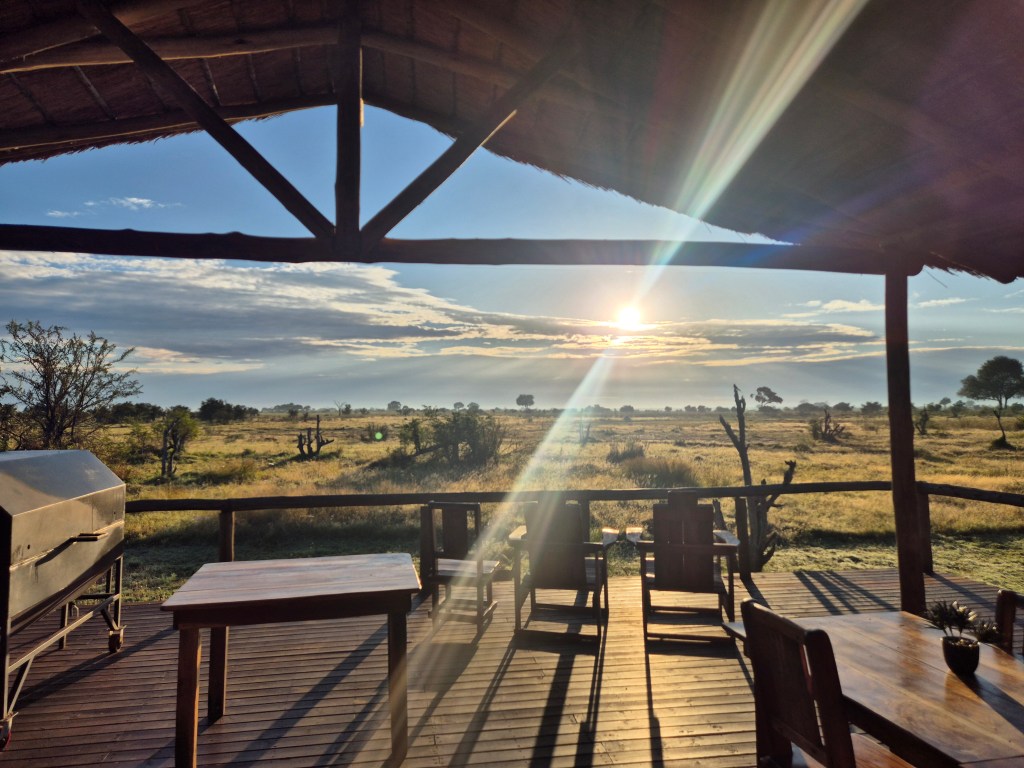
The setting is the camp’s quiet headline act. The Mababe Depression is a vast seasonal wetland — the bed of an ancient lake that once formed part of the same system as Makgadikgadi — lying south of the Savuti Channel and north of the Khwai River. When the rains come, the basin floods into shallow grassland that pulls in big herds of elephant, buffalo, zebra and tsessebe, and with them the predators: lion, spotted hyena, leopard, cheetah and African wild dog. It is a genuine wildlife corridor, not just a pretty backdrop, and the camp’s deck and infinity pool look straight out over the pan. Several guests describe sipping a cold drink at the pool while waterbuck, impala and zebra drift past the waterhole, and lions and hyenas can be heard — sometimes seen — moving through after dark.

Types of lodging
Mababe is unusual in that it caters to two quite different kinds of traveller under one roof: self-drive campers and guests who want a proper bed and a roof.
Campsites. There are eight standard campsites plus a larger overland site, and the layout is exactly what a tired self-driver hopes for. Each site has its own private ablution block with a hot shower, flush toilet, scullery and braai area, plus 220-volt power points and firewood. There is no need to share a communal block. The campsites are aimed at self-drives, and the camp does not supply tents or camping equipment, so you bring your own kit. What you get in return is privacy, hot water, electricity and — the recurring favourite in guest reviews — that swimming pool and bar overlooking the floodplain.
Lodge rooms. For those not camping, the lodge offers air-conditioned rooms with a private bathroom and a balcony, most with views over the flood plain and river. There are Standard Double rooms, a set of Deluxe rooms, and a Family Room with three bedrooms that sleeps six. The Deluxe rooms are the pick of the bunch: they add a fridge and an outdoor shower and bath looking out over the pan. The rooms are relatively new — they opened in mid-2023, after the campsite had already been running for a couple of years — so the finishes are fresh.
Room guests can choose from several packages, ranging from simple bed & breakfast up to a fully inclusive option that bundles all meals, local drinks, two activities, and airport transfers. Packed lunches can be arranged for long game-drive days.
Food, facilities and the family touch
For somewhere this remote, the list of comforts is long: an on-site restaurant and bar, an infinity pool, a small shop selling basics and ice, laundry facilities, and Wi-Fi at the main area and bar. The camp is wheelchair-friendly and can even arrange emergency helicopter evacuation. Meals (breakfast, lunch and dinner) are available with pre-booking, and reviewers single out the three-course dinners as a highlight — “best dinner in Botswana” is a phrase that comes up more than once.
But the thread running through almost every review is the people. This is a family-run operation, and guests repeatedly mention the warmth of the owner and staff — help with a dusty trailer, a birthday cake that wasn’t asked for, a tyre problem sorted out on the spot. More than one traveller has cancelled their next night elsewhere and simply stayed longer.
The wildlife areas on your doorstep
Mababe’s location turns it into a springboard for some of Botswana’s finest game areas, all reachable on day trips.

Savuti (Chobe National Park)
Just 7 km away through Mababe Gate, Savuti is predator country, famous for its lions, spotted hyena clans and the mysterious Savuti Channel that floods and dries on its own unpredictable schedule. When dry it becomes a stark, beautiful marsh dotted with game; when it flows, the greenery and wildlife explode.

Moremi Game Reserve & Khwai
About 35–37 km west lies Moremi’s North Gate at Khwai, the entry to one of Africa’s great reserves — nearly 5,000 km² of floodplain, mopane woodland and lagoon on the eastern Okavango, home to elephant, buffalo, big cats, and a celebrated population of African wild dog. From camp you can reach the classic Moremi spots on a day drive: Xakanaxa and Third Bridge are roughly 70 km away.

The Khwai River
The Khwai marks Moremi’s northern boundary and is a superb area in its own right for mokoro (dug-out canoe) trips and riverine game viewing.
Activities from camp
You don’t have to self-drive everything. The camp can arrange game drives into Moremi, Xakanaxa and Savuti; boat cruises departing from Xakanaxa in the heart of the delta (from a few hours up to multi-day Trans-Okavango trips); gentle mokoro excursions along the Khwai; and helicopter scenic flights over the delta, Khwai and Mababe. Mobile safaris can also be arranged. Day excursions need to be booked about seven days in advance, so plan ahead rather than turning up and hoping.
Why it’s the ideal Maun–Savuti–Kasane overnight stop
The northern overland route — Maun → Moremi/Khwai → Mababe → Savuti → Chobe → Kasane — is one of the most rewarding self-drive itineraries in southern Africa, but it is demanding. The tracks are thick sand and slow going, the parks have no fuel or shops, and tackling Maun to Kasane in one push is exhausting and means missing the best game areas entirely. Mababe solves that. It sits right at the halfway mark, just outside the Savuti gate, with hot showers, power to recharge fridges and devices, cold drinks, a real meal and a pool — exactly the reset a dusty convoy needs before pushing north into Savuti and on to the Chobe riverfront. Whether you’re rolling in for a single night to break the drive or settling in for several to explore Moremi and Savuti by day, it fits the route perfectly.
Our experience
We pitched up here for one night in May, self-driving with our rooftop tent, and ended up wishing we’d booked longer. Even on a quick overnight the small luxuries stood out — working Wi-Fi to plan the next leg, and a genuinely good restaurant meal after a dusty day on the road. The moment we’ll always remember, though, came after dark: lying in the rooftop tent listening to hippos grunting and splashing in the Khwai River just a few metres from our campsite. That’s the kind of night that reminds you exactly why you came to Botswana.
Practical information
- Location: Mababe, Khwai–Mababe region, northern Botswana — ~120 km from Maun, ~190 km from Kasane, ~7 km from Mababe Gate (Savuti), ~35–37 km from Moremi North Gate (Khwai).
- Getting there: A high-clearance 4×4 is essential; the access roads and surrounding parks are deep sand with seasonal water crossings. Campsites are for self-drives. Road and helicopter transfers from Maun Airport or Khwai airstrip can be arranged for lodge guests.
- Accommodation: 8 campsites + 1 overland site (private ablutions, 220v power, braai, firewood); lodge rooms in Standard Double, Deluxe and a 6-sleeper Family Room.
- Best time to visit: The dry season (roughly July–October) concentrates game around water and is prime for Moremi and Savuti; the green season brings the Mababe Depression to life with herds and newborns.
- Booking & contact: mababeriverlodge.com · mababeriverlodge@gmail.com · +267 736 35534. Meals and activities should be pre-booked (activities about 7 days ahead).
 25South
Leave a comment