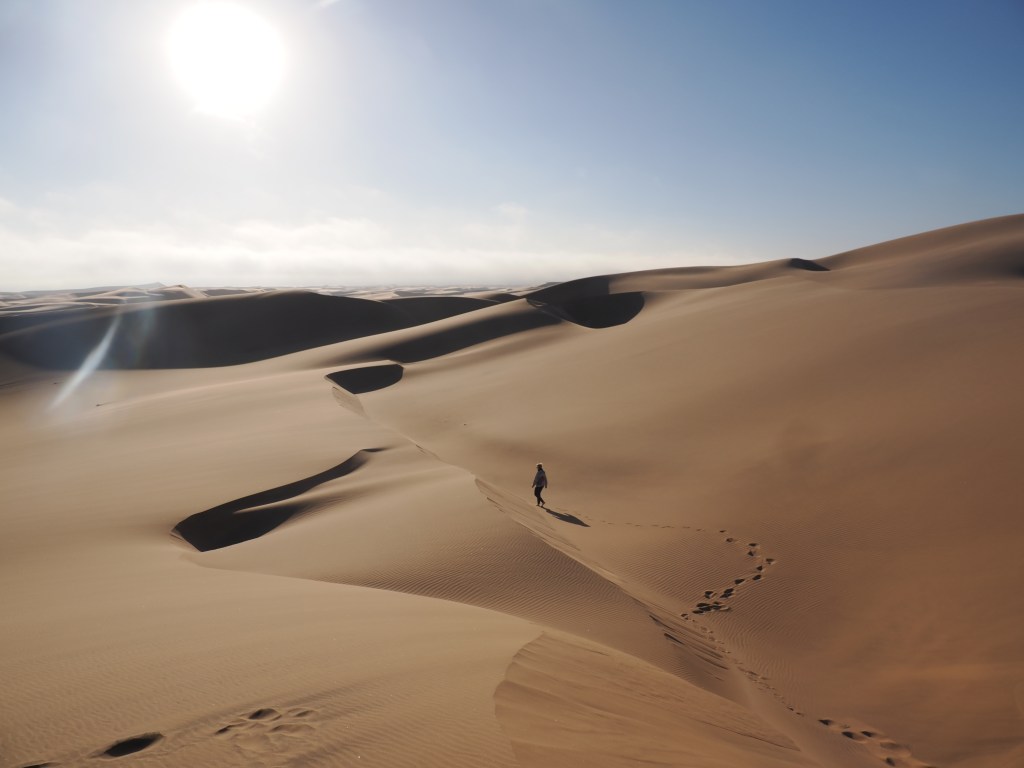
The coastal dunes outside Swakopmund — empty at first glance, but teeming with hidden life.
Stand on the edge of the dune belt just outside Swakopmund and the first impression is one of emptiness. Wave after wave of pale, wind-combed sand rolls toward the Atlantic, apparently lifeless under a soft coastal haze. We knew, of course, that the Namib isn’t truly barren — but nothing prepared us for how much life is hidden beneath that sand, or for the sheer variety of creatures our guide would coax into the open over the next few hours. By the end of the afternoon, those “empty” dunes had become one of the richest wildlife experiences of our entire time in Namibia.
This is the magic of the Living Desert Tour. While Namibia is famous for the “Big Five,” the Namib coast has its own celebrated cast: the Little Five, the small, superbly adapted animals of the dunes. Tracking them is the whole point of the tour. Here’s our first-hand account, woven together with everything you’ll want to know before you go — costs, timings, the wildlife, and how to make the most of your morning (or, in our case, afternoon) in the sand.
Reading the desert like a book
We joined the afternoon departure, and one of the first things that struck us was our guide, Ansgar. Rather than wandering the dunes at random, he seemed to read the desert like a book. He would stop the Land Cruiser, walk off alone, study a set of tiny tracks or a particular plant, sometimes dig carefully into the sand — and then call us over to reveal another perfectly camouflaged animal. Watching his tracking skills was almost as impressive as seeing the wildlife itself.
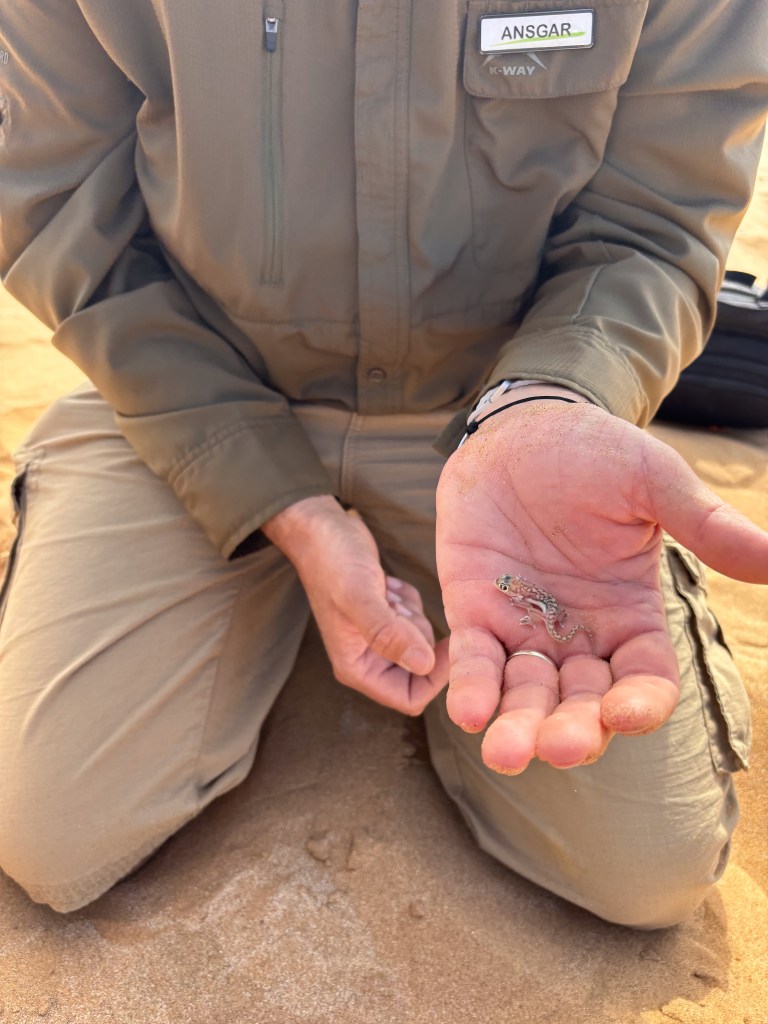
Ansgar was entertaining, approachable and exceptionally knowledgeable, and his enthusiasm for the Namib was obvious throughout. He explained the complex desert ecosystem in a way that was easy to follow without ever becoming overly technical — how the Atlantic fog that rolls in off the cold ocean almost every morning sustains the whole dune system, how different animals draw moisture from it, and how the entire food chain fits together, from the smallest beetle up to the jackals and birds. The tour felt genuinely educational, but it was also a lot of fun.
That fog, we learned, is the real secret of the place. It is the lifeblood of the dunes: beetles harvest it, plants drink it, and life that should by rights be impossible here clings on, finely tuned to a sliver of daily moisture.
What the Living Desert Tour is
The Living Desert Tour is a half-day, small-group 4×4 excursion into the coastal dunes between Swakopmund and Walvis Bay, inside the protected Dorob National Park. Rather than chasing big game across open plains, the experience is intimate and ground-level: you spend the time learning to spot the tracks, holes and tell-tale ripples in the sand, and then meet the animals that made them — geckos, lizards, snakes, spiders, beetles and the remarkable Namaqua chameleon.
The “Little Five” dune tour was pioneered in the 1990s by Tommy Collard, a former nature-conservation officer who developed the original guided dune drive that so many operators now follow. We went with Tommy’s Tours and Safaris (trading online as Living Desert Tours), the company he founded in 1997. Tommy’s background — military survival and tracking training, an agriculture diploma, and years with the Department of Nature Conservation — shaped a style of guiding that is equal parts naturalist, conservationist and storyteller, and it clearly lives on in guides like Ansgar. Tours run in English, German, or a seamless mix of both.
Good to know: Tommy’s isn’t the only operator. Living Desert Adventures, led by conservationist Chris Nel, is the other long-established favourite, and smaller eco-dune and quad-bike variations exist too. All share the same conservation-first ethic, so you’re in good hands whichever you choose.
Cost, timings and practical details
Prices vary a little between operators and change over time, so always confirm when you book. As a current guide:
- Adult price: around N$900–N$1,000 per person (roughly US$50–US$55).
- Children: around N$450–N$550 (typically children 12 and under).
- Duration: 4 to 5 hours.
- Departures: morning pick-up around 08:00; afternoon tours (around 14:00) run on request, weather and minimum numbers permitting. We did the afternoon and loved the light (more on that below).
- Included: professional guide, 4×4 vehicle, Dorob park access, plus water, soft drinks and light snacks.
- Pick-up and drop-off: included for accommodation in Swakopmund; a meeting point can usually be arranged if you’re staying further out.
A few booking notes worth knowing. Most operators have no card facilities in the field — you either pay cash (Namibian dollars, with euros or US dollars often accepted) or settle via a pre-payment link sent by email. Tours generally run daily except 1 January and 25 December, usually with a minimum of two adults for a departure, and cancellations within 24 hours typically incur the full charge. Group sizes are kept small — often two eight-seater vehicles — so it pays to book a day or two ahead, especially in the busy season (roughly June to October).
If you want to combine experiences, several operators offer a full-day Living Desert + Sandwich Harbour combo (around N$3,700 per person, lunch included), pairing the dune wildlife with the dramatic place where the Namib dunes plunge straight into the Atlantic.
Wildlife highlights: our personal Little Five
Sightings are never guaranteed — this is wild nature, not a zoo — but Ansgar knew exactly where and how to look, and we came away having met most of the dunes’ headline residents. As wildlife photographers, we especially appreciated that there was never any sense of being rushed: we had plenty of time to observe each animal, ask questions and take photographs. Three encounters stood out above the rest.
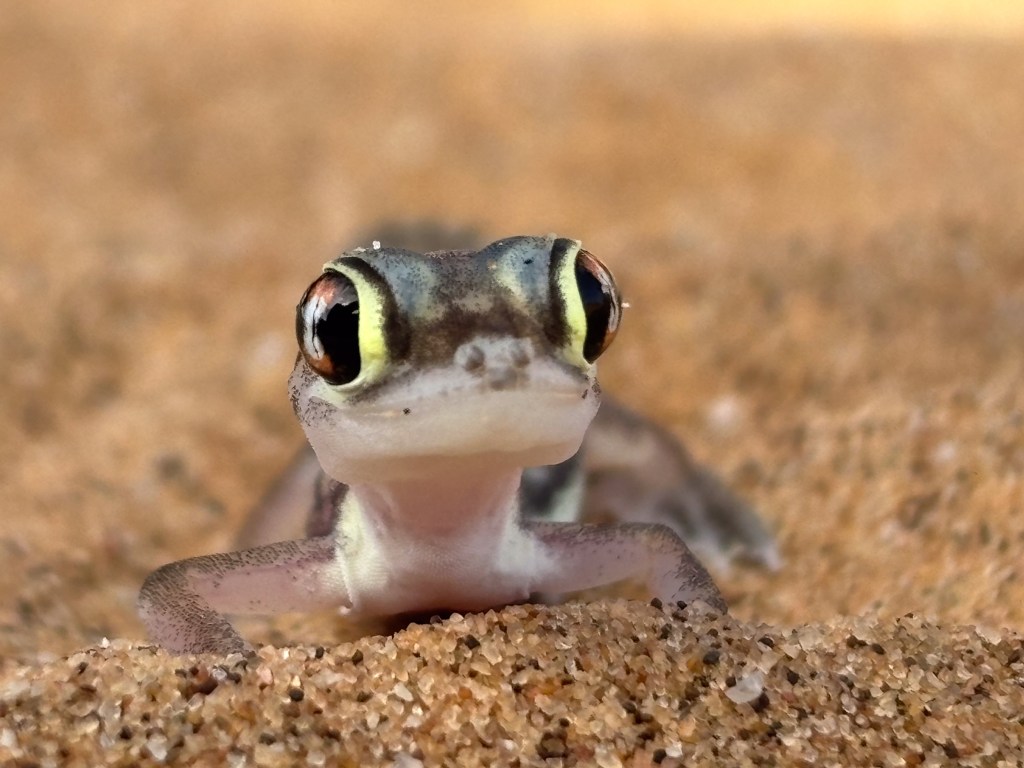
The translucent, web-footed Namib gecko — one of the most extraordinary reptiles we’ve ever seen.
The Namib web-footed gecko (Pachydactylus rangei) was our number one. This small, nocturnal gecko has translucent, salmon-pink skin so delicate you can sometimes see the organs beneath it, and oversized webbed feet that work like snowshoes on loose sand and help it dig. It’s endemic to the Namib — found nowhere else on Earth — and gets much of its water by licking fog from its own eyes. Seeing one up close was reason enough to take the tour.
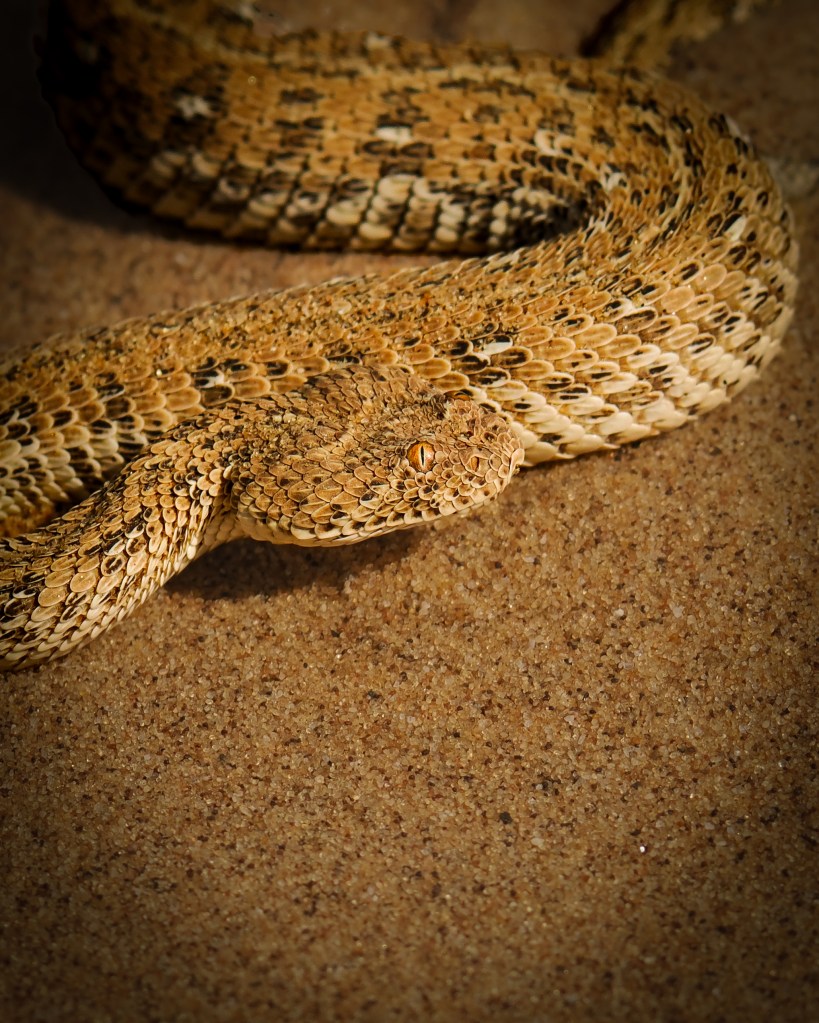
Péringuey’s adder, buried with only its eyes showing — a masterclass in desert camouflage.
Péringuey’s adder (Bitis peringueyi) was our second highlight, perfectly camouflaged beneath the sand and a fascinating example of desert adaptation. The Namib sidewinder is one of the smallest adders in the world. It “swims” sideways across loose sand and buries itself with only its upward-facing eyes exposed, twitching its dark tail-tip as a lure to draw curious prey within striking distance.
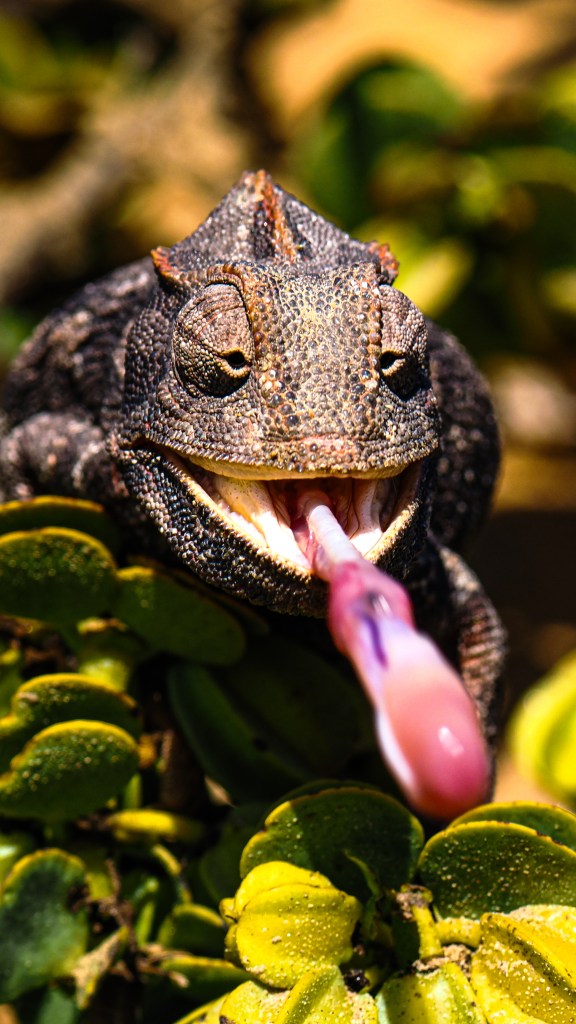
The Namaqua chameleon — our favourite photographic moment came as it shot out its tongue to catch an insect.
The Namaqua chameleon (Chamaeleo namaquensis) gave us our favourite photographic moment of the day, when we watched it extend its tongue to snatch an insect. It’s one of Africa’s largest and fastest chameleons and a true desert specialist, changing colour not only to communicate but to regulate temperature — turning dark to soak up the morning sun and pale to reflect the midday heat.
The rest of the cast
The dunes hold two more members of the classic Little Five. The shovel-snouted lizard (Meroles anchietae) is the famous “dancing” lizard, lifting its feet in an alternating rhythm to keep them off the scorching sand and diving snout-first beneath the surface to escape heat and predators. The dancing white lady spider (Leucorchestris arenicola) has one of nature’s most extraordinary escape tricks: when threatened it tucks in its legs and cartwheels down the dune face, rolling many times a second to outrun a predator.
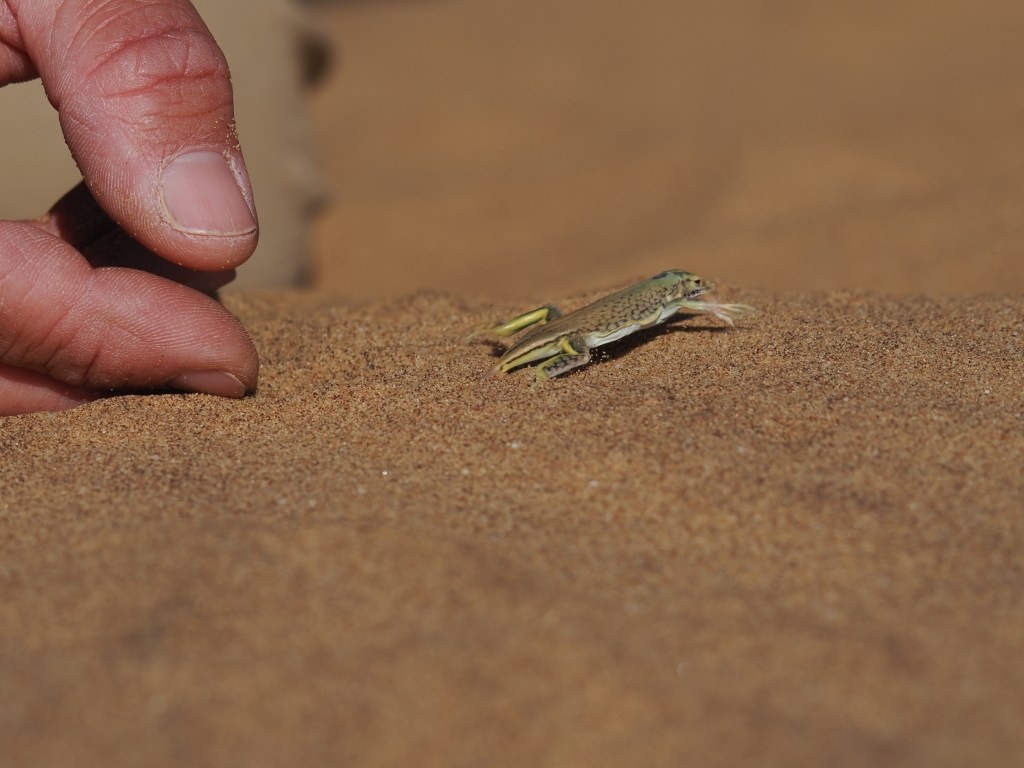
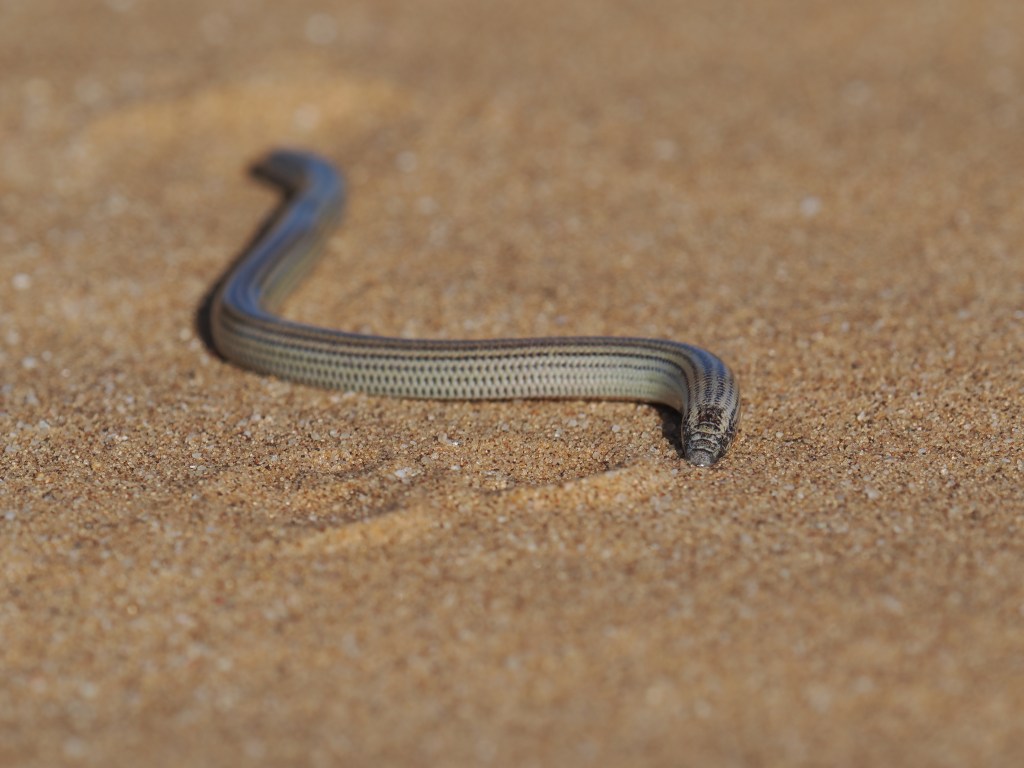
Ansgar also pointed out the tok-tokkies — the black tenebrionid beetles that scuttle across the sand and sit at the very base of the dune food chain. Some species perform an astonishing “fog-basking” routine, climbing a dune at dawn, standing on their heads and letting ocean fog condense on their ridged backs before channelling the droplets down to their mouths. Along the way we also learned about sand-diving skinks, the clever desert plants, and how every thread of this ecosystem connects to the next.
Photography on the tour
For us, this was a photographer’s dream. Ansgar let us get remarkably close to many of the animals while always treating them with respect, and we were often able to lie flat on the sand and shoot from eye level, creating intimate, ground-level perspectives you simply can’t get otherwise. Most animals stayed still long enough to photograph properly — only one small lizard vanished almost the instant it appeared.
Doing the afternoon tour turned out to be a happy accident: the warm, low light was excellent for photography, giving the sand a golden glow and the animals soft, flattering illumination. If you’re serious about your images, we’d genuinely recommend the afternoon slot.
Animal welfare came first
Throughout the experience we had the clear impression that conservation came first. Ansgar obviously cared about the animals, handling each species confidently and appropriately only when it was necessary to move one briefly for a closer look, and always returning it to where it was found. At no point did we feel the wildlife was being treated carelessly or paraded simply for entertainment — which, for us, made the whole tour easier to enjoy and easy to recommend.
The scenic finale
While the Little Five are the headline act, one of our favourite memories came in the second half of the tour. Driving the classic Land Cruiser across the dunes was an experience in itself — and then we stopped on top of one of the high dunes and looked out across the endless golden sand toward the Atlantic Ocean. It was simply breathtaking. That contrast between desert and sea created one of the most beautiful landscapes we saw anywhere in Namibia, and a perfect way to end the afternoon.
Tips for the best experience
A little preparation goes a long way:
- Eat a good meal beforehand (or bring a snack); you’ll be out for several hours.
- Dress in layers. The coast can be chilly and foggy and then hot within the same outing. Add a hat and sunglasses.
- Bring sunscreen and a charged camera or phone with a spare battery — you’ll want close-ups of the gecko and chameleon.
- Footwear can be casual. You won’t walk far; some people even go barefoot, though the sand gets hot.
- Consider the afternoon tour for warmer light if photography matters to you.
- Carry cash in case card payment isn’t available, and book a day or two ahead in peak season.
Final thoughts
After the grand scale of Namibia’s elephants, lions and endless gravel plains, the Living Desert Tour gave us something refreshingly different: a chance to slow down, look closely, and marvel at survival on the smallest scale. It completely rewired how we see the desert. Those miles of “empty” sand we’d driven past elsewhere suddenly read as a living, breathing community of specialists — each one perfectly tuned to a place that should be uninhabitable.
For nature lovers, photographers, families, and anyone curious about how life clings on at the very edge of possibility, Tommy’s Living Desert Tour from Swakopmund was among the most memorable few hours of our trip — and the ideal gentle counterpoint to the big-game drama elsewhere in Namibia.
📍 Tommy’s Living Desert Tours — Contact & Booking
Tour: Living Desert “Little Five” Tour (Swakopmund) · 4–5 hours · morning & afternoon departures
Website: livingdeserttours.com.na
Email: info@livingdeserttours.com.na
Phone / WhatsApp: +264 81 128 1038
Instagram: @tommystoursandsafaris
Also on: TripAdvisor
Tours run daily except 25 December and 1 January. Pick-up and drop-off from Swakopmund accommodation included. Booking ahead is recommended, especially in peak season.
Disclosure: We paid for this tour in full ourselves. This is not a sponsored post and we received no payment, discount or free service in exchange for it — all opinions are our own.
All photographs are our own. © @meanderingmantis
 25South