
It is the highest mountain in Africa, the tallest free-standing mountain on earth, and — remarkably — one you can walk up. No ropes, no ice axes, no technical climbing: just you, your legs, a small army of porters, and 5,895 metres of altitude doing its best to turn you back. Reaching Uhuru Peak on Kilimanjaro’s crater rim is one of the great bucket-list adventures, and unlike most of the world’s high summits it is genuinely achievable for fit, determined first-timers. This guide covers everything you need to plan it: the routes, how long it takes, when to go, how to get there, what it costs, how to choose an ethical operator — and what else to do in Tanzania once you’re down.
The roof of Africa
Kilimanjaro is a dormant volcano with three cones — Kibo (the summit), Mawenzi and Shira — rising in glorious isolation from the plains of northern Tanzania. The summit, Uhuru Peak at 5,895 m, sits on the rim of Kibo’s crater, and the climb passes through five distinct climate zones on the way up: from cultivated farmland and rainforest, through heath and alpine desert, to the arctic summit and its shrinking glaciers. You begin among banana palms and finish among ice.
The single thing every first-timer underestimates is altitude. Kilimanjaro asks nothing technical of you, but the air at the summit holds roughly half the oxygen of sea level, and altitude sickness — not fitness — is what stops most people who fail. The good news is that altitude is manageable: climb slowly, choose a longer route, and your odds soar. More on that below.
Choosing your route — the big decision

Seven established routes lead up the mountain, and the one you pick shapes your scenery, your crowds, your price and — crucially — your chance of summiting. Here are the ones that matter:
Machame (“the Whiskey Route”) — the most popular route, busy but beautiful, with the dramatic Barranco Wall and excellent “climb high, sleep low” acclimatisation. Usually done in 6–7 days. A superb all-rounder.
Lemosho — widely considered the best route overall: scenic, quieter in its early days, and with one of the highest success rates thanks to a gentle acclimatisation profile. Best done over 7–8 days.
Northern Circuit — the longest route at 9 days, the quietest, and the most successful of all, with summit rates above 90% because it gives your body the most time to adjust. The choice if you have the days and want the best odds.
Rongai — the only route approaching from the north (near the Kenyan border), drier and quieter, and a good option in the wetter months. 6–7 days.
Marangu (“the Coca-Cola Route”) — the oldest and only route with hut accommodation rather than tents. Often sold as a cheaper 5-day climb, but that short profile gives it the lowest success rate of the popular routes — many people fail simply because they don’t get enough time to acclimatise.
Umbwe and Shira are steeper, more demanding or less common variants for experienced trekkers.
How many days? Why longer wins

If you take one thing from this guide, make it this: more days means a dramatically better chance of standing on the summit. The numbers are stark. A rushed 5-day Marangu climb has a success rate around 50%; a 6-day climb sits near 70–75%; a 7-day climb climbs to 80–85%; and 8–9-day routes like Lemosho and the Northern Circuit reach 90% or higher.
The reason is acclimatisation. Your body needs time to produce more red blood cells and adjust to thin air, and the extra days let it. Good routes are deliberately designed to “climb high, sleep low” — you ascend to a high point during the day, then descend to sleep lower, training your body without overtaxing it. A 7- or 8-day itinerary is the sweet spot for most climbers: long enough to acclimatise properly, short enough to keep costs and leave manageable.
Drink three to four litres of water a day, walk pole pole (Swahili for “slowly, slowly” — you’ll hear it constantly), eat even when your appetite vanishes, and tell your guides honestly how you feel. Mild headaches and breathlessness are normal; dizziness, vomiting or confusion mean you descend. Many climbers carry Diamox (acetazolamide) to aid acclimatisation — discuss it with your doctor before you travel.
When to go
Kilimanjaro can be climbed year-round, but the two dry seasons are far and away the best windows:
January to March is warmer by day, often quieter on the trails, and carries a higher chance of snow near the summit — beautiful, and a good pick if you want fewer crowds.
June to October is the long dry season and the most popular time, with stable weather and clear skies (it also overlaps with the Great Migration and prime safari season, which makes it ideal for combining a climb with a safari).
Avoid the long rains of late March to May, and the short rains of November, when trails are muddy, views are clouded, and some routes get slippery — though Rongai, on the drier northern side, holds up best in marginal months.
Getting there
Almost everyone flies into Kilimanjaro International Airport (JRO), which sits conveniently between the two base towns of Moshi (about 45–60 minutes away) and Arusha. It’s served by airlines including KLM, Qatar Airways, Turkish Airlines, Ethiopian Airlines and Kenya Airways, usually via a hub connection.
Your operator will collect you and transfer you to a lodge in Moshi or Arusha, where you’ll meet your guide, have your gear checked, and rest. Plan to arrive at least a day before your climb begins — it lets you recover from the flight, sort any last-minute kit, and start the mountain rested rather than frazzled.
What it costs
Kilimanjaro is not a cheap mountain, and for good reason — a big part of the price is fixed government park fees and a large support crew. Budget realistically:
A quality, ethical operator package runs roughly US$2,500–3,500 per person for a 6–8 day climb, covering guides, porters, cooks, food, tents and park fees. Add international flights, gear, travel insurance (with high-altitude evacuation cover), tips and incidentals, and the all-in total typically lands around US$3,500–6,500.
Of that, park fees alone are substantial — built from a daily conservation fee (around US$60–70 per person per day), nightly camping or hut fees, a one-time rescue fee, and crew fees — commonly adding up to roughly US$800–1,000+ per person on a week-long climb.
A word of warning: if you see a climb advertised for under US$2,000, ask hard questions. After fixed park fees and fair crew wages, there is very little room left — and rock-bottom operators almost always cut corners on safety, food, equipment or, most shamefully, porter pay.
Choosing an operator — and why it really matters

This is the most important decision you’ll make, and it is not just about price. Kilimanjaro runs on the backs of its porters — the men and women who carry the tents, food and your duffel up the mountain — and the industry has a long history of underpaying and mistreating them.
Choose a company partnered with the Kilimanjaro Porters Assistance Project (KPAP). KPAP partners commit to fair wages, proper loads, decent food and gear for their crews. A well-treated crew is also a safer crew for you — motivated, experienced guides who watch your acclimatisation closely and make good calls when things go wrong. Look for strong recent reviews, a high guide-to-climber ratio, clear inclusions, and transparency about wages. Paying a fair price isn’t just ethical; it’s how you buy a safer, better-run climb.
Tipping
Tips are a real and expected part of the cost, and they matter enormously to a crew earning modest daily wages. Budget roughly US$250–350 per climber for the whole team, pooled and handed over at a tipping ceremony on your final morning. As a rough guide per day: lead guide US$20–30, assistant guides US$15–20, cook US$10–15, and each porter US$8–12. Bring it in clean US dollars.
Training and what to pack
You don’t need to be an athlete, but you do need to be comfortable walking 5–7 hours a day on consecutive days. Train with long hill walks, stair climbing and back-to-back weekend hikes in the months before, ideally in the boots you’ll wear on the mountain.
For kit, the golden rule is layers for five climate zones: broken-in waterproof hiking boots, a warm insulated jacket and serious gloves/hat for the freezing summit night, moisture-wicking base layers, waterproofs, a four-season sleeping bag, a headtorch, sunglasses and high-factor sun cream, and trekking poles. Most operators rent the bulky cold-weather gear if you’d rather not buy it.
Summit night
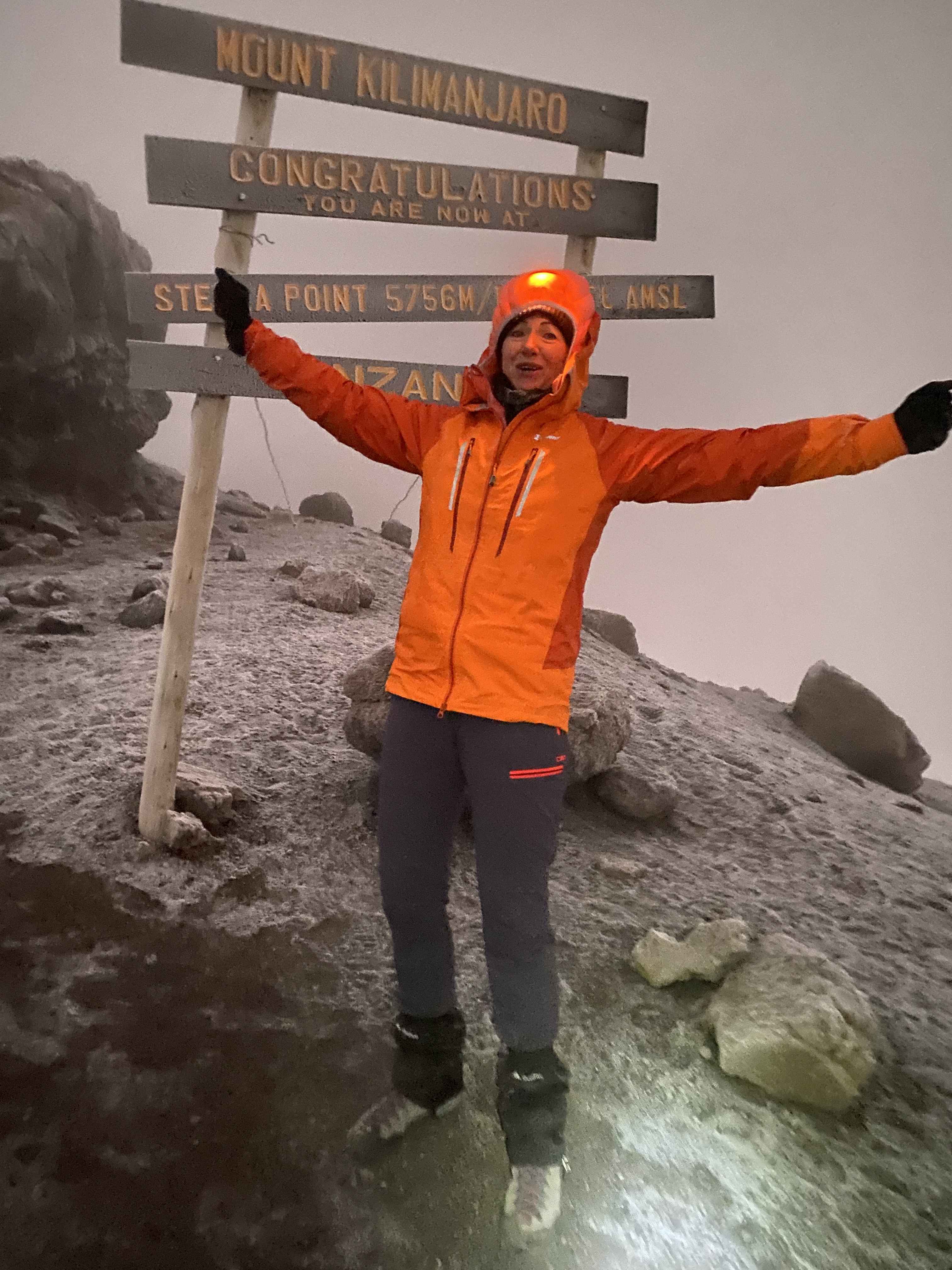
Summit night is unlike anything else. You’ll be woken around midnight, layer up against brutal cold, and set off by headtorch in a slow, silent line of lights switch-backing up the scree toward the rim. It is cold, it is long, and it is hard — and then the sun rises over the African plains far below, you reach the crater rim, and a final walk along the edge brings you to the weather-beaten green sign at Uhuru Peak. Standing at 5,895 m, on the roof of an entire continent, watching the dawn light the glaciers — for most people, it’s a moment they never forget.
🦁 Already in Tanzania? Don’t stop at the summit

You’ve flown all the way to northern Tanzania — the same region holds some of the greatest wildlife on earth. After a day or two recovering from the climb, the classic add-ons are all within reach:
- The Serengeti — the endless plains and the stage for the Great Migration. (See our guide to the Great Migration: when and where to see it.)
- Ngorongoro Crater — a collapsed volcanic caldera packed with lion, elephant, flamingo and black rhino; one of the densest concentrations of wildlife anywhere.
- Tarangire National Park — huge elephant herds and ancient baobab trees, often quieter than its famous neighbours.
- Lake Manyara — flamingo-fringed and famous for its tree-climbing lions, an easy stop en route to the Serengeti.
- Zanzibar — when your legs have had enough, fly to the spice island for white sand, turquoise water and the old alleys of Stone Town. The perfect “climb-and-collapse” finale.
A popular shape for the whole trip: a 7–8 day climb, two days’ rest, a 3–4 day safari across the Serengeti and Ngorongoro, and a few days on Zanzibar to finish — roughly two to three weeks all told.
🏔️ We’ve climbed it ourselves
We’ve stood on Kilimanjaro’s crater rim at dawn — and we know how much the right route, the right timing, and above all the right operator can make or break the experience. If you’re planning your own climb and want honest, first-hand advice — including which operators and guides we’d recommend — we’re happy to help. Drop us a note via our contact form and we’ll gladly share what we learned on the mountain.
 25South